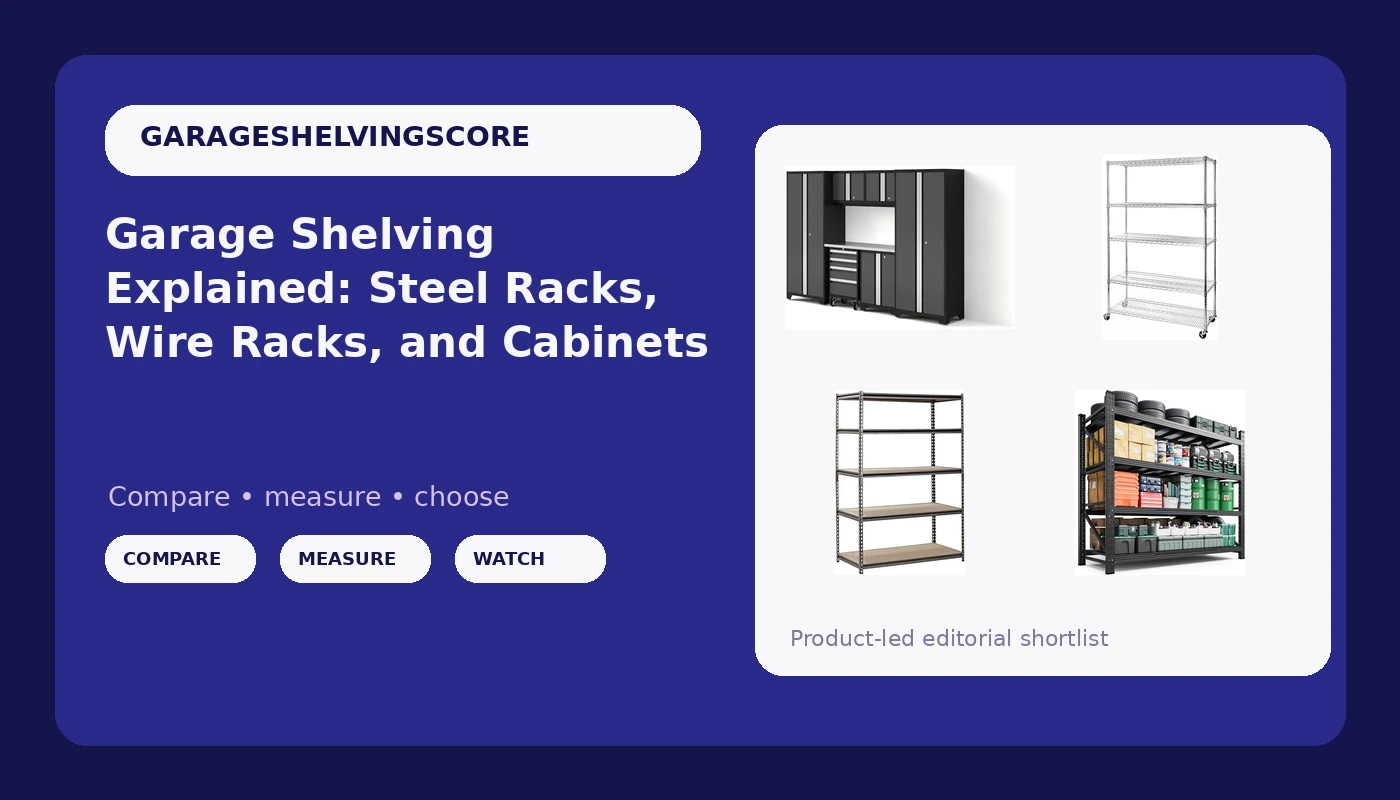
Garage storage gets decided in one afternoon and then lived with for a decade, which is why heavy duty garage shelving deserves more thought than the average impulse buy. A bolted steel rack, a wire unit, and a welded cabinet set can all be filed under the same word, but they hold different loads, occupy different footprints, and ask different things of your walls. The four units below cover that whole range, from a two-pack of adjustable steel racks to a fully welded cabinetry set. The sections after the callouts explain what actually determines whether a shelf stays loaded for years or ends up on the floor with your tote bins.
Related: Garage Shelving Weight Ratings Explained →
Quick answer
Start with the load and the wall, not the shelf. If you need raw capacity for totes, tools, and bulk goods, a bolted steel rack rated in the low thousands of pounds is the practical answer, and it costs a fraction of a cabinet set. If you want the garage to read as a finished room with closed storage, a welded cabinet set is the different product you are actually shopping for. Wire racks sit in the middle: useful for light, ventilated storage, and the wrong place for a loaded tool chest.
Four useful options
| Model | Best fit | What stands out |
|---|---|---|
| Letaya 3000LBS Storage Shelves Heavy Duty, 4 Tier Adjustable Utility Rack Shelf | Bulk loads on a budget | Four adjustable tiers in a 48" W x 24" D x 70" H all-steel frame |
| NewAge Products Gray Bold Series 7PC Garage Cabinetry Set | A finished, closed-storage garage | Fully welded 24-gauge steel across a 108" W x 18" D x 76.75" H set |
| Seville Classics UltraDurable Heavy Duty NSF Solid Steel Wire Rack | Light, ventilated storage | Five tiers at 48" W x 18" D, NSF listed |
| EDSAL Heavy Duty Garage Shelf Steel Metal Storage, 5 Level Adjustable (Pack of 2) | Two long runs at once | Two units, each 72" H x 48" W x 24" D, with five adjustable levels |
The bulk-capacity pick: Letaya 3000LBS Storage Shelves Heavy Duty
The trade-off here is that you are buying capacity, not cabinetry. A 24-inch-deep rack eats floor space along the wall, so measure the car bay before you commit, and understand that the advertised rating assumes an even, distributed load on a properly anchored frame. Bolted racks also move a little under load in a way welded cabinets do not, which matters more to how the garage feels than to how it performs. If your storage is a wall of mismatched totes, this is the shape of unit that fixes it.
The finished-garage pick: NewAge Products Gray Bold Series 7PC Garage Cabinetry Set
This is a different category of purchase, and it should be judged that way. Closed cabinets hide the mess, protect contents from dust and garage temperature swings, and hold their alignment because there are no bolted joints to work loose. What you give up is open access and easy reconfiguration: once a cabinet run is placed and anchored, rearranging means moving the whole set. The other trade-off is depth. Eighteen inches is deliberate, because it leaves room for a vehicle, but it also means deep, awkward items that fit on a 24-inch rack will not fit inside a cabinet.
The ventilated pick: Seville Classics UltraDurable Heavy Duty NSF Solid Steel Wire Rack
Wire decking is the honest answer for a specific job and a poor answer for another. It is excellent for paint cans, seasonal gear, boxed goods, and anything that benefits from airflow. It is the wrong surface for a heavy tool chest or a stack of tile, because the load concentrates on individual wires and on the clips that hold them rather than spreading across a solid deck. If you already own wire shelving that sags, that is usually the reason. Buy this one for light and medium storage and keep the heavy loads on a steel rack.
The two-run pick: EDSAL Heavy Duty Garage Shelf Steel Metal Storage
The logic of a two-pack is symmetry: matching units on opposite walls look intentional, and you avoid the mismatch that comes from buying one rack now and a different one next spring. The cost is commitment. Two 24-inch-deep racks occupy a serious amount of floor along both walls, and in a two-car garage that can be the difference between parking inside and parking in the driveway. Place them first on paper, or with painter's tape on the slab, before you assemble anything.
Prices and availability may change. Product images, names, and retailer links are matched to verified listings. No current price, rating, stock status, or measured result is stated here without current evidence.
What a load rating actually tells you
A published weight rating is a lab number. It describes a new unit, evenly loaded, mounted to a structure that does not flex, in a space with stable temperature and humidity. Your garage is not that space. It swings from below freezing in January to a hundred degrees in July, the slab may be the only solid thing in the room, and the wall behind the shelf is probably drywall over studs spaced sixteen inches apart.
That is why the rating is a starting point rather than a promise. The load path runs from the item, through the deck, into the frame, through the bracket or post, into the anchor, and finally into the stud, the concrete, or nothing at all. Every one of those links can fail independently. A rack rated for a thousand pounds attached with drywall plugs will fail at a fraction of that, not because the rack was lying but because the wall was never part of the rating.
Two more things drive real-world durability. The first is joint construction: fully welded frames like the cabinet set hold their geometry, while bolted racks depend on every bolt staying tight through seasonal expansion and contraction. The second is finish. Powder coat on budget steel is the first thing to go in a garage that sees temperature swings, and once it flakes, bare steel starts rusting at the weld points. Neither issue shows up in a showroom, and both show up within a couple of winters.
How to size a shelving run before you buy
- Measure the wall and mark the studs. Find and mark every stud along the run with tape, then measure the clear wall length between obstructions. A 48-inch unit needs 48 inches of clear wall plus a little breathing room at each end for the frame and your hands.
- Write down what is actually going on the shelf. Totes of holiday decorations, cases of oil, a tile saw, and a stack of plywood are four different load problems. Total the weight honestly, then double it, because that is roughly what happens over five years.
- Do the footprint math against the parking bay. A 24-inch-deep rack is the right call for bulky goods, but two of them turn a two-car garage into a one-car garage. Tape the footprint on the slab and walk around it before you order.
- Check height against everything overhead. Garage door tracks, opener rails, light fixtures, and ceiling racks all live in the space above 70 inches. A 76.75-inch cabinet set will not fit under a low track, and a tall rack installed under one will get hit.
- Match the anchor to the wall type. Drywall alone is not an anchor point. Wood studs, a ledger board, or concrete with the right fasteners are. If the wall cannot take the load, the shelf needs to move to a wall that can, or to a freestanding configuration.
Practical guidance for a garage that stays organized
- Put the heaviest items on the lowest shelf. High shelves are for light, bulky, seasonal goods; low shelves are for oil, tile, and tools. This is the single change that most reduces shelf failure and back injuries.
- Anchor every tall unit, even a freestanding one. A 72-inch rack that is not tied to the structure is a tip-over waiting for a kid, a ladder, or a bumper.
- Leave 18 to 24 inches of working clearance in front of the run. Shelving you cannot reach is shelving you stop using, and the front six inches of a deep shelf tend to fill with whatever did not have a home.
- Keep clear plastic totes and label them on the end, not the lid. You should be able to read what is inside from the middle of the garage floor without pulling the bin out.
- Inspect the frame and the anchors once a season. Tighten what has loosened, touch up bare steel where the finish has failed, and check that the shelf clips or bolts are still seated.
Which option should you choose?
Choose the Letaya 3000LBS Storage Shelves Heavy Duty when you need maximum capacity for the money and your storage is open, heavy, and constantly changing. Choose the NewAge Products Gray Bold Series 7PC Garage Cabinetry Set when the garage is finished or about to be, you want closed storage, and the look of the space matters as much as the capacity. Choose the Seville Classics UltraDurable Heavy Duty NSF Solid Steel Wire Rack when your loads are light to medium and you want airflow, cleanability, and a narrow 18-inch profile. Choose the EDSAL Heavy Duty Garage Shelf Steel Metal Storage two-pack when you are outfitting two walls at once and want matching units with deep shelves.
One caveat applies to all four: none of these ratings mean anything until the unit is anchored correctly for your wall type. Confirm what is behind the drywall before you drill, and treat every manufacturer rating as a lab condition rather than a garage condition.
The bottom line
The right heavy duty garage shelving depends less on the shelf than on the job you are asking it to do. Bolted steel racks deliver the most capacity per dollar and suit open, heavy, ever-changing storage. Welded cabinet sets cost more and give you a finished room with doors that close. Wire racks are the correct tool for light loads and airflow, and the wrong tool for a loaded tool chest. Measure the wall, find the studs, tape the footprint on the slab, and buy the unit that fits the load you actually have rather than the one you hope to have.