
Related: Best Garage Wall Storage Systems for Tools and Bikes
Twenty years of hanging shelves in Kansas City garages taught me that the steel is rarely the failure point. Heavy duty garage shelving fails at the wall, at the anchor, and at the joint where the beam meets the post. Manufacturers rate a rack in a lab with perfect mounting on a perfect wall. Your drywall is not a lab, and your studs are never where the instructions assume they are.
That does not make the numbers lies. It makes them ceilings. A rack rated at 2,400 pounds is rated for 2,400 pounds under ideal conditions, evenly distributed, on a floor that does not heave with the frost. The gap between that ceiling and your reality is where paint cans end up on the concrete. So here are four units worth buying this fall, sorted by what they are good at: a five tier rack with a narrow footprint, a 2,400 pound unit for the guy who stores tile and engine blocks, a 64 inch wall rail that gets the rakes off the floor, and a rolling sports rack that finally corrals the basketballs. I will cover mounting on every one of them, because that is the part the listing never tells you.
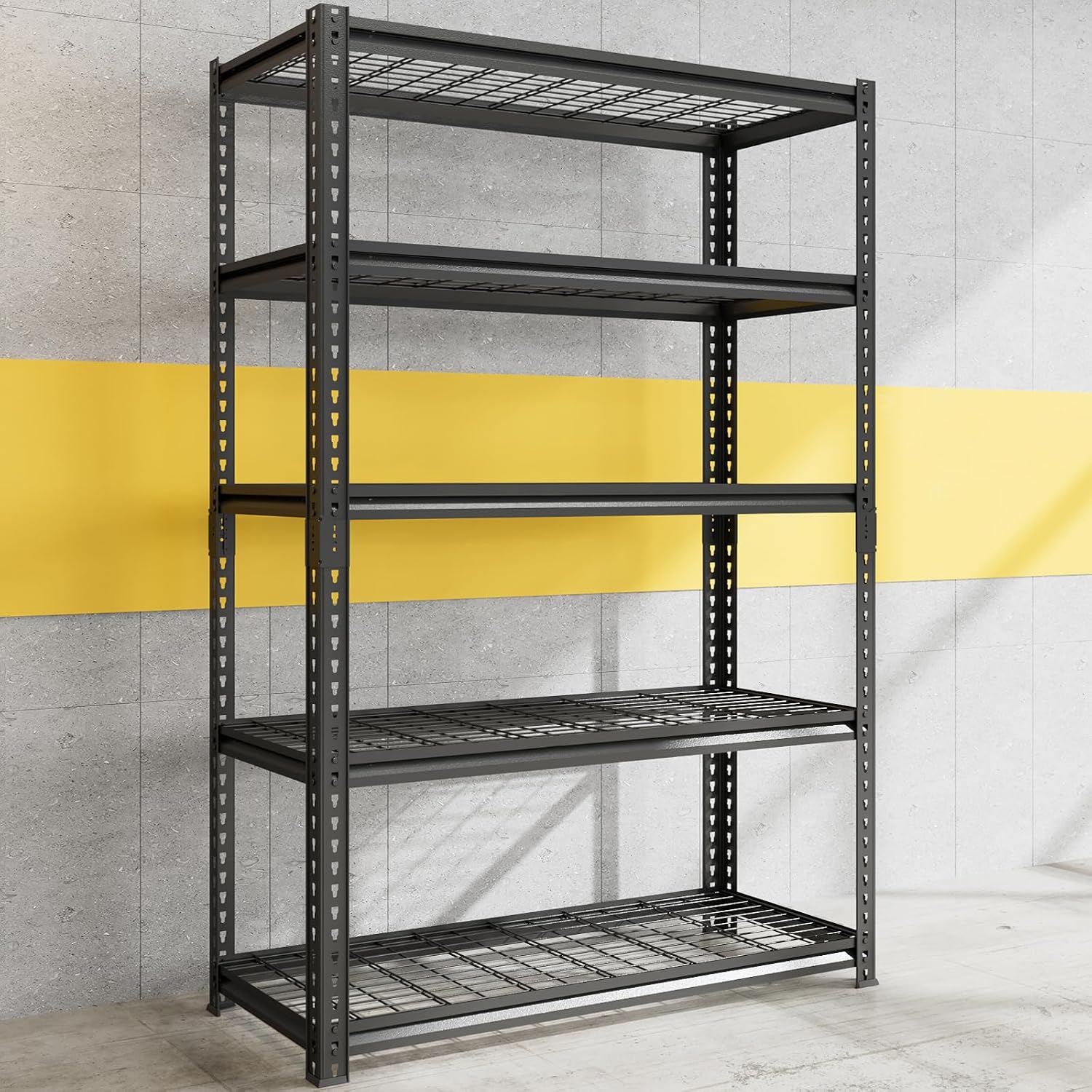
Best Overall: 72 Inch Five Tier Garage Shelving Unit
This is the rack I would put in a one car bay where the walls are already busy. At 72 inches tall, 35.4 inches wide, and 15.7 inches deep, it takes a strip of floor and goes up, which is the only direction a garage has left. Five tiers, all adjustable, so you can set the spacing around a cooler, a shop vac, or a stack of totes instead of fighting a fixed shelf.
The anti-fall rails are the detail I care about most. On a 15.7 inch deep shelf, boxes creep forward every time you slide one in. A rail across the front is the difference between a box landing on the shelf and a box landing on your hood.
It is a freestanding unit, and freestanding does not mean leave it alone. I would still tie the top rail to a stud with a lag screw. A tall rack with a loaded top shelf and an empty bottom shelf is a lever waiting for a kid on a bike. Find the stud with a stud finder, not by knocking. Knocking works right up until it does not.
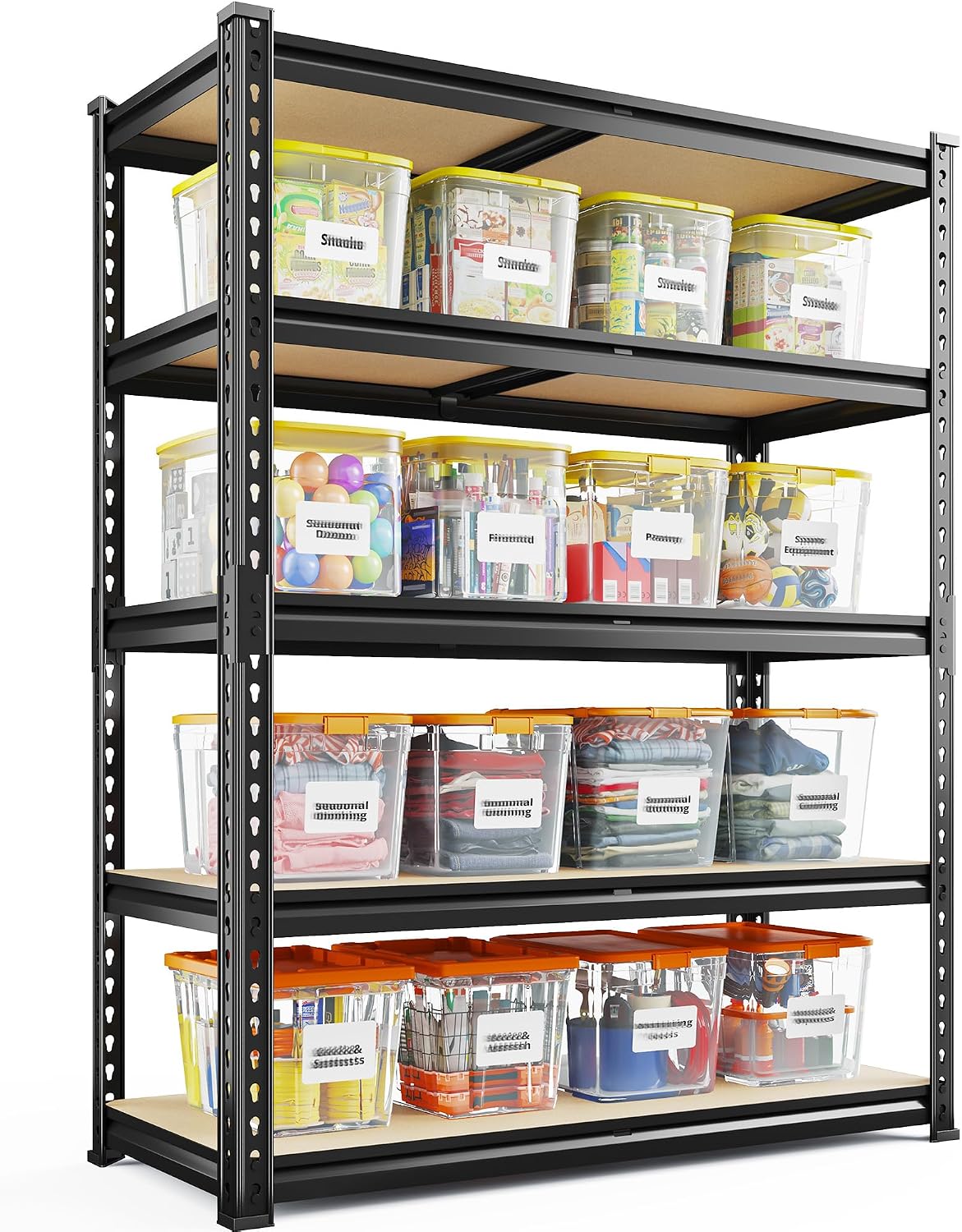
Best Heavy Duty Pick: REIBII 2400 Lbs Garage Shelving
Two thousand four hundred pounds is the number printed on the box, and it is why this unit turns up in basements and garages where people store real weight: leftover tile, bottled water, engine parts, the bags of concrete nobody ever returned. It is an adjustable shelving unit, so tier spacing moves. That matters more than people think. A fixed rack forces you to fit your stuff to the shelf. An adjustable rack lets you fit the shelf to your stuff.
The honest caveat is that 2,400 pounds is a whole unit figure, not a per shelf figure, and it assumes an even spread. Divide it across the tiers in your head before you load one shelf with a transmission. Keep the dense weight low, where the load path is short and the unit is wide.
If this goes in a basement with a damp floor, set it on feet or a scrap of pressure treated lumber rather than directly on concrete that wicks. Steel and standing water are not a long term relationship.
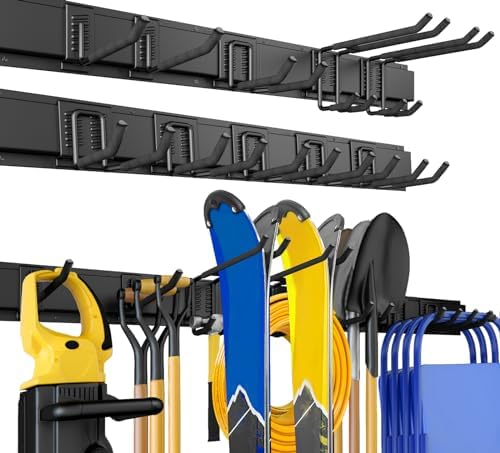
Best Wall System: UUP 64 Inch Wall Mount Tool Organizer
Not everything belongs on a shelf. Rakes, brooms, mops, ladders, and a snowboard belong on a wall, and this 64 inch rail with adjustable metal hooks is listed at 620 pounds. That is plenty for a lawn tool collection. The adjustable hooks mean you can rearrange when you add a trimmer, or when your spouse decides the leaf blower needs a new home. Rearranging a rail is a ten minute job. Rearranging a shelf means unloading the shelf.
The catch with any wall mount is the wall itself. A 620 pound rating assumes fasteners driven into something structural. Sixty four inches spans several studs in a normal garage, so you have options, but you have to hit them. If your garage is finished drywall over furring strips, or worse, block, this is the moment to stop and plan instead of drilling. The rail is metal, adjustable, and works in a shed as well as a garage, which is where I would put a second one.
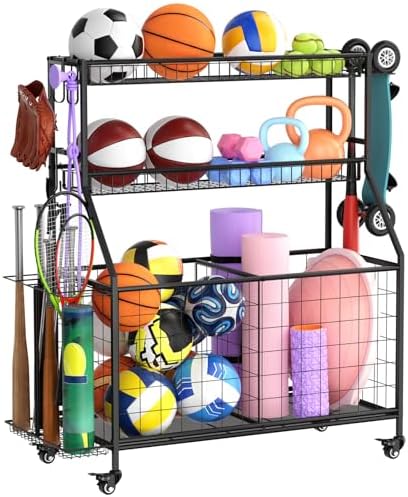
Best for Sports Gear: Sports Equipment Garage Organizer
Balls are the reason garages look messy even when they are not. This is a ball storage rack with a basket, hooks, and a rolling cart, built for sports gear and toys, for indoor or outdoor use. The rolling cart is the part that sells it. A rack you cannot move becomes a rack you build your garage around. A rack on casters goes where the season goes: by the door in summer, against the wall in January.
The hooks take the awkward stuff, the helmets, the gloves, the jump ropes, the scooters nobody claims. This is the most expensive unit of the four and it holds the least weight of the four, and that is fine. It is not a shelving unit, it is a containment system, and containment is what keeps the rest of your shelving useful.
How I judge a garage shelving unit
The contractor test is simple and slow. Load it with what the label says, then double it, then leave it for a year. If a unit survives a Kansas City year, a July of hundred degree days and a January of single digits, with the powder coat intact and the welds quiet, it passes. I have watched cheap coating flake off in one winter while the steel underneath was perfectly fine, and I have watched a rack rated for a thousand pounds bow in the middle of a shelf span with half that weight on it. The rating is measured at the bracket, not at the span. The span is where you see the failure.
Three questions come before anything goes on a wall or on a rack:
- What is the wall made of, and where are the studs?
- What is the load path from the shelf down to the floor or into the framing?
- Can a normal homeowner install this with a drill, a level, and a stud finder?
If the answer to the third one is no, the unit had better be worth a contractor's hourly rate, because you are paying it either way.
What load ratings and wall types actually mean
A published capacity assumes even distribution. Nobody loads a shelf evenly. You put the heavy tote on one end and the extension cords on the other, and now one bracket is carrying most of the weight. That is not a defective product, that is physics, and it is why I keep the heavy items on the bottom tier and the light items up top.
Anchors are the other half of the story. A listing that says a wall anchor is included is usually talking about a plastic plug rated for a picture frame, not a shelf. Into a stud, a lag screw or a structural screw is the answer. Into drywall alone, there is no answer I trust for a loaded shelf.
Temperature swings finish the job that bad mounting starts. A garage moves more than a house does. Metal expands and contracts, powder coat cracks at the corners, and bolts work loose a quarter turn at a time. Check the fasteners in October and again in April, and you will catch most problems before they become dents in a car hood.
The garage shelving reference table
This is the table I keep in the truck. Listed capacity is what the manufacturer publishes, which is a starting point, not a verdict. The rest is what the unit is for and how it attaches.
| Product | Best for | Mounting | Listed capacity | Price |
|---|---|---|---|---|
 Visit on Amazon → 72" H Garage Shelving Unit |
Narrow bays and everyday garage loads | Freestanding, five adjustable tiers | Not stated in the listing | Check current Amazon price |
 Visit on Amazon → REIBII 2400 Lbs Garage Shelving |
Tile, water, engine parts, dense loads | Freestanding, adjustable tiers | 2400 lbs as listed | $43.99 |
 Visit on Amazon → UUP 64 Inches Garage Storage Wall Mount |
Rakes, brooms, mops, ladders, boards | Wall mount rail, must hit studs | 620 lbs as listed | $62.98 |
 Visit on Amazon → Sports Equipment Garage Organizer |
Balls, toys, helmets, scooters | Rolling cart, indoor or outdoor | Not stated in the listing | $89.99 |
A note on wire shelving
Skip wire shelving for anything heavier than tote bags. The wires sag under a tool box, the clips pop out of the bracket, and the shelf that held paint cans for two years lets go the week you decide to organize. If wire is what you already have, keep it high and keep it light.
The wall mount question
A wall rail is the best square foot play after ceiling storage. It costs you nothing in floor space, it holds the awkward long items that no shelf handles well, and it lets you rearrange without unloading. The only real requirement is framing. Know your wall before you buy the rail, not after.
Should you buy the 72 inch five tier garage shelving unit?
Yes, if your bay is narrow and your walls are already spoken for. The footprint slides into a one car space, the anti-fall rails keep boxes where you put them, and adjustable tiers mean you can build the shelf around your gear instead of the other way around. Tie the top to a stud and it will outlast the paint on your garage door.
Should you buy the REIBII 2400 Lbs Garage Shelving?
Yes, if you store dense weight. The listed capacity is the headline, and the adjustable tiers are the feature that actually changes how you use it. Spread the load, keep the heavy items low, and check the fasteners twice a year. This is the unit for the guy with tile left over from a bathroom and nowhere to put it.
Should you buy the UUP 64 inch wall mount tool organizer?
Yes, if your rakes and ladders are eating floor space. A 620 pound rated rail with adjustable hooks reorganizes in ten minutes, which is something no shelf can promise. Just do the wall homework first. Find the studs, plan the layout, and drill once.
Should you buy the sports equipment organizer?
Yes, if balls and toys are the reason your garage looks worse than it is. The basket, the hooks, and the rolling cart make it a containment system, and containment is the job that keeps the rest of your storage working. It holds less weight than the racks here, so keep it to sports gear and let the shelves carry the heavy stuff.