
Related: How to Find Studs Before You Hang Anything Heavy in a Garage
I have been building and finishing garages around Kansas City for twenty years, and the last eight of those have been almost entirely garage shelving and ceiling storage. The pattern never changes. Somebody buys a rack, reads "200 pounds per shelf," drives four lag bolts into drywall, and calls it finished. Then winter arrives, the cheap powder coat flakes, the clips pop, and the shelf is on the floor with the holiday totes. Garage shelving and ceiling storage is not complicated, but it is structural. The rack is only half the system. The other half is whatever is behind your drywall, and that is the half nobody checks.
So this is not a list of the cheapest racks on Amazon. It is four pieces I would actually spec into a garage, in the order I would buy them: one heavy floor unit, one light wire rack for the narrow wall, and two ceiling mounts that use the free real estate above the car. I will tell you what each one is for, what it is not for, and where the weight actually goes.
Best Overall for Heavy Loads: VEVOR 5-Tier Storage Shelving Unit
This is the unit for the person who has been stacking tile, pavers, and engine blocks on the concrete because there was nowhere else to put them. Five tiers, 60 by 24 by 78 inches, and a 2,000 pound capacity rating for the whole rack. Read that last part again, because it matters: that is a unit rating, not a per-shelf rating. Two thousand pounds spread across five shelves is 400 pounds a shelf, and that is a real number for a steel rack. Load one shelf with a thousand pounds of tile and you have turned a storage rack into a lever.
What I like is the footprint. Sixty inches wide and 24 deep means a full sheet of plywood lies flat, and 24 inches of depth swallows a standard tote with room left over for the lid. At 78 inches tall it uses the vertical space most garages waste above head height, which is exactly where the heavy, once-a-year stuff belongs.
What I do not like is how "adjustable" gets sold. On a rack this heavy, adjustable means adjustable before you load it. Once it is full, moving one shelf means unloading everything above it. Measure the tallest thing you own, set the shelf heights once, and leave it alone.
The other thing: this rack assumes a level floor. Garage slabs slope toward the door by design, usually an inch or two over the run. Shim the low feet. If you do not, the load leans into the wall instead of sitting on the uprights, and the wall was never part of the design.
Best Value for the Narrow Wall: Amazon Basics 5-Shelf Steel Wire Rack
I have said unkind things about wire shelving, and I stand behind most of them. But there is a place for it, and this is it. The Amazon Basics rack is 23.2 inches wide and 13.4 deep, which is the size that fits between the garage door track and the wall, or along the narrow strip beside the water heater where nothing else will go. Five shelves, 60 inches tall, rated 200 pounds per shelf, chrome finish.
Notice the difference in how the rating is written. This one is per shelf, which is honest and useful. Two hundred pounds per shelf on a 23-inch-wide unit is fine for paint cans, totes, jugs of washer fluid, and boxes of holiday decorations. It is not fine for a toolbox, a vise, or a stack of brake rotors.
Wire shelves flex under point loads. Put a heavy item with a small base in the middle of a wire span and you will watch the wire bow. That is not a defect, that is geometry. If you keep loads broad and light, the rack does its job for years. I have one holding paint cans right now, and I am aware of the irony.
Best Overhead Ladder Storage: StoreYourBoard Adjustable Ladder Rack
Ladders are the worst thing in any garage. They are long, awkward, and they always end up leaning against the wall in the one spot where the car door needs to open. This rack puts them on the ceiling, out of the footprint entirely, and the adjustable design takes both a step ladder and an extension ladder.
The rating is 75 pounds. That is the number that decides everything. A fiberglass extension ladder can run well past that on its own, and an aluminum one will sit under it. Do the math with your actual ladder before you buy, and do not assume "ladder rack" means "any ladder."
The install is a ceiling job, which means joists. Garage ceiling joists run one direction, usually perpendicular to the door, and they are typically spaced 16 or 24 inches on center. You need the rack's mounting points landing on wood, not on drywall and not on the thin panel between joists. If the spacing does not line up, a pair of strut channels or a couple of 2x4 crossers bolted across the joists gives you something real to fasten to.
Best Overhead Bike Storage: Wallmaster Ceiling Bike Hanger
A bike parked on the floor takes up roughly the same square footage as a small workbench, and it is square footage you are paying for. The Wallmaster is a pulley hoist, so the bike goes up to the ceiling and comes down on a rope, which means nobody has to lift a 30-pound bike over their head to store it.
The pulley arrangement is the whole point. Rope, pulleys, a cleat or a hook to tie off, and hooks that cradle the frame or the wheels. Because the lift is mechanical, one person can raise and lower the bike without help, and the bike ends up flat against the ceiling, above the car, in space that was doing nothing.
This is a ceiling mount too, so the same rule applies as the ladder rack: find the joists. A bike hanging from drywall anchors is a bike that is going to land on your hood. Two lag bolts into solid wood per mounting point, and check them once a season, because a garage ceiling sees temperature swings that loosen hardware.
How I test garage storage
I do not trust a rating off a box. Every rack that comes through my hands goes through the same protocol, and it takes a year, not an afternoon. First, I mount it the way the instructions say, with normal tools, and I time the install. If it takes a pro with a hammer drill three hours, that is a fact a homeowner needs to know before the box shows up.
Then I load it to the label rating and leave it a week. Then I double it, and leave it there. Then it sits through a full Kansas City year: 95-degree July afternoons, single-digit January mornings, and every expansion and contraction in between. That cycle is what kills cheap hardware. Powder coat flakes, bolts work loose, clips lose their grip, and wire starts to bow.
What I am watching for is where the failure starts. It is almost never the weld. It is the fastener, the finish, or the mounting point. A rack rated for 2,000 pounds on a floor is a different product from a rack rated for 75 pounds hanging from joists, and both of those are different from a wire shelf rated per shelf. Confusing those three is how people end up with a shelf on the floor.
What the weight ratings actually mean
There are three kinds of numbers in this category, and mixing them up is the most common mistake I see.
The first is a whole-unit rating. That is the VEVOR's 2,000 pounds. It describes the rack as a system, standing on a level floor, with the load spread out. It says nothing about what any single shelf will take.
The second is a per-shelf rating. That is the Amazon Basics rack at 200 pounds per shelf. This one is more useful for planning, but it still assumes the load is distributed across the shelf rather than concentrated in the middle of a wire span.
The third is a mounting rating, which is what the StoreYourBoard rack's 75 pounds really is. That number is limited by what the fasteners can hold in a ceiling joist, not by the steel in the rack. It is the number most people ignore, and it is the one that ends up mattering.
Load path is the rest of it. Weight goes from the shelf, to the upright or the bracket, to the floor or the joist. Drywall is not in that chain. Drywall is a decorative surface that happens to be where you want to hang things. Find the studs, or find a different wall.
The garage storage reference table
This is the table I keep for clients when we are planning a garage, and it is the same one I use to sort a purchase. Ratings are the published numbers, not my own.
| Product | Type and mounting | Published capacity | Best for | Watch out for |
|---|---|---|---|---|
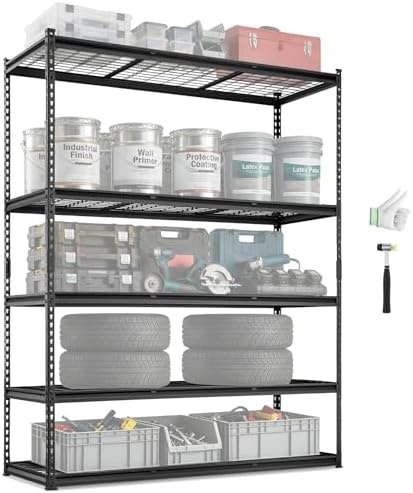 Visit on Amazon → Visit on Amazon →VEVOR 5-Tier Storage Shelving Unit |
Freestanding, floor | 2,000 lbs total across the unit | Tile, pavers, engine blocks, bulk totes, plywood sheets | Whole-unit rating, needs a level floor and shims |
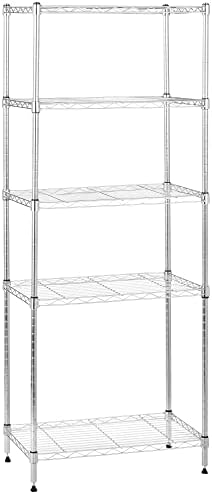 Visit on Amazon → Visit on Amazon →Amazon Basics 5-Shelf Wire Rack |
Freestanding, floor, 23.2" x 13.4" x 60" | 200 lbs per shelf | Paint, jugs, totes, seasonal boxes on a narrow wall | Wire flexes under point loads |
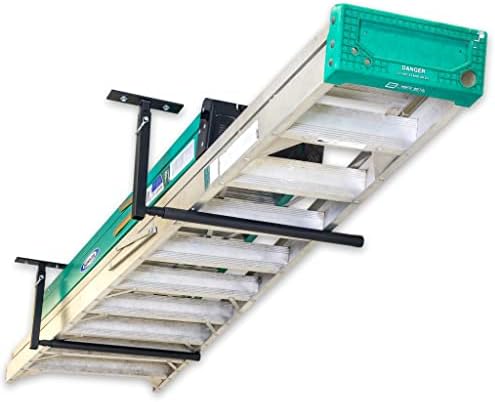 Visit on Amazon → Visit on Amazon →StoreYourBoard Overhead Ladder Rack |
Ceiling mount, joists required | 75 lbs | Step ladders and lighter extension ladders | 75 lbs limits which ladders qualify |
 Visit on Amazon → Visit on Amazon →Wallmaster Ceiling Bike Hanger |
Ceiling mount, pulley hoist | Not stated on the listing | Bikes that need to leave the floor | Still a joist mount, check hardware seasonally |
The pattern in that table is the whole lesson. The floor units are rated by the pound. The ceiling units are rated by what the joist will take. Both matter, and neither one is the same as the number on the shelf edge.
Should you buy the VEVOR 5-Tier Storage Shelving Unit?
Yes, if your problem is heavy and permanent. Tile, pavers, engine blocks, and a full sheet of plywood lying flat on a 24-inch-deep shelf is a real upgrade over a pile on the concrete. The 2,000 pound rating is a unit rating, so plan your shelf heights once and distribute the load instead of testing the number on one shelf.
Skip it if you rent, if you rearrange your garage every spring, or if your slab is out of level and you are not willing to shim. A heavy rack on a sloped floor is a leaning rack, and the wall behind it was never designed to carry your stuff.
Should you buy the Amazon Basics 5-Shelf Wire Rack?
Yes, for the narrow wall and the light load. At 23.2 by 13.4 inches it goes places a deep rack cannot, and 200 pounds per shelf is honest capacity for paint, jugs, and totes. It is the cheapest way to get vertical storage along the strip beside the door track.
No, if you plan to put a toolbox, a vise, or a stack of rotors on it. That is the moment wire shelving stops being storage and becomes a bet, and it is a bet you lose at the worst time, which is when the shelf is full.
Should you buy the StoreYourBoard Overhead Ladder Rack?
Yes, if you have a step ladder and a ceiling with accessible joists. Getting the ladder off the floor is worth more than the rack costs, because the floor space it frees up is the space you actually park in. The adjustable design covers both step and extension ladders.
Check your ladder weight first. The 75 pound rating is the ceiling, and fiberglass extension ladders can go past it. If your ladder is over that number, this is the wrong product, and no amount of clever mounting changes the rating.
Should you buy the Wallmaster Ceiling Bike Hanger?
Yes, if the bike has been living where the car should be. The pulley system means you can raise and lower it solo, and the bike ends up flat above the car instead of leaning against the wall. It is the single best square-footage play in a garage, and it costs less than the shelving you would need to store the same bike on the floor.
Mount it into joists, not into drywall, and check the hardware once a season. Ceiling storage gets the biggest temperature swings in the building, and hardware that was tight in October can be loose by March.