Related: How to Find Studs Before You Mount Anything in a Garage
I have hung a garage tool organizer wall mount in more garages than I can count, and I have watched a few of them come down. That is why I write about storage the way I do. A rack that holds 300 pounds in a lab on a poured concrete wall and a rack that holds 300 pounds in your garage on half inch drywall are two different products, even when the box prints the same number.
This fall I lined up four units in the affordable range: two wall mounted tool racks and two shelving units, all of them fighting for the same square footage in a two car garage. The REIBII 2400LBS Garage Shelving is the one I would trust under real weight. The TIDYME 48 inch rack is the one I would put over a workbench. The 5 tier Metal Storage Shelves and the PIYILO adjustable rack are the value plays, and both of them earn their spot if you mount them like you mean it.
Three things decide whether a shelf stays up
The wall, not the shelf. Before I look at a single product, I look at the wall. Is it drywall over wood studs, drywall over steel studs, block, or poured concrete? A 48 inch rack on 16 inch centers will find four studs. That is the whole reason I like that length. If your framing is 24 inches on center, or if you have a block wall, the plan changes and the hardware changes with it.
The load path. Weight goes from the shelf deck into the bracket, from the bracket into the fastener, and from the fastener into the framing. If any link in that chain is soft, the shelf is coming down. This is why I do not trust the plastic plugs that come in the hardware bag for anything heavier than a rake.
The air in the garage. A garage swings from 100 degrees in August to single digits in January, and it does it with the door open half the time. Powder coat is the first thing to give up in that cycle. Check the welds and the coating at the joints, not the parts of the shelf that face the room.
Best heavy-duty shelving: REIBII 2400LBS Garage Shelving
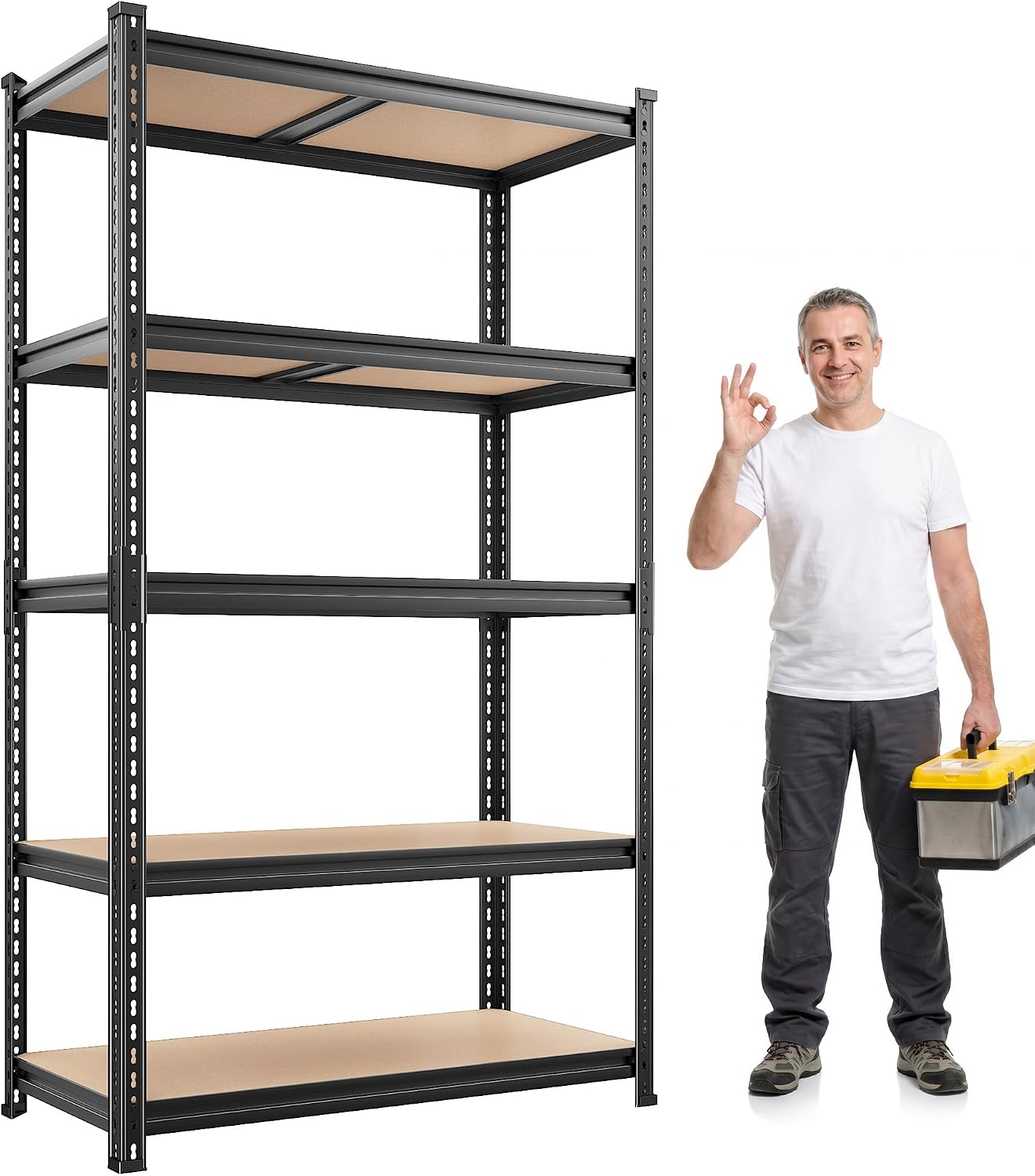
This is the unit in the group with a number big enough to argue about. The maker claims 2,400 pounds, and the footprint is 36 inches wide, 16 inches deep, and 72 inches tall. That combination is the sweet spot for a garage: 16 inches of depth leaves you an aisle, 36 inches of width fits between a garage door track and a corner, and 72 inches puts the top shelf within reach without a ladder for most people.
Here is my honest read on a 2,400 pound claim. That number was earned in a lab on a flat floor with the load spread evenly across the deck. Your garage floor is not that floor. Your load is a stack of paint cans on one side and a case of oil on the other. Treat the rating as a ceiling, not a target, keep the weight low and centered, and this shelf will hold up to real garage life. Keep the weight high and lopsided and you are testing the cross bracing instead of the shelf.
I like it for tile, paint, engine parts, and the heavy totes you stop moving after a while. Put something under the feet if your slab takes on water, and check the bracing bolts again after the first month.
Best value shelving: Metal Storage Shelves 5-Tier Garage Shelving Unit
Five tiers, 35.4 inches wide, 15.7 inches deep, 71.2 inches tall. Read those numbers next to the REIBII and you will see the play: nearly identical footprint, one more shelf deck, and a lighter build. Five decks in the same height means less clearance between shelves, which is fine for totes, boxes, and cans, and annoying for anything tall.
The listing does not publish a weight rating, and I will not invent one. No rating means you make the decision yourself, and that means you load it like a person who wants to keep it. Put the heavy stuff on the bottom two decks, keep the top deck for light bins, and do not stack a full tool chest on it just because the box says heavy duty. A tool chest belongs on a bench or on the floor.
Where this unit wins is cost per square foot of storage. If your garage problem is fifteen medium boxes and no place to put them, this is the shelf that solves it. If your problem is a transmission on a pallet, it is not.
Best wall rack for long tools: TIDYME Garage Tool Organizer Wall Mount
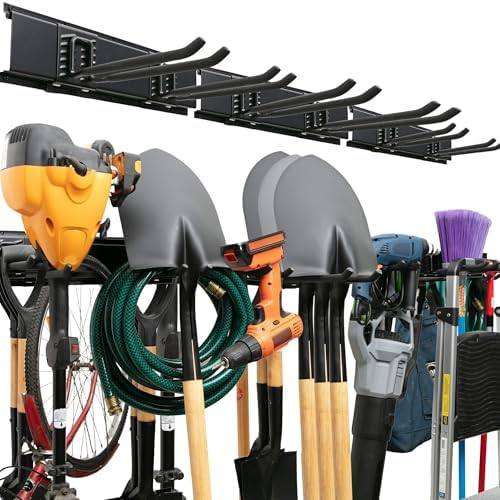
Forty eight inches, three racks, six hooks, and a claimed 300 pound capacity. The number that matters to me is the 48. On 16 inch centers that span reaches four studs, and four studs with lag bolts will hold more than most people will ever hang on it.
The 300 pound figure is a wall rating, not a shelf rating. It assumes the fasteners land in framing and the load sits close to the wall. Hang shovels, rakes, extension poles, and a trimmer flat against the wall and you are inside the design. Hang a ladder by one rung so it stands out a foot from the wall and you have turned a straight pull into a lever, and levers win.
Six hooks handle the short stuff: cords, hoses, a leaf blower, the trimmer guard you keep meaning to reattach. This is the rack I put over a workbench, at eye level, where the wall was previously holding nothing but a calendar.
Best adjustable wall rack: PIYILO 48 in Garage Tool Organizer Wall Mount
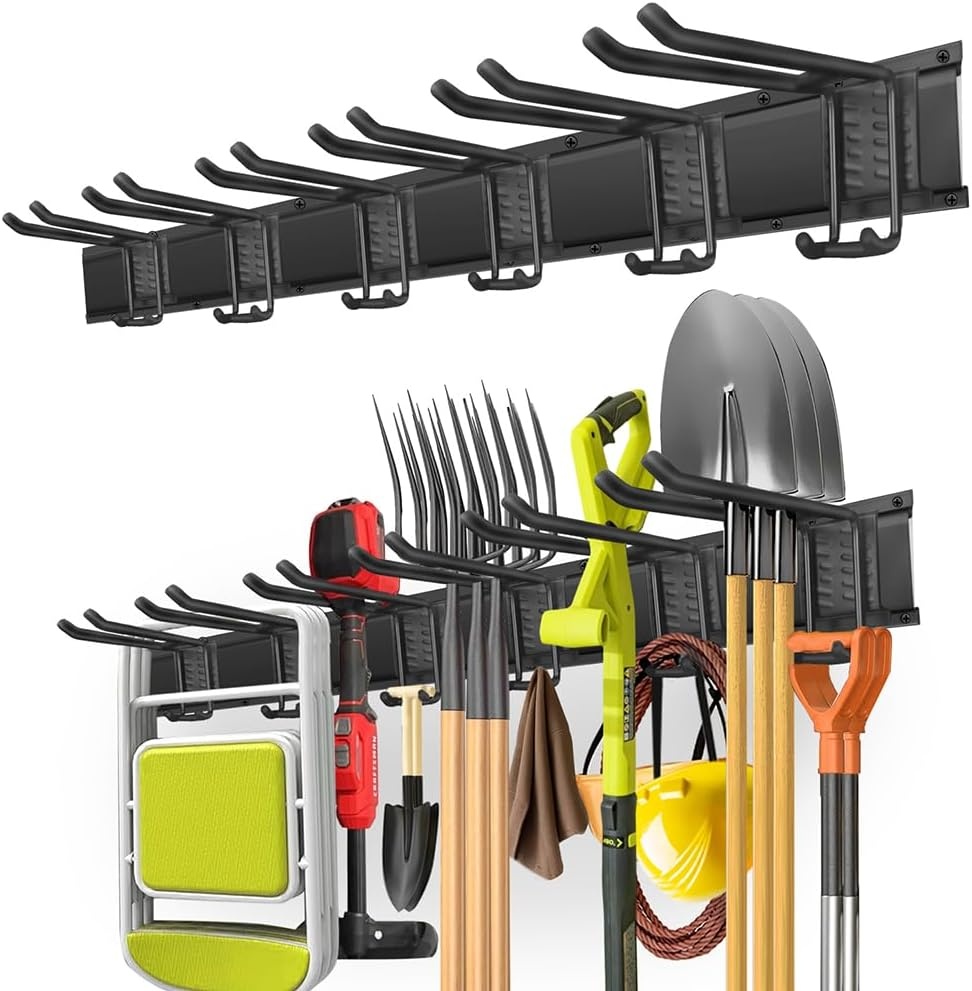
Same 48 inch span, adjustable instead of fixed. That adjustability is the feature I care about, because the tools in your garage change. You buy a new trimmer with a different shaft, you switch from a gas blower to a battery one, you add a second ladder. A fixed rack makes you re-drill. An adjustable one makes you loosen two bolts.
The listing does not publish a weight rating here either, so the wall does the talking. Same rule applies: find the studs, use lag bolts sized for the framing, and keep the load tight to the wall. If you are mounting to a block wall, use the right anchors for block and expect a slower install.
For the money, this is the rack I would hand to somebody who is not sure what they are going to store yet. It is the one that survives your next tool purchase.
The garage storage reference table
| Product | Claimed capacity | Footprint | Best for | Price |
|---|---|---|---|---|
 Visit on Amazon → REIBII 2400LBS Garage Shelving |
2,400 lbs | 36 in W x 16 in D x 72 in H | Tile, paint, engine parts, heavy totes | $55.99 |
 Visit on Amazon → Metal Storage Shelves 5-Tier Garage Shelving Unit |
Not rated in the listing | 35.4 in W x 15.7 in D x 71.2 in H | Boxes, totes, cans, light bins | $79.99 |
 Visit on Amazon → TIDYME Garage Tool Organizer Wall Mount, 48 in, 3 Racks 6 Hooks |
300 lbs, wall mounted | 48 in span | Long-handled tools over a bench | $49.95 |
 Visit on Amazon → PIYILO 48 in Garage Tool Organizer Wall Mount, Adjustable Tool Storage Rack |
Not rated in the listing | 48 in span, adjustable | Tools that change from year to year | $30.98 |
Both shelving units land within an inch of each other on height and within half an inch on depth. That is not a coincidence. It is the size that fits a garage. If you are choosing between them, you are choosing between one more deck and a heavier build.
How I test, and what I will not claim
I run everything through what I call the contractor test. Load it with what the label says, then double it, then leave it for a year and see what the powder coat and the fasteners do through a Kansas City winter. I do not publish a load number for a shelf I have not loaded myself, and I do not repeat a manufacturer number as if it were my own.
What I will tell you is what to check yourself, because it takes ten minutes and it matters more than any review. Put a level on the deck. Push the unit side to side with your hand and watch where it moves. Look at the welds at the corners, where the coating always goes first. Check that the feet sit flat on the slab and not on a low spot where water collects. And if the unit wobbles before you load it, it will lean after.
For wall racks, the test is different. Grab the rack and pull straight out, hard, before you hang anything on it. Then pull down. If the fasteners move, you found the problem before your rake did.
Analysis and test results
The gap between these four products is not quality. It is what the wall and the floor allow.
On shelving, the REIBII carries the only number big enough to build a plan around, and its 16 inch depth is what keeps a two car garage usable. The 5 tier unit gives you a fifth deck in the same footprint, which is a real win when your clutter is boxes, and a real liability when your clutter is heavy, because there is no published rating to lean on. When a listing does not give you a rating, the answer is not to guess. It is to load conservatively and check the shelf after the first month.
On wall storage, both racks are 48 inches, and that is the number I keep coming back to. Four studs, four lag bolts, and a load that sits tight to the wall is a system. Two drywall plugs and a load that hangs out on a lever is a bet. The TIDYME brings a claimed 300 pound wall rating and a fixed layout. The PIYILO brings adjustability and no published rating. If you know exactly what you are hanging, take the rating. If you do not, take the adjustment and mount it properly.
The other thing that separates them is air. Every one of these units lives in a space that freezes, thaws, and sweats. Powder coat fails at the welds first, every time. If you see rust starting at a joint in year one, catch it with a wire brush and a rattle can before it spreads. That is a ten minute job that buys you five years.
Should you buy the REIBII 2400LBS Garage Shelving?
Yes, if you have heavy stock and a level slab. The 36 by 16 by 72 footprint fits a garage wall without turning your aisle into a hallway, and it is the only unit here with a capacity claim I would build a plan around. Load it low and even, keep the feet out of water, and re-check the bracing after the first month. It is the shelf I would put under the tile saw and the paint.
Should you buy the Metal Storage Shelves 5-Tier?
Yes, if your problem is volume rather than weight. Five decks in a 35 inch footprint is a lot of places to put a box, and the price per square foot of storage is the reason to buy it. Just do not treat the missing rating as permission. Bottom decks get the heavy stuff, top deck gets the light stuff, and the tool chest stays on the floor.
Should you buy the TIDYME wall mount?
Yes, for long-handled tools. The 48 inch span finds four studs on standard framing, and the 300 pound claim is realistic when you mount into wood with lag bolts and keep the load flat to the wall. Skip the included plugs. If you want the wall over your bench to start earning its keep, this is the fastest way to do it.
Should you buy the PIYILO adjustable rack?
Yes, if you are still figuring out what lives where. Adjustability is worth more than a rating you will never approach, and it saves you from re-drilling the wall every time a tool changes shape. Same rules as the other rack: studs, lag bolts, load tight to the wall. Buy this one if your garage is still changing. Buy the TIDYME if it has settled down.
Whichever you pick, the product is the easy part. The wall is the hard part. Find the studs, size the fasteners to the framing, and load it like the rating is a ceiling. Do that and any of these four will still be holding your stuff when the next garage door opener quits.