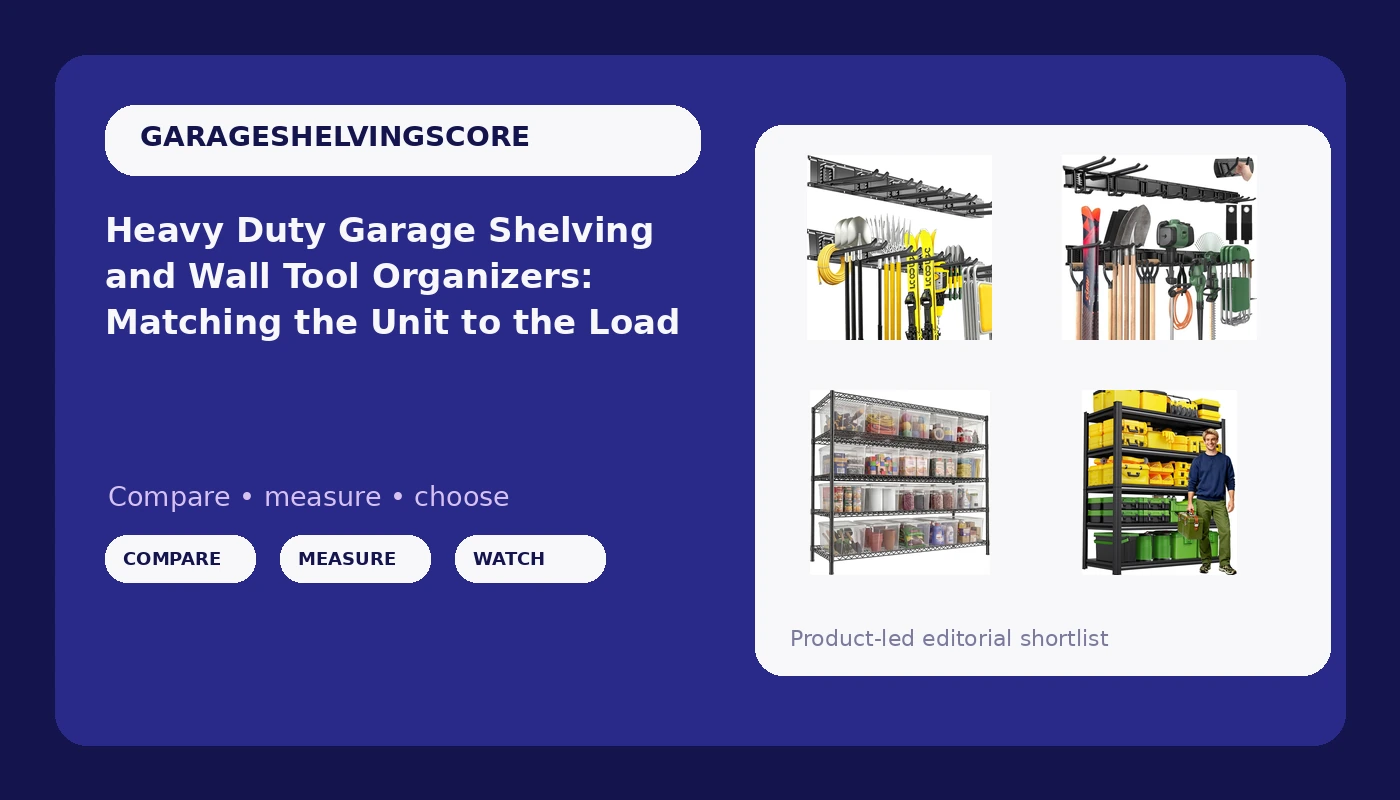
Every garage has the same two problems. The floor is buried in boxes, and the long-handled tools are leaning in a corner waiting to fall on somebody. Heavy duty garage shelving fixes the first problem. A wall-mounted tool organizer fixes the second. They are different tools for different loads, and the most common mistake is buying one to do the job of the other.
This is an explainer, not a shootout. The four products below come from two families: floor-standing 5-tier metal shelving units and steel wall racks that hold long-handled tools on hooks. What follows is how to read the weight ratings, how to decide which family your garage actually needs, and what each of these four is built to do.
Related: How to Find Studs and Anchor Heavy Garage Shelving →
Quick answer
Match the hardware to the shape of the load, then match the mounting to the wall you actually have. Bulky, stackable weight belongs on a floor-standing shelving unit, because the legs carry the load straight to the slab. Long, awkward, relatively light items belong on a wall rack, because hooks give you storage without giving up floor space. Every weight rating printed on these products assumes a solid, correctly anchored mounting surface. A rack rated for hundreds of pounds on a stud wall is not rated for those pounds on drywall alone.
4 useful options
| Model | Best fit | What stands out |
|---|---|---|
| REIBII 3200LBS Storage Shelves 55.5" W Garage Shelving Heavy Duty 5 Tier Adjustable Wire Shelving Unit Metal Shelving for Garage Pantry Commercial Basement | Bulky, heavy loads along a wide wall | Listed 3,200 lb capacity; 5 adjustable tiers; 55.5 in W x 18 in D x 71 in H |
| Metal Storage Shelves 5-Tier Garage Shelving Unit | Tight walls and narrow footprints | 15.7 in D x 35.4 in W x 71.2 in H; five tiers in a narrow frame |
| LBT 66" Garage Tool Organizer Wall Mount | Long-handled tools across a long wall | 66 in rail with a listed 720 lb capacity |
| Garage Tool Organizer Wall Mount, 48 Inch | Small shops and first wall racks | 48 in steel rail with 6 adjustable straight hooks |
The high-capacity shelving unit: REIBII 3200LBS Storage Shelves 55.5" W Garage Shelving Heavy Duty 5 Tier Adjustable Wire Shelving Unit Metal Shelving for Garage Pantry Commercial Basement
The trade-off here is footprint. A 55.5 in wide, 18 in deep unit claims a serious piece of wall, and it stands 71 in tall, which means it needs to be strapped or anchored to the wall so it cannot tip forward when a top shelf is loaded. Wire decking is also a decision, not a defect: it is light, it drains, and it lets air move, but small items fall through and heavy point loads sit on individual wires rather than a solid surface. If your storage is totes and boxed goods, wire is fine. If it is loose hardware and small parts, plan on shelf liners.
The narrow-footprint shelving unit: Metal Storage Shelves 5-Tier Garage Shelving Unit
Narrow and tall is the most tip-prone shape in a garage, so treat wall attachment as part of the install, not an accessory. The upside is that a 35.4 in wide unit fits where almost nothing else does, and five tiers give you vertical storage that a workbench top cannot. The downside is that narrow shelves hold narrow things: paint cans, hand tools, small bins, and stacked parts. If your load is 27-gallon totes, measure the tote before you buy, because a 15.7 in deep shelf will not swallow a deep tote.
The long wall rack: LBT 66" Garage Tool Organizer Wall Mount
A 66 in rail is long enough that the install becomes the whole story. If your wall studs are 16 in on center, a rail that length can catch several studs when it is positioned well, and that is what makes the listed capacity mean anything. Set it into studs and it will carry shovels, rakes, trimmers, and ladders. Set it into drywall with the plugs in the box and the rail becomes a shelf that is coming down. Also check what is behind the wall before you drill: a rail this long crosses a lot of territory, and that territory includes wiring and plumbing more often than people expect.
The compact wall rack: Garage Tool Organizer Wall Mount, 48 Inch
Adjustable hooks are the feature that matters most over time, because a tool wall that cannot be rearranged gets abandoned the first time you buy a different trimmer. The 48 in length is also a friendlier starting point: it is easier to find a clear run of wall, easier to hit two studs, and easier to move later if the layout is wrong. The limit is capacity and coverage. Six hooks fill up faster than people think, and a 48 in rail holds roughly three-quarters of what the 66 in rail holds before you have to double up.
Prices and availability may change. Product images, names, and retailer links are matched to verified listings. No current price, rating, stock status, or measured result is stated here without current evidence.
Why the number on the box is not the number on your wall
Weight ratings are written in ideal conditions: a solid mounting surface, correct fasteners, evenly distributed load, and a bracket that does not move. Your garage wall is not an ideal condition. It is drywall over studs, sometimes with insulation behind it, sometimes with a garage door track bolted to it, and sometimes with nothing but a hollow cavity where you expected wood.
That is why the load path matters more than the rating. Load travels from the shelf or hook, into the fastener, into whatever the fastener is biting, and then into the structure of the building. Break any link and the whole chain fails. A lag bolt into a stud is a real connection. The same bolt into half an inch of drywall is a decoration.
Two practical rules follow. First, find studs before you buy anything, because the spacing of your studs determines where a rail can go and how much of it can be anchored. Second, treat any rating as a ceiling rather than a target, and treat it as a ceiling for evenly spread weight rather than one heavy item in the middle. A unit listed at a high capacity can still fail locally if all the weight sits on one point of one shelf.
Sizing the system before you buy
The most useful measurement in a garage is not the wall length. It is the aisle. If the point of organizing the garage is to park a car in it, then every storage decision has to leave the car a path, and that usually means keeping shelves tight to the walls and keeping depth under control.
After the aisle, measure depth and height. An 18 in deep unit holds full-size totes. A 15.7 in deep unit holds narrow ones. A 71 in tall unit uses vertical space but needs wall anchoring. A wall rack uses no floor at all, which is why the two families often work together: shelving for the totes on the back wall, hooks for the long tools on the side wall.
Then estimate the load honestly. Count the totes, guess their weight, and add a margin. Most people underestimate by half.
- Walk the garage and mark every wall that is actually usable, meaning clear of doors, tracks, panels, and outlets.
- Find the studs with a stud finder and mark the centers with painter's tape so the layout is visible before you buy.
- Measure depth, width, and height at each spot, and write down the aisle clearance you need for a vehicle.
- Sort what you store into bulky stackable items and long awkward items, since those two categories point to different products.
- Decide the mounting surface for each spot and pick fasteners rated for that surface, not fasteners that came in the bag.
Installing and living with it
- Anchor tall shelving units to the wall. A 71 in unit loaded on the top tier is a lever, and the wall is what stops it.
- Put the heaviest items low and the lightest items high, on both shelves and racks. This lowers the center of gravity and makes the whole thing safer to use.
- Leave the top tier for light, rarely used items, since reaching overhead with a heavy tote is how people get hurt.
- Check fasteners after the first temperature swing of the season and again after the first heavy load. Garage hardware loosens as wood moves with humidity and cold.
- Keep hooks for the tools you use weekly and put seasonal tools at the far end of the rail, so the everyday wall stays uncluttered.
Which option should you choose?
Choose the REIBII 3200LBS Storage Shelves when you have a long, clear wall, a load of bulky totes or boxed goods, and you want the highest listed capacity in this group. Choose the Metal Storage Shelves 5-Tier Garage Shelving Unit when the only space left is a narrow strip and you still need five tiers of vertical storage. Choose the LBT 66" Garage Tool Organizer Wall Mount when long-handled tools are the problem and you have a 66 in run of wall with studs behind it. Choose the Garage Tool Organizer Wall Mount, 48 Inch when you want a smaller, rearrangable tool wall with six adjustable hooks and a shorter rail that is easier to anchor.
One caveat applies to all four. The capacities and dimensions here come from the product listings, and the mounting conditions in your garage are the variable nobody can measure from a listing page. Confirm the wall construction, confirm the stud layout, and size your load below the listed number rather than at it.
The bottom line
Floor-standing shelving and wall-mounted racks solve different halves of the same problem, and most garages end up needing both. Buy the shelving for the weight, buy the hooks for the length, and spend your real attention on the wall behind them. The steel is rarely the weak point. The anchor usually is.