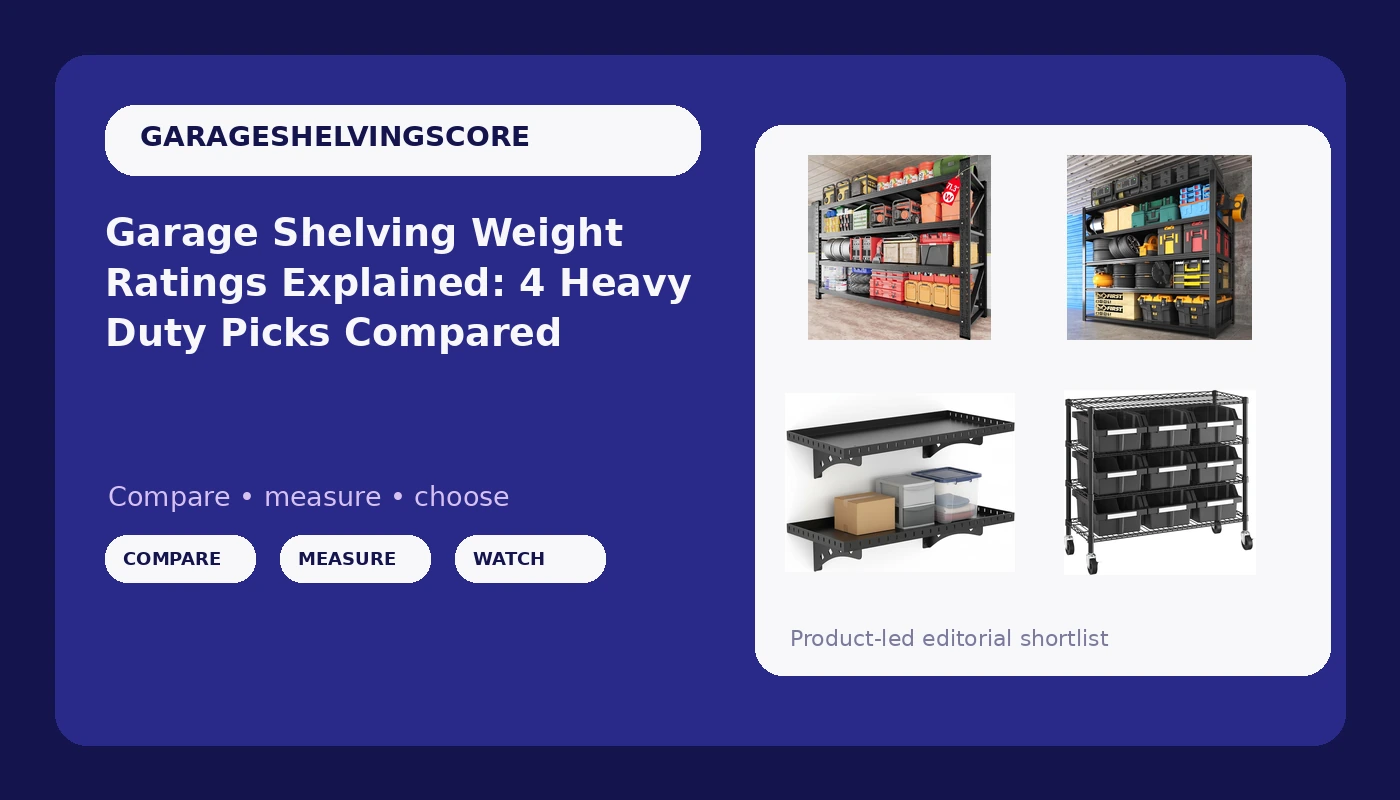
Every heavy duty garage shelving listing you open leads with a big number: 5,000 pounds, or 100 pounds, printed in a font size that suggests it is a promise. It is not a promise about your garage. It is a figure measured under conditions the manufacturer controls, on a flat surface or a perfect wall, with the load spread evenly and every fastener doing exactly what the engineer assumed it would. Your garage has a slab that slopes toward the door, drywall over studs spaced 16 inches on center, a water heater in the corner, and a winter that swings hard enough to move metal. The distance between the catalog number and what a shelf actually holds is where most garage storage failures begin.
That gap is not a reason to avoid shelving. It is a reason to read the specs properly and to spend your install time on the parts the rating quietly assumes. The four units below cover four different jobs: a wide industrial rack for deep bulk storage, a tall five tier unit for a long wall run, a small wall mounted pair for tools, and a bin rack for hardware and small parts. None of them is a universal answer, and the unit that disappoints you is usually the one matched to the wrong job, not the one with the lowest number on the box.
Related: How to Find Studs Behind a Finished Garage Wall →
Quick answer
Match the format to the load path before you match it to the load. A wide steel rack with a very high rating still needs a level floor, even weight distribution, and a sensible center of gravity. A wall shelf rated in the low hundreds needs two studs and no drywall-only plugs. Pick the shape that fits your space and the kind of weight you actually store, then put your effort into mounting, because mounting is the part the rating assumes and the part most people rush.
4 useful options
| Model | Best fit | What stands out |
|---|---|---|
| 71.3" Wide Heavy Duty Garage Shelving Units, 5000LBS Deep Storage Shelves | Deep bulk storage along a back or side wall | 71.3"W x 24"D x 70"H steel frame with a 5,000 pound class rating on the listing |
| Garage Shelving Heavy Duty, 48" W x 20" D x 72.2" H, 5 Tier Adjustable Metal Shelving | A tall wall run with adjustable shelf heights | Five adjustable tiers in a 48"W x 20"D x 72.2"H footprint |
| 2 Pack Garage Wall Shelf, 1X2 Ft Heavy Duty Shelving | Tools, chemicals, and daily-use items near the bench | Two wall mounted 1x2 ft units, listed at up to 100 lbs each |
| 4-Tier NSF 9-Bin Steel Wire Shelving Rack, 36"W x 14"D x 31"H | Small hardware, fasteners, and parts organization | NSF listed wire rack with nine bins in a low 31 inch profile |
Bulk storage: 71.3" Wide Heavy Duty Garage Shelving Units, 5000LBS Deep Storage Shelves
A unit this wide is a floor-standing structure, not a wall fixture, and that changes what you check first. The feet need to sit flat on the slab, so put a level on the floor before you assemble anything and plan to shim the low leg. Load the bottom shelves with the heavy material and keep the top tier for light, bulky items, because a tall rack with a wide footprint is stable right up until the center of gravity moves above the midpoint. The 5,000 pound figure is a distributed total across the whole unit, not a limit for one shelf, so a single shelf loaded with a few hundred pounds of concrete is a very different situation than the same weight spread across four tiers. If your back wall is drywall over studs, this is the format that mostly avoids the anchoring question, since a wide rack carries its own load. It does not avoid the floor question.
Tall wall run: Garage Shelving Heavy Duty,Storage Shelves,48" Wx20 Dx72.2 H,5 Tier Adjustable Metal Shelving Storage Rack,Industrial Shelving Unit for Basement,Warehouse,Garage Organization.1 Pack
Twenty inches of depth and 48 inches of width is the shape that fits most two-car garages without eating the door swing. The trade-off is height. At just over six feet, this unit wants to be against a wall, and if it is, think about what that wall does in an earthquake or when a car nudges it, which is why a simple strap from the top of the frame to a stud is cheap insurance. Adjustability is the feature that pays off over time: set the tiers for the containers you own now, and accept that you will move at least one of them within a year. If you are lining up two or three of these, leave a gap between units so you can reach the side of the middle one, and check that all the feet land on the same plane.
Tool and bench storage: 2 Pack Garage Wall Shelf, 1X2 Ft Heavy Duty Shelving, for Garage, Power Tools, Toolbox, Storage Shelves with for Workshop Office, Holds Up to 100 Lbs (Black)
This is the category where mounting decides everything. A 100 pound wall shelf rated in a lab is rated on solid framing, and a drywall plug in half inch board is not solid framing. Two fasteners into two studs, or into blocking you installed for the purpose, is the difference between a shelf and a projectile. The second thing to think about is height: mount these above bench height so you are not bending, but low enough that a 40 pound tool case is not going over your head. If your garage wall is masonry, the anchor conversation changes entirely, and if it is a finished wall with no accessible studs, plan on adding a plywood backer panel first. Small shelves are also the easiest place to overload without noticing, because people stack them until the front edge droops.
Parts and hardware: 4-Tier NSF 9-Bin Steel Wire Shelving Rack, 36"W x 14"D x 31"H, Graphite
Wire shelving gets a bad reputation, and most of that reputation was earned by wire units holding things wire was never meant to hold. Bins of screws, hose fittings, electrical connectors, sandpaper, and small hand tools are exactly the right load for a wire rack: the weight stays modest and the open construction means you can see what is in the bin without pulling it out. The 14 inch depth keeps the aisle clear, and at 31 inches tall it can sit under a workbench or a garage window without blocking light. Where this format goes wrong is when it becomes a shelf for paint cans or a bench grinder. Keep it on parts duty, keep the heavy bins on the bottom tier, and check the clips or sleeves at each corner whenever you rearrange it, since those joints are what carry the load down to the floor.
Prices and availability may change. Product images, names, and retailer links must be matched by verified ASIN. Do not state a current price, rating, stock status, or measured result without current evidence.
How weight ratings are actually measured
A published capacity is a total for the unit under ideal conditions, and it usually assumes several things at once. The load is distributed evenly across the shelf surface rather than concentrated in one spot. The shelf is supported at every point the design intends. The fasteners are anchored into material with real withdrawal strength, not into the paper face of drywall. The floor or wall behind the unit does not move. The temperature does not swing enough to loosen the joints.
That last point matters more in a garage than in a closet. Metal expands and contracts with temperature, and bolted or clipped joints can loosen over a season of freeze and thaw. The failure is rarely dramatic: a clip backs out a quarter turn, a shelf sags a little, and then one day you load it and it drops.
There is also a difference between a rating measured at the bracket and a rating measured at the shelf. A bracket might hold 200 pounds while the shelf it carries deflects under 80, because sheet metal spans bend in the middle long before the hardware gives up. When you see a high number, ask what it applies to: the whole unit, one shelf, or one bracket. Those are three different claims, and only one of them describes what you are about to do.
Finally, ratings are static. They describe a load sitting still. Adding motion, a car door, a kid grabbing a handle, a floor jack rolling into a leg, turns a static load into a dynamic one, and dynamic loads are how shelving actually fails.
Matching the unit to your wall, floor, and load
- Measure the space, including the door swing, the water heater clearance, and how far the garage door tracks come back into the room.
- Identify the wall type: bare studs, drywall over studs, masonry, or a finished wall you cannot open. This decides your anchoring options before you decide anything else.
- Sort your load into three piles: heavy and bulky, medium and boxed, and small and loose. Each pile wants a different format.
- Check the floor with a level. Sloped slabs are normal, and shimming a floor-standing rack is part of the install, not a workaround.
- Decide what happens to the top tier. If it is above eye level, plan for light and bulky only, and strap tall units to a stud.
Practical guidance for a garage that stays organized
- Put the weight low. The bottom tier of any floor-standing rack should carry the heavy material, because a low center of gravity is what keeps a tall unit honest.
- Find framing or add blocking. A plywood backer panel over drywall gives you solid mounting anywhere you want it and takes an afternoon.
- Leave a walkway. A 36 inch aisle in front of your shelving is the difference between a storage system and a wall of stuff you avoid.
- Account for temperature. Recheck fasteners and clips after the first hard freeze and again in spring, and expect a little seasonal movement in any metal unit.
- Label the bins. Nine bins full of hardware are only useful if you can find the one you need without emptying them onto the floor.
Which option should you choose?
Choose the 71.3" Wide Heavy Duty Garage Shelving Units when you need deep, wide bulk storage for totes, cases, and long material, and you have a level stretch of floor along a back or side wall. Choose the Garage Shelving Heavy Duty 5 Tier unit when you want a tall, narrow wall run with adjustable tiers that can be bought one at a time and lined up as your storage grows. Choose the 2 Pack Garage Wall Shelf when the problem is bench clutter and small items you use weekly, and you can reach solid framing for mounting. Choose the 4-Tier NSF 9-Bin Steel Wire Shelving Rack when the mess is small parts and hardware, and a low profile unit under a bench or window is the space you actually have.
The caveat that applies to all four: capacity figures are published under conditions you do not control, and none of these listings tells you what your specific wall, floor, and fasteners will do. Treat every rating as a starting point that your mounting method either supports or undermines.
The bottom line
The number on the box is the least useful part of a shelving decision until you know what it refers to. A 5,000 pound rack and a 100 pound wall shelf can both be exactly right, in different garages, for different loads, mounted in different ways. Read the rating as a claim about ideal conditions, then look at your own conditions: wall type, floor level, load type, and how high you plan to stack. Match the format to the job, spend your effort on the anchoring, and recheck the joints after the seasons change. That is how a shelf stays a shelf instead of becoming a story you tell about the day the garage reorganized itself.