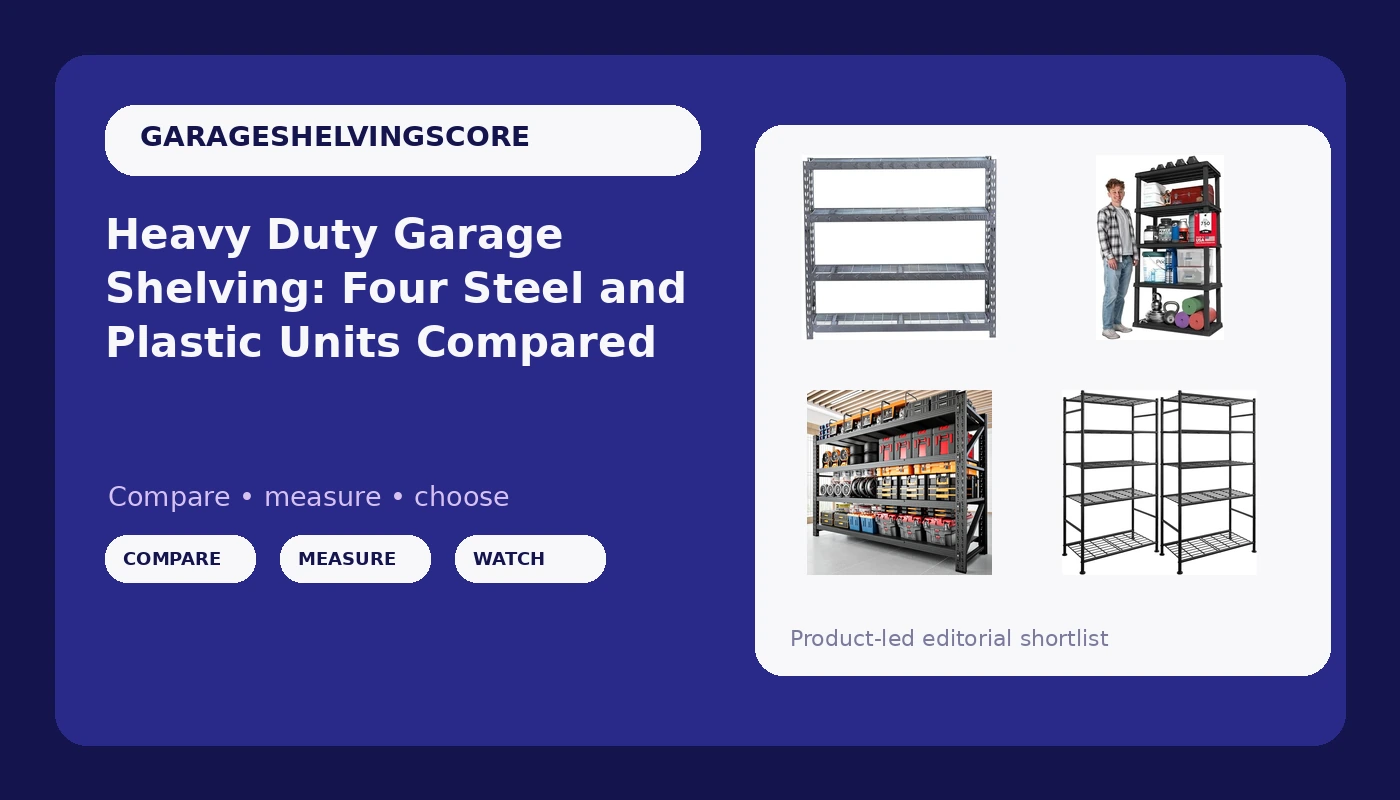
Most garages do not have a space problem, they have a vertical storage problem. The floor gets used, the walls get ignored, and everything from holiday bins to a table saw ends up in a pile near the door. Heavy duty garage shelving fixes that by turning one wall into a stack of horizontal surfaces that can hold real weight. The catch is that "heavy duty" is a marketing phrase, not a specification. Two units with nearly the same footprint can differ by hundreds of pounds of claimed capacity, and the number printed on the box assumes a mounting condition your garage may not have. This guide covers four units, what each one is actually built for, and how to decide before you spend money.
Related: Ceiling Garage Storage Racks: How Overhead Racks Compare →
Quick answer
There is no single unit that wins here, because the right choice depends on your wall and your load. For the largest claimed capacity and a wide, deep footprint, the RAVIGIN 5000LBS Storage Shelves is the heavy-duty option in this group. For two narrow steel runs at a low entry cost, the Sakugi 2-Pack is the practical pick. For light bins and household overflow, the IRIS USA Plastic Storage Shelves handle that job at a lower weight class. For a wide, welded steel unit that reads as furniture in a finished garage, the Gladiator 4-Shelf unit is built for that role. Match the unit to the wall first, the load second, and the price last.
4 useful options
| Model | Best fit | What stands out |
|---|---|---|
| RAVIGIN 5000LBS Storage Shelves | Bulk storage of heavy tools and materials | 71 in. wide, 24 in. deep, 70 in. tall, with a 5,000 lb claimed capacity |
| Sakugi 2-Pack 5-Tier Steel Garage Storage Shelves | Two narrow runs split across a wall | Two units, each 33.5 in. wide, 12.6 in. deep, 72 in. tall |
| IRIS USA Plastic Storage Shelves | Light bins, paint, and household overflow | Made in USA, plastic construction, 73 in. tall, 36 in. wide, 18 in. deep |
| Gladiator 73 in. H x 77 in. W x 24 in. D 4-Shelf Welded Steel Garage Shelving Unit | A wide storage wall with a finished look | Welded steel, 77 in. wide, 24 in. deep, four shelves |
Heavy-duty pick: RAVIGIN 5000LBS Storage Shelves
The trade-off with this one is footprint. At 71 in. wide and 24 in. deep, it wants a long, unobstructed wall, and it takes up real floor space in front of itself so you can reach the back of each shelf. If your garage is a single-car bay, that depth is the difference between parking inside and not. Treat the 5,000 lb figure as a total, evenly distributed across the unit, not as a number you can hang on one shelf corner. The manufacturer's rating assumes a sound mounting surface and proper assembly; your job is to supply both.
Budget two-pack: Sakugi 2-Pack 5-Tier Steel Garage Storage Shelves
The 12.6 in. depth is the whole story here. It is great for paint cans, parts bins, spray bottles, small boxes, and the long tail of garage clutter that does not need a 24 in. platform. It is not great for a 24 in. deep storage tote, which will overhang the front edge. Two units also give you a layout decision the single wide units do not: you can stack both side by side for one dense run, or put one on each side of the garage so the things you use most are always a few steps away. That flexibility is worth more than the depth you give up, as long as your loads stay in the medium range.
Light-load option: IRIS USA Plastic Storage Shelves
Plastic shelving has a clear place in a garage: light things, stored high. Holiday bins, empty coolers, seasonal clothing, paper goods, and the boxes you keep meaning to sort. What it is not built for is a loaded tool box, a stack of tile, or anything with a sharp edge that can score a shelf. Plastic also moves more than steel in a garage that swings from 100 degrees in July to single digits in January, and the shelf clips are the part that usually gives up first. Buy it for the right job and it will last; overload it once and you will be picking bins up off the floor.
Wide steel unit: Gladiator 73 in. H x 77 in. W x 24 in. D 4-Shelf Welded Steel Garage Shelving Unit
This is the unit you buy when the garage is finished, the walls are painted, and you want storage that looks intentional rather than improvised. Welded construction means fewer joints to loosen, and four shelves across 77 in. of width gives you a lot of usable surface per tier. The trade-offs are wall length and weight. You need a very long uninterrupted wall, and a welded steel unit at this size is not a one-person carry up a set of stairs. Plan for a second set of hands, and check the powder coat for shipping damage before you assemble, because a gouge in the finish is the first place rust starts.
Prices and availability may change. Product images, names, and retailer links must be matched by verified ASIN. Do not state a current price, rating, stock status, or measured result without current evidence.
What a weight rating actually means
A capacity number is a lab result. It assumes a sound wall, correct hardware, even distribution across the shelf, and a room that stays at a stable temperature. Your garage is none of those things. So the number is a starting point, not a promise.
Two distinctions matter most. First, total capacity versus per-shelf capacity. A unit rated for thousands of pounds across the whole frame may have a much lower limit on any single shelf, because the load path runs shelf to beam to post to floor or wall. Concentrating weight in one corner is how a rack bends. Second, mounting surface. A rating measured against a stud wall or concrete does not transfer to drywall alone. Drywall anchors resist pull-out poorly; they are for shear loads on light items. Find the studs, or plan a wall that can carry the load, or bolt into concrete with the right anchors.
There is also the fastener question. Bolts that strip before they are tight, brackets that flex under load, and powder coat that flakes after one winter are the three failure points that show up long before a weld does. When you assemble any of these units, snug hardware in stages and re-check it after the first month of use.
Shelf depth, width, and what actually fits
Depth decides what you can store, more than width does. A 12.6 in. deep unit fits cans, bottles, small parts bins, and narrow boxes. An 18 in. deep unit fits most standard storage totes and larger boxes. A 24 in. deep unit fits deep totes, tool boxes, and equipment cases, but it also eats floor space in front of the rack so you can pull things out.
Width decides how much you can store per tier, and it also decides whether the unit fits at all. A 33.5 in. unit slots into almost any wall segment. A 71 in. or 77 in. unit needs a long, clear run with no doors, outlets, or water heaters in the way.
Height is the last variable. Units in the 70 to 73 in. range put the top shelf just above eye level for most adults, which is fine for light, occasional-use items and bad for anything heavy. The middle shelves are the working shelves. Plan accordingly before you load.
- Measure the wall, then mark every stud location with a stud finder before you order anything.
- Write down what you actually plan to store, in pounds, and add it up honestly.
- Choose depth first based on the largest item you own, then width based on the wall.
- Confirm the mounting surface: drywall with studs, open framing, or concrete.
- Sketch the layout on paper, including where the car door opens, before you buy a second unit.
Practical guidance for a garage install
- Put the heaviest items on the lowest shelf, where the load path is shortest and lifting is easiest.
- Anchor into studs or concrete, never into drywall alone, and use hardware rated for the load you plan to carry.
- Reserve the top shelf for light, seasonal, occasional-use items.
- Leave enough clear depth in front of the rack to pull a full tote straight out, not sideways.
- Check the floor first. A sloped or cracked slab means you should level the unit and shim the feet before loading it.
- Re-check every bolt and clip after the first month, then again after the first hard temperature swing.
Which option should you choose?
Choose the RAVIGIN 5000LBS Storage Shelves when you have a long wall, need a deep platform, and your loads are genuinely heavy. Choose the Sakugi 2-Pack 5-Tier Steel Garage Storage Shelves when you want two narrow steel runs, a lower entry cost, and you are storing medium-weight items that fit within 12.6 in. of depth. Choose the IRIS USA Plastic Storage Shelves when your loads are light bins and household overflow and you want the tall shelf space without the steel weight. Choose the Gladiator 73 in. H x 77 in. W x 24 in. D 4-Shelf Welded Steel Garage Shelving Unit when the garage is finished and you want welded steel construction across a wide span.
One caveat applies to all four: the capacity figures are manufacturer claims made under ideal conditions, not results measured in your garage. The variable you control is the wall. Get that right and any of these units will do its job.
The bottom line
The unit that works is the one whose footprint fits your wall and whose depth fits what you actually store. Start with a stud finder and a tape measure, not a product page. Then decide between deep and heavy, narrow and cheap, plastic and light, or wide and finished. Any of these four will hold far more than the pile on your floor does today, and each one will hold it for years if you mount it to something solid.