Related: Best Garage Wall Storage Systems for Tools and Bikes
I have installed heavy duty garage shelving in hundreds of garages around Kansas City, and I have taken a fair amount of it back out. Not because the steel failed. Because somebody bolted a rack rated for a small car into drywall with the plastic plugs that came in the box, stacked it with engine blocks, and then stood there wondering why the whole thing leaned off the wall like a fence post in a flood.
Weight ratings get measured in a lab with perfect mounting on a perfect wall. Your drywall is not a lab, and your 1962 garage framing is not a perfect wall. So the units worth your money are the ones that hold up when a real load lands on a real wall. I judge every rack the same way, what I call the contractor test: read the label, then ask what happens at double that load, after a Kansas City winter has had a year to work on the powder coat and the shelf clips.
Two of the racks below are shelves, one is a narrow-depth unit for the wall you gave up on, and one is a hook rail that solves the problem shelves never fix. All four are meant to be anchored into studs or concrete. None of them belong on drywall plugs.
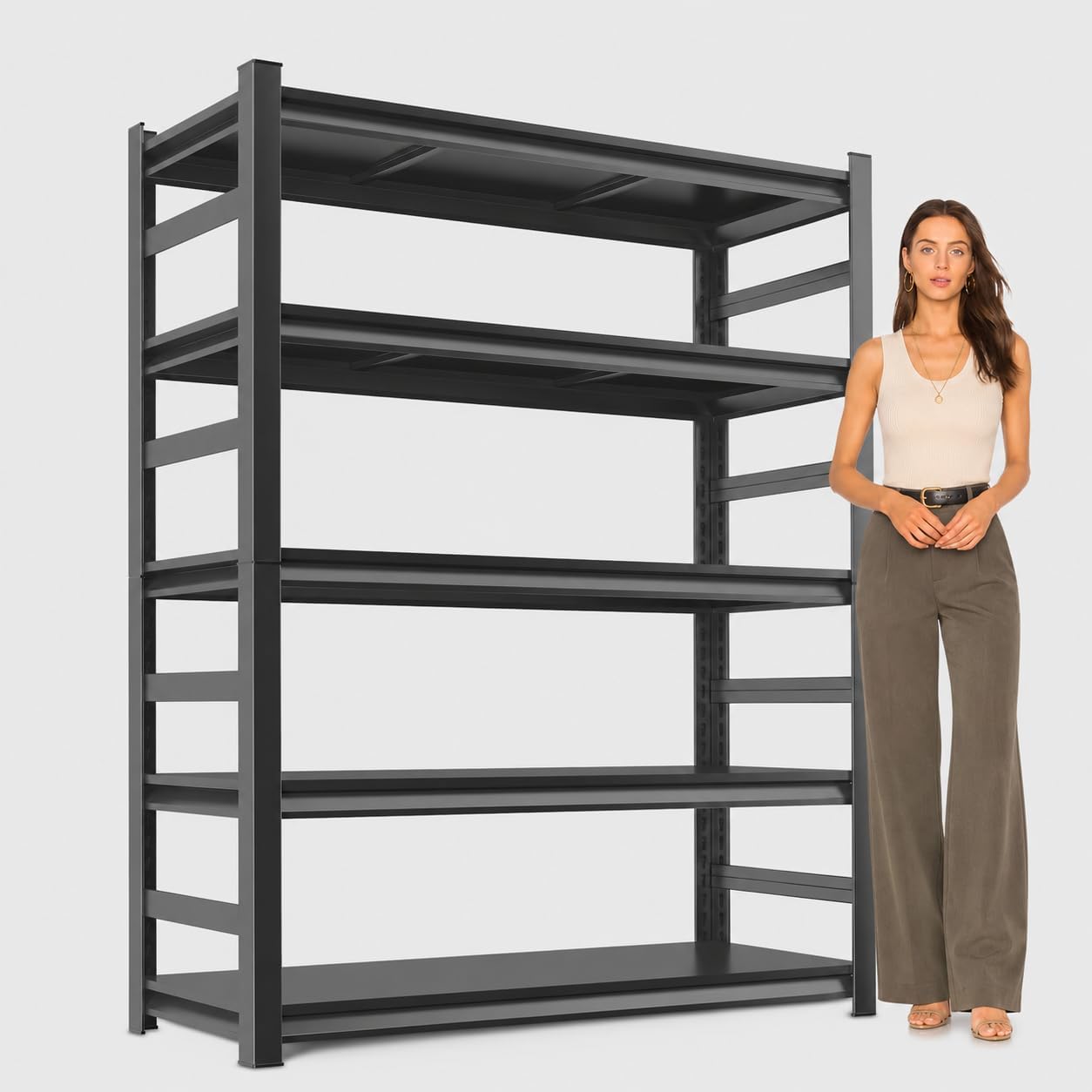
Best Overall: 3,000 lb Five-Tier Steel Shelving
This is the rack I point at when somebody says they want to store anything short of a transmission. Five tiers, all adjustable, 72 inches tall, and a 3,000 pound capacity rating on a steel frame that looks like it means it.
Here is the part most people miss: 3,000 pounds is the whole unit, not one shelf. How that number splits across five tiers is the spec that actually decides what you can put where, and it is the first thing I check on any rack. Read it before you load it. An adjustable shelf that is asked to carry more than its share is the shelf that ends up bowing.
The tiers move without a second person and without a mallet, which matters more than the marketing suggests. I have fought shelving that needed two hands, a rubber mallet, and a prayer to change a shelf height, and I have hated every one of them.
At 72 inches tall, plan the top tier for totes, holiday bins, and the stuff you touch twice a year. Keep the chainsaw and the everyday tools at chest height. And anchor it properly: two studs minimum, structural fasteners, and masonry anchors if you are on concrete. At this capacity, anchoring is not a suggestion.
The downsides are honest ones. It is heavy, it arrives in pieces you will move twice, and it looks like industrial equipment in a garage, because that is what it is. If you wanted furniture, you are shopping in the wrong category. Check current Amazon price before you commit.
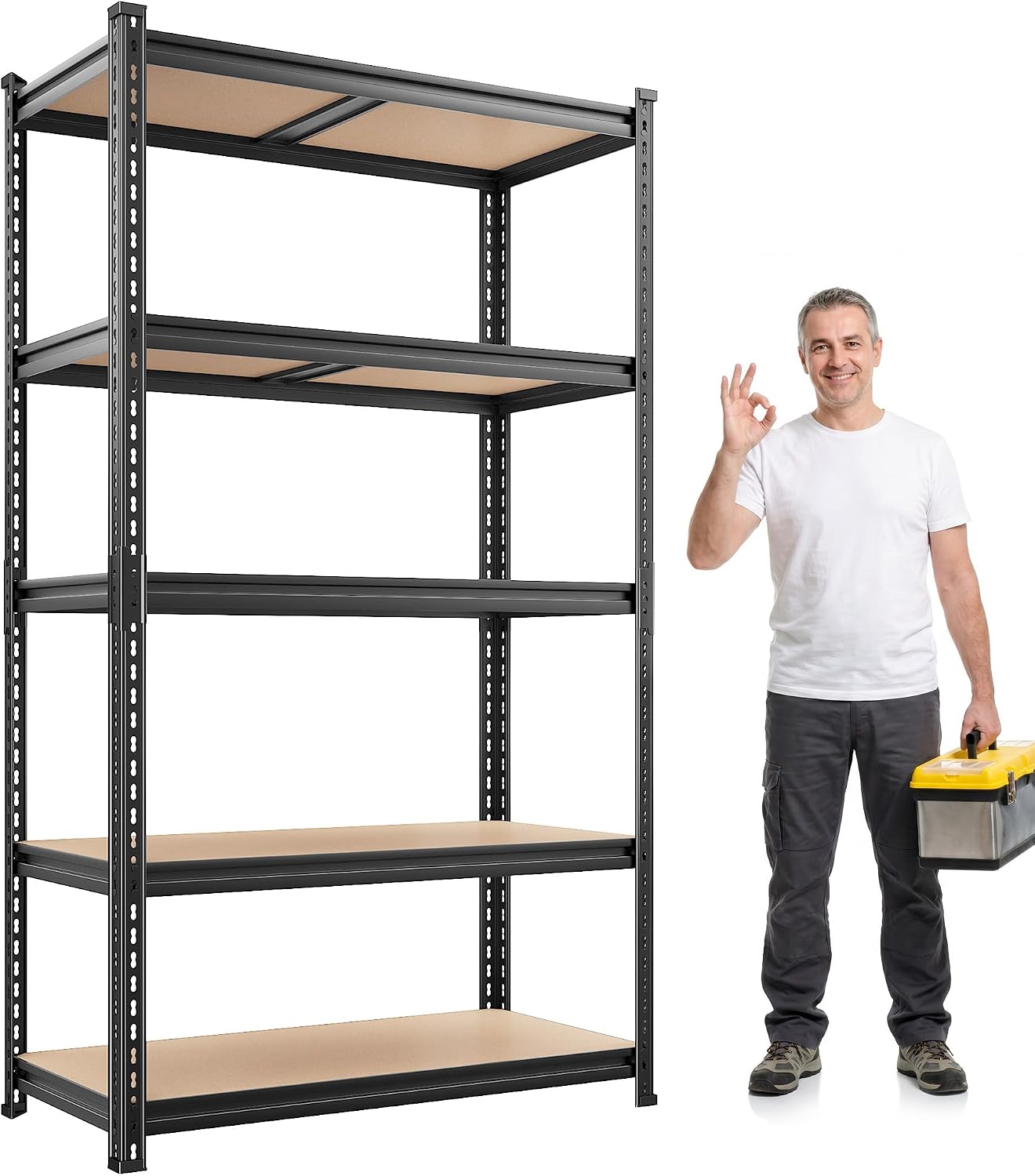
Best Value: REIBII 2,400 lb Shelving
Thirty-six inches wide, 16 inches deep, 72 inches tall, and rated for 2,400 pounds. That width is the sweet spot on a two-car garage wall: narrow enough to fit between a service door and a corner, wide enough to hold a real stack of totes.
The 2,400 pound rating sits under the 3,000 pound unit above, and that is the honest trade you make for the money. For most homeowners, 2,400 pounds is already more than they will ever put on a shelf. My rule is simple: if you cannot describe the load in one sentence, you are probably over it. Tile, engine blocks, and a pallet of concrete? Go heavier. Paint, tools, camping gear, and the holiday bins? This is plenty.
The 36 inch width is also what makes it fit places a 48 inch rack will not. If your garage wall is chopped up by a water heater, a door, or a workbench, measure the gap before you buy anything wider.
Same anchoring rules apply. Studs, structural screws, and a level. A tall rack that leans is a rack that is already on its way down, and no capacity rating saves you from that.
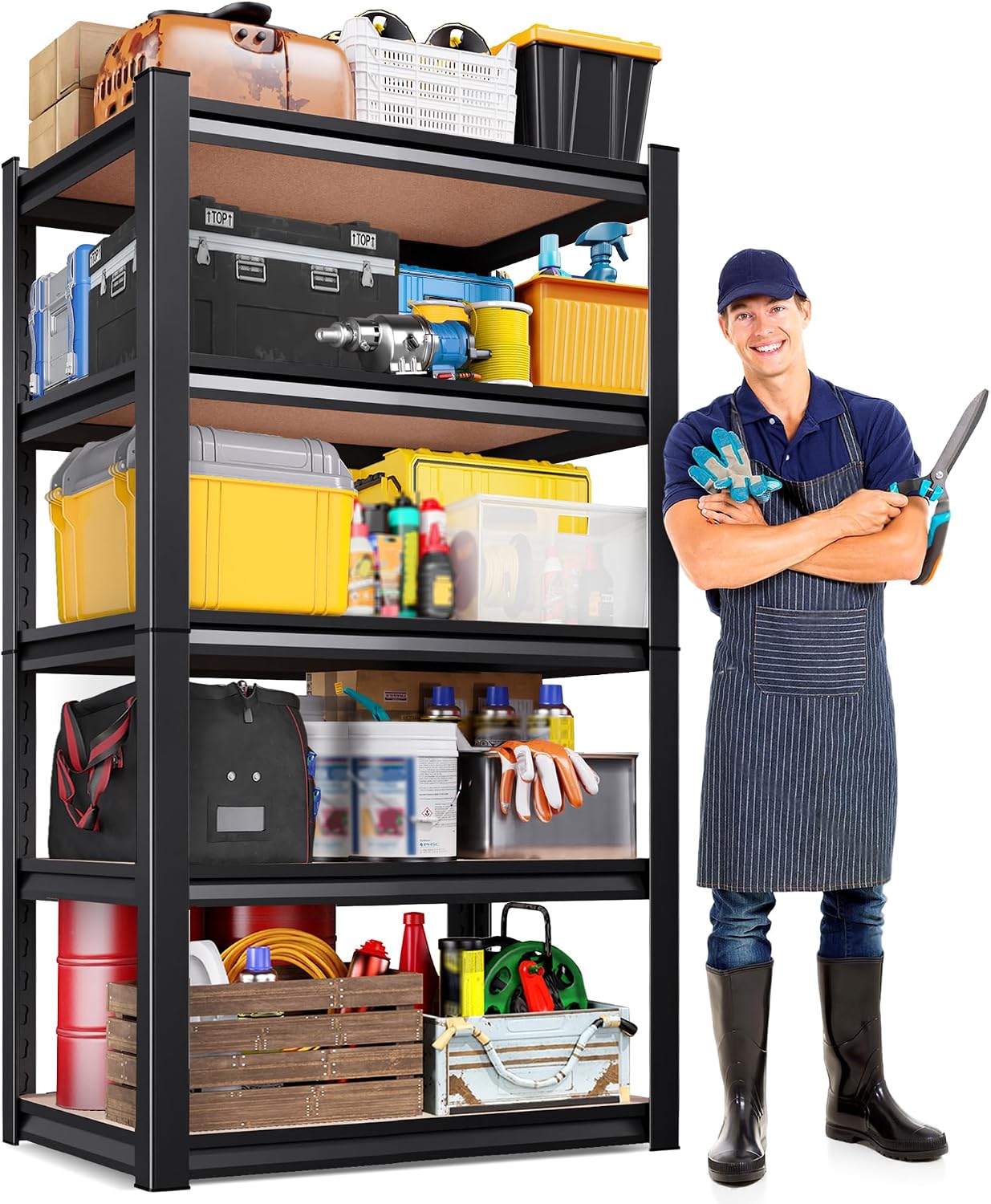
Best for Tight Walls: 71 by 28 by 12 Inch Shelving
Twelve inches deep. That is the entire pitch. Most garage racks run 16 to 24 inches deep, which is fine until you need storage on the wall where the car door swings open. This unit is 71 inches tall, 28 inches wide, and 12 inches deep, rated for 1,900 pounds, and it slides into the skinny spots everything else has to skip.
I use this footprint for paint, chemicals, pantry overflow, and anything that lives in a case and stacks flat. It is also the unit I would pick for a basement landing or a utility room, where depth is the enemy and you still want the shelves off the floor.
Do not buy this one expecting to park a mower deck on it, and do not expect a deep 24 inch tote to sit on it without hanging over the edge. Twelve inches deep means twelve inches of usable depth. Measure your totes.
The 1,900 pound rating is the lowest of the three racks here, and that is fine, because the load it is built for is cans, bottles, cases, and tools, not a small-block engine. Match the rack to the load and this one will outlast the garage.
Best Wall Organizer: TIDYME 48 Inch Double Hook Rail
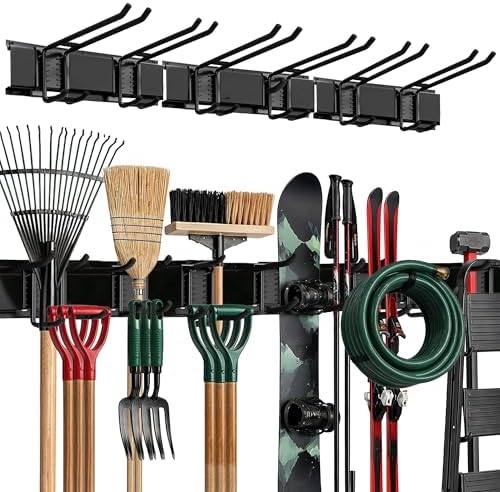
Not every storage problem is a shelf problem. Shovels, rakes, ladders, extension cords, and the trimmer you keep tripping over are hanging problems, and a 48 inch rail with double hooks fixes them for less than the price of one bad shelf.
The double hook layout holds two tools per position, which is roughly double what a single hook rail carries in the same wall space, and 48 inches is long enough to actually clear the floor clutter instead of just moving it six inches to the left.
Now the part that matters. Mount it into studs. A shovel holder loaded with long-handled tools is a lever, and a lever bolted to drywall plugs will find the weakest point in your wall and open it up. If your studs do not line up with where you want the rail, put a backer board across the studs first and mount the rail to the board.
This is the piece that turns a garage with shelves into a garage that works. The racks hold the boxes. The hooks hold the stuff you reach for every week, which is exactly the stuff that ends up on the floor.
The comparison table
Capacities and dimensions below come straight from the listings. Check current Amazon price on each, because these move.
| Unit | Rated capacity | Footprint | Best for |
|---|---|---|---|
 Visit on Amazon → Visit on Amazon →3,000 lb five-tier steel shelving |
3,000 lbs | 72" H, 5 adjustable tiers | Heavy tools, tile, engine parts |
 Visit on Amazon → Visit on Amazon →REIBII 2,400 lb shelving |
2,400 lbs | 36" W x 16" D x 72" H | General garage wall storage |
 Visit on Amazon → Visit on Amazon →71 by 28 by 12 inch shelving unit |
1,900 lbs | 71" H x 28" W x 12" D | Tight walls, pantry, basement |
 Visit on Amazon → Visit on Amazon →TIDYME 48 inch double hook rail |
Hanging tools only | 48" rail, double hooks | Shovels, rakes, cords, ladders |
How I judge a garage shelf
Every rack gets the same review, and the load rating is only the start.
Anchor path first. Can this unit reach two studs at 16 inches on center, or does the design force me into a single stud and a prayer? A shelf that cannot hit structure is a shelf I will not put in a paying client's garage, no matter what the box says.
Then the joints. Welds, clips, and bolts are where cheap shelving fails, not the middle of a shelf. I look at how the tiers lock in, whether the clips are steel or plastic, and whether the hardware strips before it is tight. Bolts that strip before they are tight tell you what the rest of the unit is like.
Then the finish. A garage swings from triple digits in August to single digits in January, and that cycle eats cheap powder coat for breakfast. Surface rust on a weld is cosmetic for a while, and then it is not.
Then the real question: would I install it in a client's garage, and would I tell them the truth about the wall they actually have?
What separates these four
The three racks cover three different loads and three different footprints. The difference between them is not quality so much as capacity and width.
The 3,000 pound unit is the heavy-tool answer. If you are storing tile, engine parts, or anything you would need a hand truck to move, that is the rack, and it is the one where the anchor matters most.
The REIBII unit is the general-purpose answer. Thirty-six inches wide, 2,400 pounds, and a footprint that fits more walls than the wider racks do. For most garages, this is the one that gets loaded with everything and never complains.
The 12 inch deep unit is the answer for the wall you gave up on. Narrow, tall, and rated for 1,900 pounds, which is more than enough for cases, cans, and paint.
The hook rail is not competing with any of them. It keeps the shovels and cords off the floor, and it is the cheapest square footage of storage in this guide.
One more thing about capacity, because it is the number people quote and the number they misread. Every rating on this page is the manufacturer's number for the whole unit, measured with proper mounting. It is not a promise about your wall. A 3,000 pound rack on drywall plugs holds about as much as a 200 pound rack, which is to say, not much, and not for long.
Should you buy the 3,000 lb five-tier steel shelving?
Yes, if you have structure to anchor into and a load that justifies it. It is the highest capacity rack here, the five tiers adjust without a fight, and the frame is built for heavy tools and equipment rather than for looks. Check current Amazon price, then go find your studs. If your only option is drywall with nothing behind it, buy lighter or build a backer.
Should you buy the REIBII 2,400 lb shelving?
Yes, for most people. It is the best balance of width, capacity, and cost in this group, and 36 inches wide fits walls that a 48 inch rack cannot. It will hold paint, tools, camping gear, and holiday bins without a complaint. Just do not ask it to be a 3,000 pound rack, because it is not, and it does not pretend to be.
Should you buy the 12 inch deep shelving unit?
Yes, if depth is your problem. Twelve inches deep is a genuinely useful footprint in a garage where a car door has to open, and 1,900 pounds covers the load this shelf is designed for. Measure your totes first. If they are 18 inches deep, this is not the rack for them.
Should you buy the TIDYME 48 inch hook rail?
Yes. It is the cheapest way to get long-handled tools off the floor, and the double hooks make good use of a 48 inch run. Mount it into studs or a backer board and it will outlast the tools hanging on it. Check current Amazon price and hang the ladder first.