Related: Garage Wall Storage: Studs, Anchors, and Load Path
I have bolted shelving into more garage walls than I can count, and I have watched a couple of them come down. Not because the unit was junk. Because the mounting was. That is the part nobody puts on the box.
So when I line up heavy duty garage shelving for a client, the unit is only half the conversation. The other half is the wall behind it, the slab under it, and what is actually going to sit on the shelves. A rack rated for 3,000 pounds holding paint cans is a waste of money. A rack rated for 400 pounds holding tile is a lawsuit.
Here are four units I would put in front of a homeowner right now, and they are not interchangeable. One is a wide adjustable freestanding rack. One gets everything off the floor entirely. One is the heavy-duty number for a workshop. One is the small-footprint pick for the narrow strip of wall you forgot you had.
My rule for all four is the same: load it to double the stated rating, leave it a year, and look at the powder coat before you look at the welds. The paint fails first. It always does.
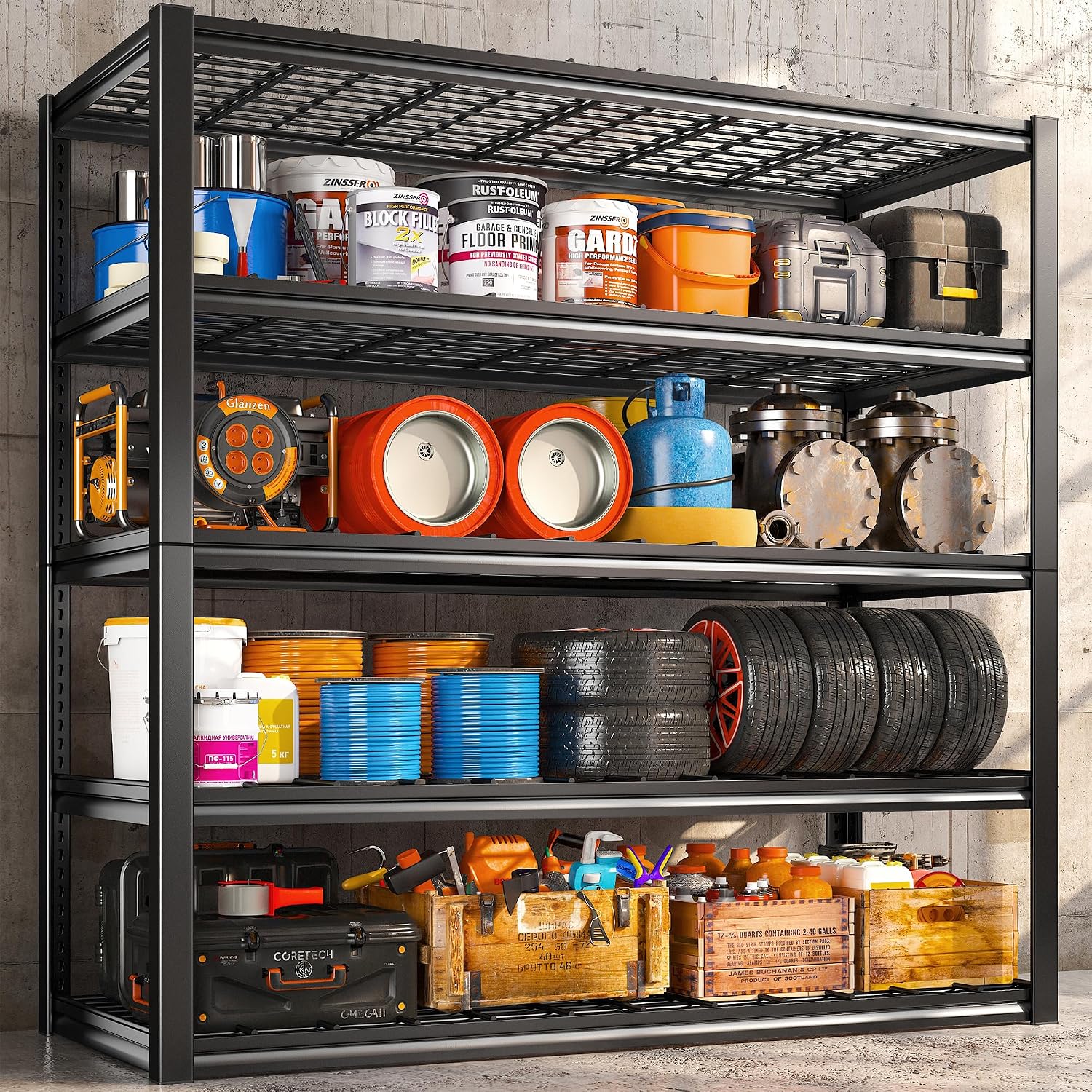
Best Overall: REIBII 48.2 inch W Storage Shelves
Width is why this one takes the top slot. A 48.2 inch unit covers a long run of wall in one piece, and a wide shelf is what actually stops you from stacking totes three deep and calling it organized. Adjustable shelves mean you set the gaps to the stuff you own, not the other way around.
It is freestanding, so it does not need good framing to stand up on its own. That does not mean you skip the wall. In a garage, a freestanding rack gets bumped by bikes, by kids, and by a car door, and a tall rack that is not tied off is a rack waiting for an excuse. I still want two anchors into studs, high up, even on a freestanding unit. That is the difference between a shelf that leans and a shelf that comes down.
Freestanding also means you own the floor. Garage slabs slope toward the door for drainage, so check the feet and shim or level as needed, because a rack that rocks will walk its way loose over a winter. And measure your parking clearance before you commit. A wide rack plus an open car door is where garages get tight, and no amount of good shelving fixes a layout that does not fit the vehicle.
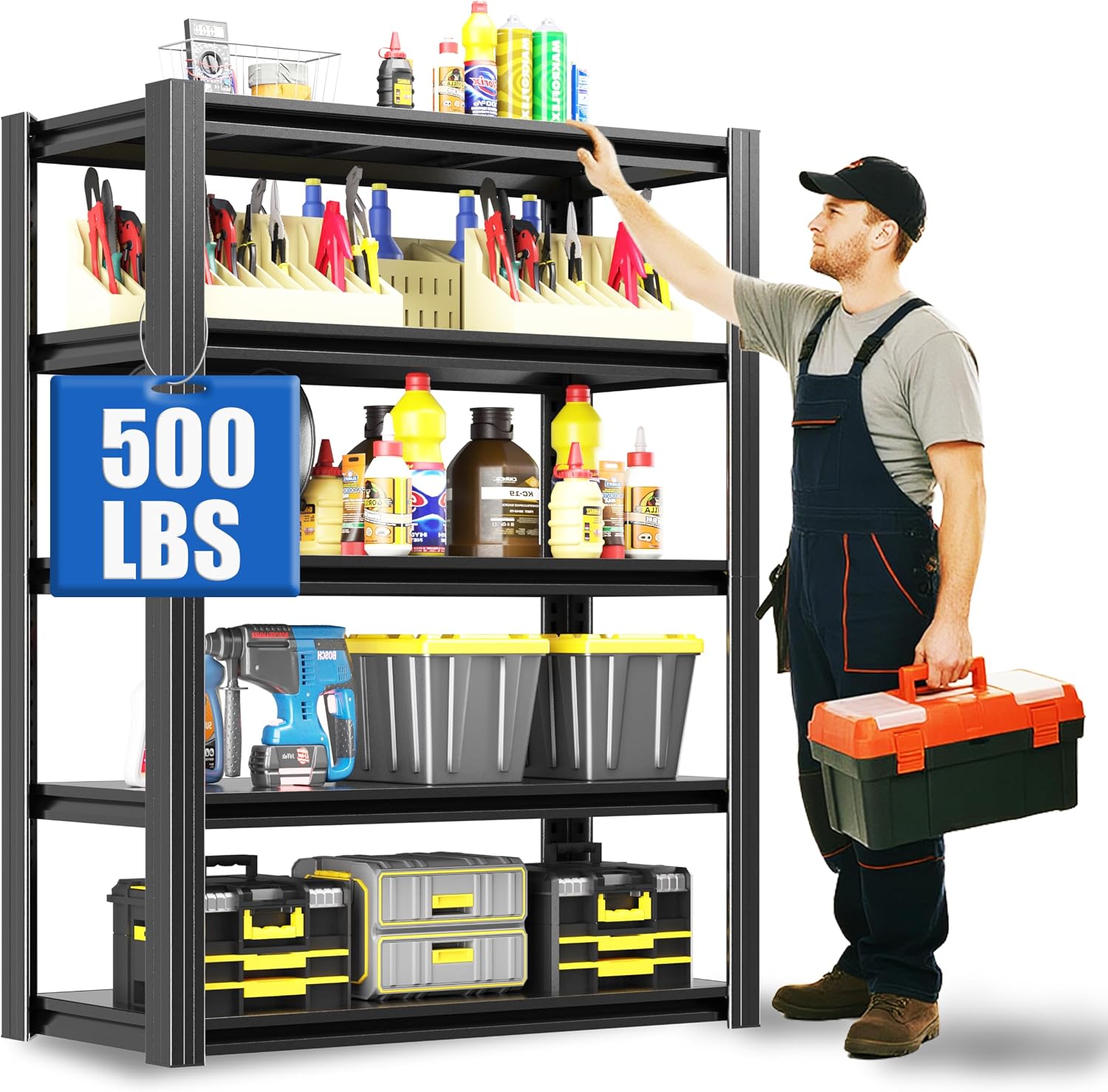
Best Heavy-Duty Pick: 63 inch H Heavy Duty Garage Shelving, 3,000 lbs
This is the one I would point at a workshop, a basement, or the back wall of a garage where the real weight lives. Five tiers, 63 inches tall, 31.5 inches wide, 16 inches deep. That 16 inch depth is the classic utility rack footprint. It holds a case of oil, a tile saw, and a stack of brake rotors without eating your walking lane.
The 3,000 pound figure is the headline, and it is also the number people misread. That is a total capacity for the unit, not a per-shelf allowance, and it assumes the load is spread and the unit is on flat ground. Read the listing carefully and check where the manufacturer is measuring, because a rating taken at the bracket is not the same as a rating taken at the middle of a shelf. That is my oldest pet peeve in this category, and it is why I test at double the stated number and then leave it a year.
Sixty-three inches is also the right height for a working shelf. It keeps the top tier within reach without a ladder for most adults, which means you will actually use all five tiers instead of turning the top one into a permanent dust collection site. Adjustable tiers mean you can drop a gap for a tall tool case and keep the rest tight.
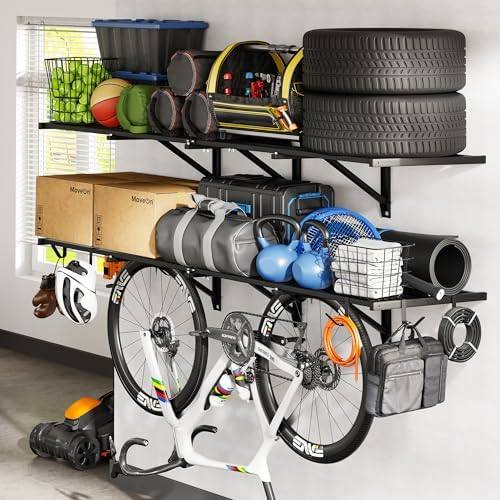
Best Wall-Mounted: FLEXIMOUNTS 2-Pack 2x6 ft Garage Wall Shelving
Wall shelving is the best square footage play in a garage after a ceiling rack, because it stores over the car instead of beside it. This two-pack gives you a pair of 2x6 ft shelves rated 1,200 pounds for the set, plus 8 hooks for cords, hoses, and ladders. Nothing on the floor, nothing blocking a door, nothing you have to move to park.
It also lives or dies on your wall. A wall shelf is rated at the bracket, into good framing, with the right fasteners, and that rating means nothing if you are hanging it off drywall alone. Find the studs. If the layout of your studs does not line up with where you want the shelves, you have two honest options: move the shelves to match the framing, or add a wall plan, meaning a slatted wall panel system that spreads the load across multiple studs. What you do not do is trust the drywall plugs in the box. "Wall anchor included" usually means a plug that holds a picture frame, not a shelf full of Christmas decorations.
The hooks are the quiet win here. Ladders, extension cords, and garden hoses are the stuff that makes a garage feel chaotic even when the shelves are clean, and hanging them is faster than folding them.
Best Small-Footprint Pick: Sakugi 5 Tier Storage Shelves
Twelve point six inches deep and 33 inches wide. That is a narrow strip of wall, and narrow strips are where most garages actually have room. It fits behind a parked car, in a pantry, in a closet, and along the wall between the door and the corner where nothing else will go.
The feature I care about most is the leveling feet. A 72 inch tall unit on a sloped slab will rock, and a rocking rack loosens its own hardware over a season. Leveling feet let you fix that instead of shimming with a scrap of plywood.
Be honest about the load. Five tiers at this footprint is for tote bags, paper goods, seasonal decor, and light tools. The moment you put a loaded tool box on the top tier of a tall narrow rack, you have made a bet, and it is a bet against gravity. Heavy stuff goes low. That is true on every unit in this guide, and it is doubly true on a narrow one.
How I judge garage shelving
I run everything through the same test, and it is not a lab test. Load it to double the stated rating. Leave it a year. Then look at it. A year of Kansas City temperature swings will find the weak point faster than any spec sheet, and the weak point is usually the powder coat, not the weld.
Then the install questions, in order. Can a homeowner do this with normal tools in an afternoon? Does the hardware hold torque, or do the bolts strip before they are tight? Are the included anchors real anchors or drywall plugs? And would I put it in a paying client's garage, where my name is on it?
That last question kills more products than the load test. A shelf that holds weight but sags, or rocks, or needs re-tightening every spring, is a callback. I do not do callbacks.
Analysis: what the specs actually tell you
Weight ratings are measured in a lab with perfect mounting. Your drywall is not a lab. Every number in a listing assumes the unit is level, the fasteners are right, and the load is spread the way the manufacturer imagined. Change any of those and you change the rating.
Wall-mounted versus freestanding
Freestanding racks carry their own load to the floor, so the wall only has to stop them from tipping. Wall shelves send the entire load into your framing, so the wall has to carry everything. That is a bigger ask. It is also why wall shelving is worth it when you have good studs and a car to park, and why it is a bad idea when you have a wall of drywall and hope.
Before you buy either, answer one question: what is behind the wall? A stud finder answers it in two minutes. Skipping that step is how shelves end up on the floor.
Where the weight actually goes
Heavy on the bottom, light on top, and nothing on the top tier of a tall narrow unit that you would not want landing on your car. A garage rack is not a bookcase. It is a structure, and structures want the load low and centered.
The finish is the tell
Cheap powder coat flakes in one winter. If you see rust blooming at the welds by spring, the finish was cosmetic, not protective. That does not make a unit useless, but it does tell you what you bought, and it tells you to keep it out of the splash zone near the garage door.
Garage shelving reference table
This is the comparison I keep in my head when a client asks what to buy. Footprints and stated capacities come straight from the listings. Where a number is not published, I am not going to guess at it, and neither should you.
| Unit | Type | Footprint | Stated capacity | Price |
|---|---|---|---|---|
 Visit on Amazon → Visit on Amazon →REIBII 48.2 inch W Storage Shelves |
Freestanding, adjustable | 48.2 inch width | See listing | $175.98 |
 Visit on Amazon → Visit on Amazon →63 inch H Heavy Duty Garage Shelving |
Freestanding, 5 tier | 63 H x 31.5 W x 16 D inches | 3,000 lbs total, stated | $79.99 |
 Visit on Amazon → Visit on Amazon →FLEXIMOUNTS 2-Pack 2x6 ft Garage Wall Shelving |
Wall mounted, 2 shelves plus 8 hooks | 2 x 6 ft each | 1,200 lbs for the pair, stated | $129.99 |
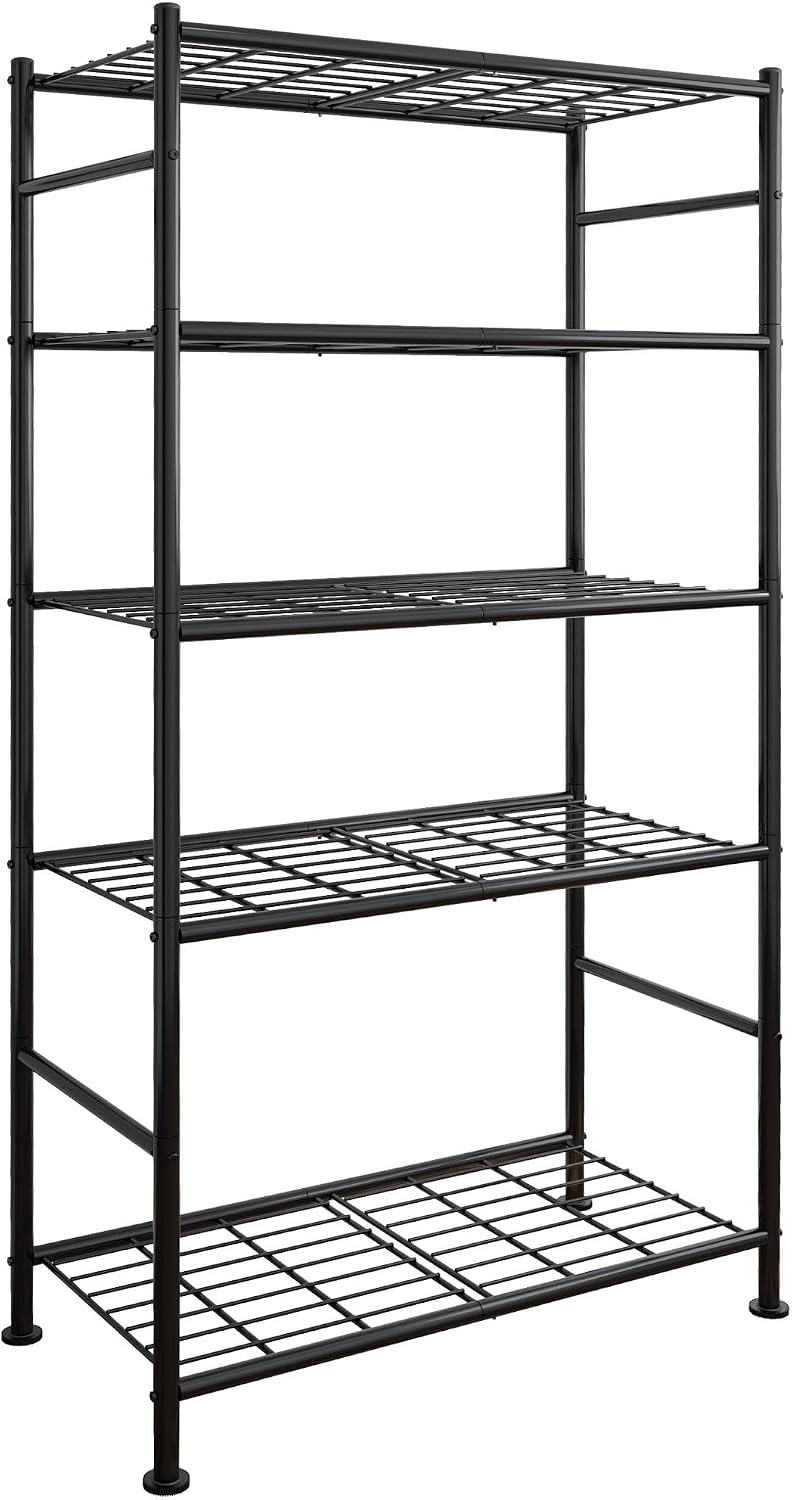 Visit on Amazon → Visit on Amazon →Sakugi 5 Tier Storage Shelves |
Freestanding, 5 tier, leveling feet | 33.0 W x 12.6 D x 72.0 H inches | See listing | $44.98 |
Read that table the way I read it. The wall unit gives you the most storage per square foot of floor. The 3,000 pound rack gives you the most weight per dollar of footprint. The wide REIBII gives you the cleanest long run. The Sakugi gives you a place to put things in a garage that has no room left. None of them is wrong. They are answers to different questions.
Should you buy the REIBII 48.2 inch W Storage Shelves?
Yes, if you have a long wall and you would rather buy one wide adjustable unit than three narrow ones. It is the most flexible of the four for a general garage, because adjustable tiers and a 48.2 inch span let you handle totes, boxes, and bulky gear on the same rack.
Tie it to a stud anyway, even though it stands on its own. Level it on your slab, keep the heavy stuff low, and check your parking clearance first. Do those three things and it will outlast the house.
Should you buy the 3,000 lb heavy duty rack?
Yes, if you are storing real weight in a workshop, basement, or garage back wall. Five adjustable tiers at 63 inches tall and 31.5 by 16 inches is the classic utility footprint, and it is the unit here I would trust with tools, tile, and cases of oil.
Just read the rating correctly. It is a total, and it assumes good ground and a spread load. Double-check the per-shelf numbers in the listing before you pile it up.
Should you buy the FLEXIMOUNTS two-pack?
Yes, if your wall has framing you can hit and you want your floor back. Two 2x6 ft shelves and 8 hooks, rated 1,200 pounds for the pair, is a lot of overhead storage over a car that never gets blocked.
The honest caveat: if you cannot find studs, do not buy this. Buy a freestanding rack instead, or plan on a slatted wall panel so the load spreads across framing. A wall shelf hung on drywall alone is a shelf that is coming down.
Should you buy the Sakugi 5 Tier?
Yes, for the narrow strip of wall you forgot you had, and for light to medium loads. Leveling feet on a 72 inch unit is a real feature, not a marketing line, because garage slabs slope and tall racks rock.
Keep it honest. Totes, paper goods, decor, light tools. A loaded tool box on the top tier of a narrow rack is a bet you will lose.