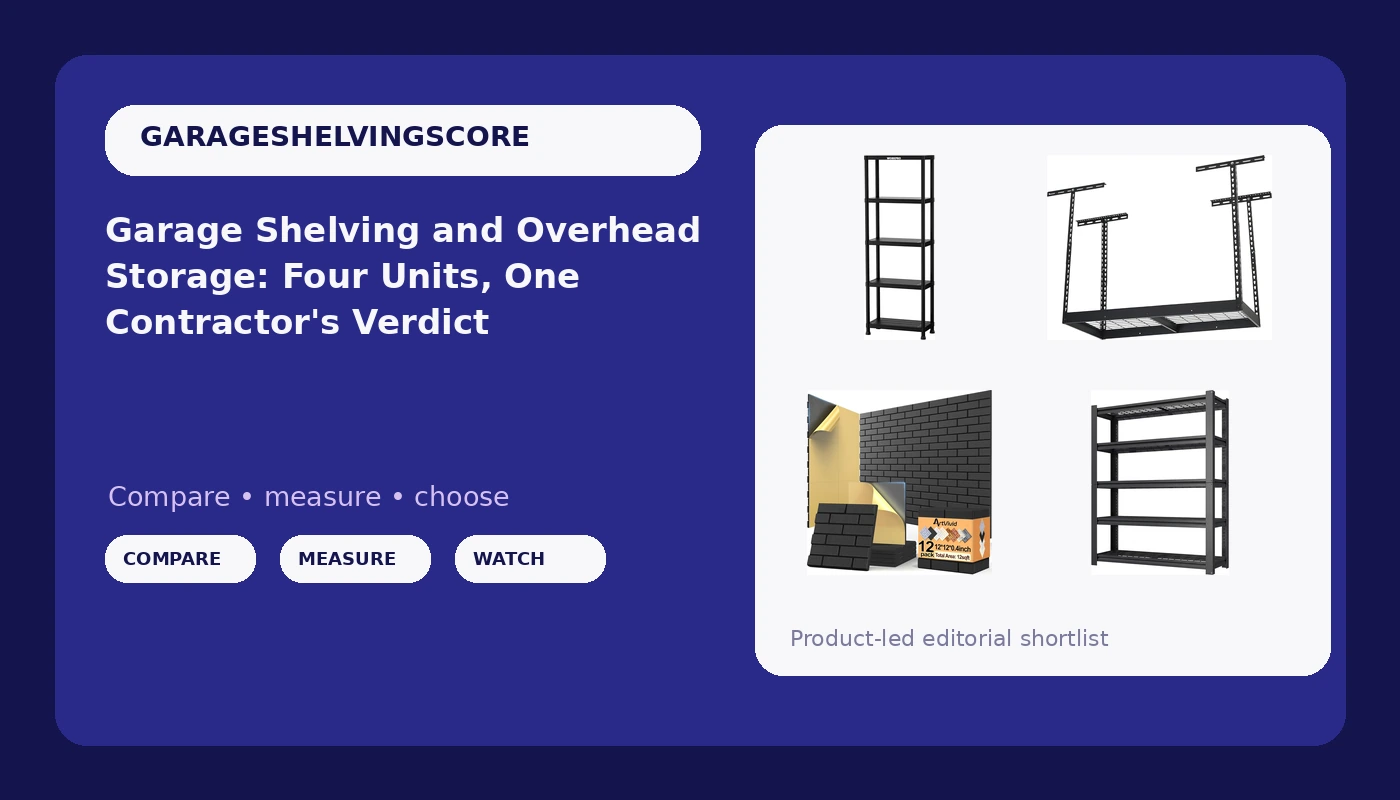
I have been a general contractor in Kansas City for twenty years, and the last eight of those have been almost entirely garage storage: shelving, ceiling racks, wall panels, workbenches. I have installed hundreds of units in garages their owners had already written off, and I have watched a few of those units fail. That is why this comparison of garage shelving and overhead storage reads the way it does. I am not going to tell you what the box claims it holds. I am going to tell you what the load path looks like once the thing is in your garage, against your wall, with your stuff on it.
Related: Garage Shelving Weight Ratings Explained
The best overall pick here is the 72 inch heavy duty metal shelving unit, because the weight runs straight down five steel tiers into the floor and the 16 inch depth still leaves room to park a car. The Klutch overhead rack is the best second purchase, because ceiling space is the only square footage in a garage you are not already using. The plastic WORKPRO unit has a real job, but it is a light-load job. The acoustic panels are not storage at all, though they fix a problem that every hard-surfaced garage has.
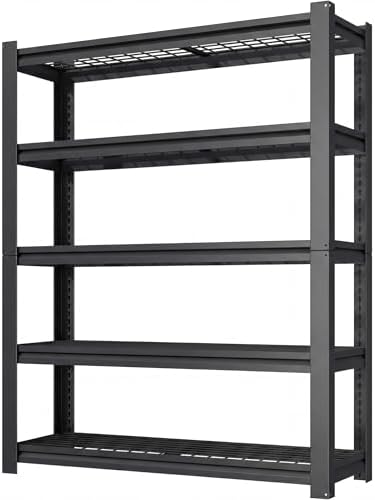
72 in. Heavy Duty Metal Garage Shelving, 5 Tier Adjustable, 16 x 35 x 72 in.
All-steel frame, five adjustable tiers, and a load path that goes straight to the floor. The 16 inch depth fits a working wall.
The finish is the weak point, not the welds. A 72 inch top tier needs a step stool and a second pair of hands to load.
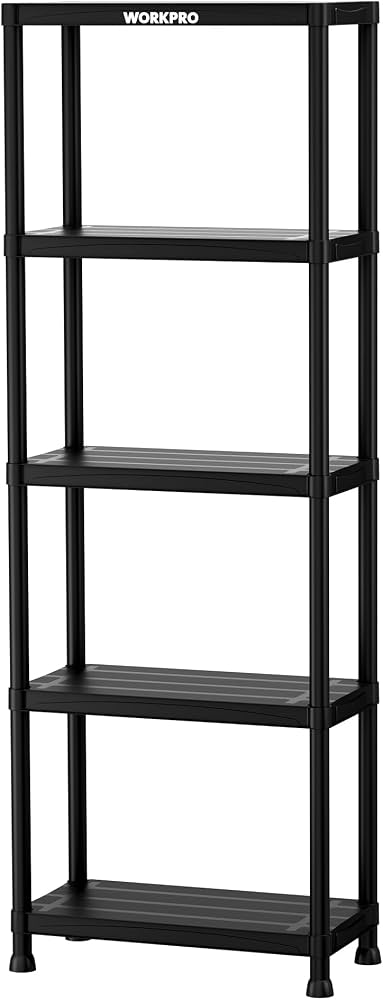
WORKPRO 5-Tier Plastic Storage Shelves, 500 lb Capacity, 67.1 x 23.9 x 12 in.
Tool-free assembly you can finish without a socket set, a shallow 12 inch footprint, and a clean look for pantry or laundry duty.
Plastic under sustained load creeps, and a cold garage makes it brittle. Put a loaded tool box on it and you have made a bet.
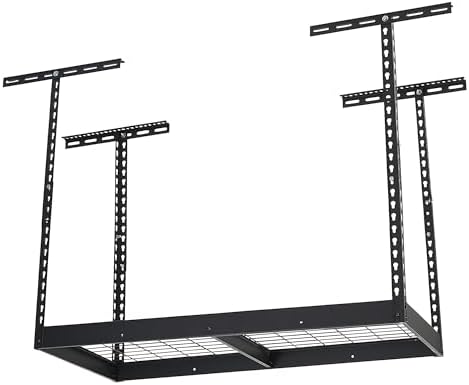
Klutch Overhead Storage Rack, 48 in. x 24 in., 350 Lb. Capacity
Uses the ceiling, which is free real estate in every garage. 350 lb is enough for holiday bins, ladders, and bulky seasonal gear.
It needs ceiling joists, a ladder, and two people. Not a one-person, one-hour job.

ArtVivid 12 Pack Acoustic Panels, Brick Pattern
Kills the slap in a hard-surfaced garage and covers a wall that has already been drilled and patched a dozen times.
It is not storage and it is not soundproofing. Adhesive mounting on bare drywall takes the paper with it when it comes off.
Prices and availability were captured from Amazon Creators API and may change.
How I test garage storage
Every unit that gets a recommendation from me has to pass what I call the contractor test. I load it to the number on the label. Then I double that number. Then I leave it for a year of Kansas City weather, which swings from single digits in January to triple digits in August with plenty of humidity in between. A shelf that survives the first week tells you nothing. A shelf that is still straight after a winter and a summer tells you everything.
I also time the installs, because "assembles in minutes" is marketing language and a stopwatch is not. And I check the hardware, which is where cheap shelving gives itself away. Bolts that strip before they are tight. Brackets rated at the bracket instead of at the shelf. A "wall anchor included" that turns out to be a drywall plug rated for a picture frame.
The last question is the one that actually decides it: would I install this in a paying client's garage? If I would not put my name on it, it does not go in this article. All four of these products passed that question, but they passed it in different rooms for different reasons.
The heavy duty metal unit: where real loads go
This is the one I would buy first for a working garage. Five steel tiers, adjustable, on a 16 inch deep by 35 inch wide footprint that tops out at 72 inches. Steel does not care about a Kansas City February. It does not creep, it does not go brittle, and when you load it correctly the force travels down the uprights and into the floor, which is the only structural element in your garage that was designed to carry weight in the first place.
Adjustability is the feature people underestimate. A fixed shelf height forces you to buy storage that fits the shelf. Adjustable tiers let you set the top shelf high for holiday bins you touch twice a year, then drop a middle shelf to a height that actually fits a tool case or a stack of parts organizers. Measure your tallest item before you decide the spacing, not after.
Two honest complaints. First, the finish on budget steel shelving is usually the first thing to fail in a garage, because road salt, humidity, and temperature swings are brutal on powder coat. The welds almost always outlast the paint. If you see a scuff or a chip, hit it with touch-up paint before the rust starts, because rust on a garage shelf is a one-way trip. Second, 72 inches is taller than it sounds. If you are shorter than about five foot eight, the top tier is a step stool shelf. Plan accordingly and keep the heavy stuff at waist height.
Plastic shelving: where it works and where the bet goes wrong
The WORKPRO unit is the fastest thing in this comparison to put together. Tool-free assembly is not a gimmick when you are doing it alone on a Saturday, and the 12 inch depth means it slides into narrow spots where a deeper steel rack would foul a car door. Five tiers at 67.1 inches tall and 23.9 inches wide, with a 500 lb capacity rating across the unit.
Here is where I draw the line, and it is the same line I draw with wire shelving. Plastic shelving has a place: light stuff, high up. Tote bags, empty coolers, paper goods, seasonal decorations, pantry overflow, laundry supplies. The moment you put a loaded tool box on a plastic shelf, you have made a bet against chemistry. Plastic creeps under sustained load, which means it does not crack, it slowly bows, and once it bows it does not come back. Add a cold garage and the material gets brittle, so the same shelf that flexed all winter can crack when you drop something on it in January.
If this is the unit you buy, load it bottom heavy, keep it out of direct sunlight, and anchor it to the wall. It is light enough that a kid or a dog can pull it over, and a shelf full of paint cans falling on a car is a bad afternoon. Used within its limits, it is a good value and it looks tidy. Used as a workbench substitute, it is a countdown.
The overhead rack: the only free real estate in a garage
The Klutch rack measures 48 inches long by 24 inches deep and carries a 350 lb rating. If you are not using your ceiling, you are renting that space to the air, and air does not pay rent. Overhead storage is the single best square footage play in a garage because it takes bulky, light, occasional items and moves them out of the zone where you walk, park, and work.
The install is where people get in trouble. This rack hangs from ceiling joists, not from drywall and not from the thin decking above your garage. Find the joists with a stud finder, mark them, and lag into solid wood. Two people and two ladders make this an afternoon. One person on a step stool with a drill in one hand is how people get hurt.
Placement rules I use on every job: keep the rack clear of the garage door tracks and the travel path of the door panel, keep it high enough that you are not ducking under it, and put it over the hood of the car or along a side wall where nothing else fits. A 350 lb rating covers bins, ladders, camping gear, and strollers. It does not cover an engine block, a transmission, or a stack of tile. If you need to store something that heavy overhead, you need a different conversation about joists.
The acoustic panels: not shelving, but they solve a real garage problem
The ArtVivid 12 pack is the odd one out here, and I want to be clear about what it does and does not do. It is not storage. It does not hold weight. It is not soundproofing, and no panel of this type will stop a compressor from being heard in the house. What it does is absorb reflected sound, and a garage is a box of hard surfaces: bare drywall, concrete floor, metal door, steel shelving. That combination turns a dropped wrench into a gunshot and makes a shop radio sound like it is playing through a wall.
If your garage doubles as a workshop, if you run power tools in there, or if the noise carries into the house, a brick pattern panel set knocks down the echo and makes the space more usable. It also has a practical cosmetic job. Garages that have had shelving bolted to them for twenty years are covered in patched holes and paint touch-ups. A panel wall hides all of it.
Mounting matters. Adhesive on bare, unpainted drywall will take the paper face with it when the panels come off, so plan on cleaning and priming first, or use mechanical fasteners into studs if you want them removable. Keep panels away from the area where you cut and grind, because the surface will collect dust.
Wall type decides the install before the product does
Every recommendation above assumes something about your walls, and I will not give mounting advice without knowing the wall type. Drywall alone holds almost nothing. Drywall over studs holds real weight, but only where you hit the studs, which is why the stud finder is the most important tool in this entire article. Concrete block and poured concrete hold excellent weight with the right anchors, and poorly with the wrong ones. A shelf that is anchored into drywall alone is a shelf that is coming down, and it will take your stuff with it.
For the steel unit, anchor the top of the frame to a stud even though it stands on the floor, because a tall, shallow, top-heavy rack wants to tip forward. For the plastic unit, anchor it regardless of what you plan to load. For the ceiling rack, the joists are the whole story.
The trade-offs nobody puts on the box
Floor space versus ceiling space. A floor rack is easy to load and easy to reach, but it eats the footprint you need for a car, a bike, or a workbench. A ceiling rack is hard to load and hard to reach, but it costs you nothing you were using.
Depth versus clearance. Sixteen inches of shelf depth in front of a parked car is workable. Twenty-four inches is often not. Measure the space between your wall and your car door before you buy anything, and measure it with the door open.
Assembly time versus load capacity. Tool-free plastic goes up in an afternoon with no tools. Steel takes longer and holds more. Ceiling work takes the longest and holds the most, because it is hanging from structure rather than resting on it.
Portability. Plastic shelving comes apart and moves with you. Bolted steel and lagged ceiling racks mostly stay with the house. If you are renting, that should shape your decision more than any capacity number.
Who should buy which
Buy the heavy duty 72 inch metal shelving if you want one unit that handles real garage loads, tools, parts, and heavy bins, and you have a wall that can spare 35 inches of width and 16 inches of depth.
Buy the WORKPRO plastic unit if you need light-duty storage fast, without tools, in a pantry, laundry room, or the dry corner of a garage, and you are honest with yourself about what you will put on it.
Buy the Klutch overhead rack if your floor is already full and your ceiling is empty. It is the best square-footage decision in this list, as long as you have joists and a helper.
Buy the acoustic panels if noise and echo are the actual problem, not clutter. It will not organize anything, but it will make the space you organized feel a lot less like a metal drum.
What I am testing next
I have a set of wall panels and a pair of wall-mounted bike hooks on the bench for the winter, along with a fresh look at how powder coat holds up on budget steel after a full Kansas City cold season. The pattern I keep seeing is that the finish fails long before the structure does, and I want to know which brands are still worth the money once the paint starts going. That report comes when the weather warms up and I can get an honest look at what the salt did.