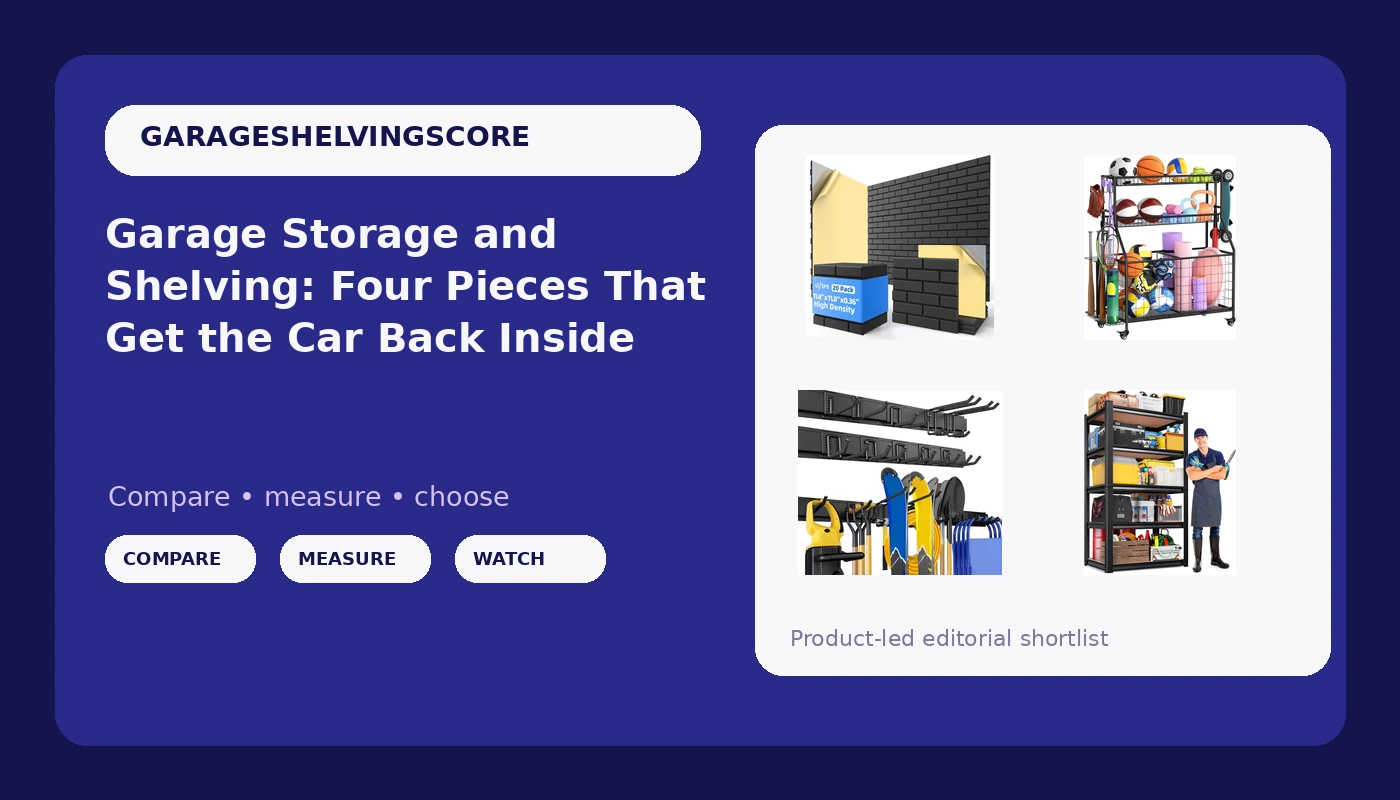
A garage rarely fails at organization because the owner is lazy. It fails because the floor is the only place anything can go. Every rake, every tote of holiday decorations, every bag of soccer balls lands in the same square footage the car is supposed to occupy, and by the time the first cold snap hits, the car is living in the driveway. That is the problem garage storage and shelving is supposed to solve, and it only works when the storage you buy matches the stuff you actually own.
I have spent a long time around garages with a tape measure in hand, and the pattern repeats. Someone buys one shelving unit, piles everything on it, and then wonders why it sags. Someone else hangs a heavy rack into drywall with the plastic plugs that came in the box and hears it pop three months later. The fix is not one heroic product. It is a handful of decisions about what stacks, what hangs, what rolls, and what should never have been in the garage in the first place.
Related: Ceiling Racks vs Wall Shelving: Where the Weight Should Go →
Quick answer
Start with a floor-standing steel shelving unit as the load-bearing core of the garage. Add a wall-mounted rail for long-handled tools so rakes and brooms stop leaning in corners. Put sports gear on a rolling organizer so it can leave the garage without being unpacked. Foam acoustic panels are a separate category: they hold no weight and matter only if the garage doubles as a workspace where echo is a nuisance.
Four useful options
| Model | Best fit | What stands out |
|---|---|---|
| 71"H x 28"W x 12"D Garage Shelving Unit, 5-Tier Heavy Duty Metal Storage Shelves 1900 LBS Capacity, Adjustable Utility Steel Racks and Shelving for Garage, Pantry, Basement, Warehouse, Black | Stackable bins and dense, heavy items | Five tiers, a 12 inch depth, and a manufacturer listed 1,900 pound total capacity |
| 64 Inches Garage Storage, UUP Garage Organization Wall Mount Garden Tool Organizer, 620lbs Adjustable Metal Hooks, Yard Shed Rail Rack, Lawn Tool Holder for Hanging Rake Broom Mop Snowboard, Home Gift | Long-handled tools and boards | A 64 inch rail with adjustable hooks and a manufacturer listed 620 pound capacity |
| Sports Equipment Garage Organizer - Heavy Duty Garage Organization Ball Storage Rack with Basket, Hooks and Rolling Cart for Sports Gear and Toy Storage, Indoor/Outdoor Use, Black | Balls, pads, and gear that travels | Basket, hooks, and a rolling cart in one unit |
| 20 Pack Acoustic Panels with Self Adhesive, 11.8" X 11.8" X 0.36" High Density Sound Proof Foam Panels for Wall, Soundproof Wall Panel, Brick Sound Absorbing Panel for Home Studio Office Decor - Black | Cutting echo in a workshop corner | Twenty self-adhesive panels with a brick texture, sold for wall decor and absorption |
The load-bearing core: 71"H x 28"W x 12"D Garage Shelving Unit
A tall, narrow unit like this is the right shape for a garage wall because it stacks vertically instead of pushing into the room. The trade-off is the one that applies to every tall steel rack: a 71 inch frame loaded with dense bins is top-heavy, and the unit should be secured to the wall or otherwise restrained against tipping. The listed capacity is a total across the whole unit, not a promise about any single shelf, and it assumes the unit is sitting on a level floor and loaded evenly. Spread the heavy totes low and keep the light, bulky stuff up high.
The long-handled tool rail: 64 Inches Garage Storage Wall Mount Organizer
The honest caveat with any wall rail is that the rail is only as strong as what it is fastened to. A 64 inch span crosses multiple studs on a typical wall, which is good news, because it means you can put a fastener into wood every 16 inches instead of relying on drywall. On a masonry wall the story changes again. The listed capacity assumes a sound mounting surface and hardware appropriate to it, so treat that number as a ceiling for ideal conditions, not a target.
The rolling sports organizer: Sports Equipment Garage Organizer
The case for wheels is simple: anything that leaves the garage regularly should not be buried behind things that never leave. A rolling unit can be pulled to the driveway, loaded, and pushed back, which means the gear gets put away instead of piled by the door. The trade-off is floor space, and a cart needs a parking spot that is not in front of the shelving unit or the tool rail. If you have a narrow single-car bay, measure the lane first.
The echo fix: 20 Pack Acoustic Panels with Self Adhesive
Here is where I would be careful with expectations. Thin foam panels of this type absorb some reflected high-frequency sound inside a room, which can take the sharp ring out of a hard-surfaced garage. They are not a soundproofing product, and no panel of this thickness stops noise from traveling through a wall to the neighbors. In a garage, dust, humidity, and temperature swings are also hard on adhesive-backed foam, so panels belong on a clean, painted wall in a spot you are not constantly brushing against.
Prices and availability may change. Product images, names, and retailer links must be matched by verified ASIN. Do not state a current price, rating, stock status, or measured result without current evidence.
How a weight rating turns into a real load
Every capacity number on a shelving box describes a chain, and the unit is only one link. The chain runs from the shelf, to the bracket, to the post, to the fastener, to the wall or floor, and it ends in whatever that wall or floor is made of. A rating measured in ideal conditions tells you what the steel can take. It does not tell you what your 1970s drywall can take, and it does not tell you what happens when a single heavy item concentrates its weight in one corner of a shelf instead of spreading across it.
That distinction between distributed and point load explains most shelving failures. A 1,900 pound total capacity spread across five shelves is roughly 380 pounds per shelf in even distribution, which is plenty for totes and tools. Drop a 200 pound engine block on one shelf edge and you have created a point load the shelf was never shaped to carry, even though you are well under the total number.
Garage conditions add a second variable. A Kansas City garage swings from below freezing in January to over 100 degrees in July, and that cycle works on fasteners, adhesives, and coatings. Anything I mount in a garage gets a re-check after the first full season, because bolts that were tight in October are not always tight in April.
Matching storage type to what you actually own
The order of operations matters more than the products:
- Empty the floor completely and sort into piles: stackable totes, long-handled tools, gear that leaves the garage, small parts, and things that should not be in a garage at all.
- Measure the walls and find the studs before you buy anything. Note outlet locations, door swings, and the travel path of the garage door and its track.
- Send the heaviest, densest piles to a floor-standing steel unit placed against a wall, loaded heavy at the bottom.
- Send long-handled tools to a wall rail mounted at a height you can reach without a ladder, with the hooks spaced for what you actually own.
- Keep anything that comes and goes on wheels, with a marked parking spot that does not block the shelving or the walkway.
Mounting and layout notes that save a redo
- Locate studs with a stud finder and mark them with tape before you drill anything. A wall rail and a shelving unit both want wood, not drywall alone.
- Plan for at least 12 inches of clearance in front of 12 inch deep shelving so you can pull a tote out without turning sideways.
- Hang long-handled tools with the handles up and the heads down, above head height, so nobody walks into a rake tine.
- Keep everything clear of the garage door track and the path of the door panels. That includes anything tall enough to lean.
- Re-check fasteners and anchors after the first heating and cooling season, and again if you add weight.
Which option should you choose?
Choose the 71"H x 28"W x 12"D Garage Shelving Unit, 5-Tier Heavy Duty Metal Storage Shelves when you need vertical capacity for totes, paint, and tools and you have a wall long enough for a narrow footprint. Choose the 64 Inches Garage Storage Wall Mount Garden Tool Organizer when your clutter is mostly long-handled: rakes, brooms, mops, and boards that currently live in a corner. Choose the Sports Equipment Garage Organizer when the mess is balls, pads, and toys that move between the driveway and the house and need to roll out of the way. Choose the 20 Pack Acoustic Panels with Self Adhesive when the storage is handled and the remaining problem is a garage that rings too loudly while you work.
None of the capacity figures above come from independent measurement. They are the numbers the manufacturers publish, and real performance depends on your wall type, your fasteners, your floor, and how evenly you load the unit. If a number matters to you, verify it against the current listing before you buy.
The bottom line
Garage storage and shelving works when the storage matches the load. A floor-standing steel unit carries the dense, stackable weight. A wall rail handles the long-handled tools that never fit on a shelf. A rolling cart handles the gear that leaves the garage. Foam panels handle echo, and only echo. Get the studs right, spread the weight, keep the walkway clear, and the car gets its bay back.