
Related: Anchoring Garage Shelving: Studs, Ledgers, and Load Paths
I've been building and finishing garages in Kansas City for 20 years, and the last eight of those have been almost entirely storage systems. In that time I've hung heavy-duty garage shelving in garages that held a riding mower, a chest freezer, a boat motor, and three kids' worth of bikes. I've also watched a brand new rack drop a shelf of paint cans onto a truck hood because the whole thing was fastened to drywall with the plugs that came in the box. That's the whole ballgame. A shelf that holds is a shelf that was planned. A shelf that fails was a shelf that was guessed at.
So this is a guide about the four kinds of garage shelving I keep coming back to, and the wall each one belongs on. One is a wall-mounted grid that lives on studs. One is a freestanding five-tier rack with leveling feet. One is a 64 inch tool organizer that turns a blank wall into a hand tool station. One is plastic, and I'll tell you exactly what it's good for and where it will let you down.
Weight ratings are measured in a lab with perfect mounting. Your drywall isn't a lab. Keep that in mind through all of this, because the number on the box is the least interesting part of any rack.
Best Overall: Jusgym 4 Pack Wall Mounted Garage Shelving
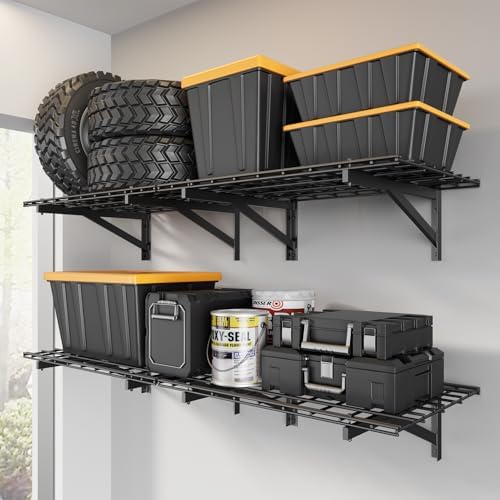
If I'm building storage for a client and the wall is open, this is the shape I want: a wall mounted grid panel, 2 feet by 3 feet, four of them in the pack, stated at 1,400 pounds for the set. An integrated grid deck means the shelf surface is one welded piece rather than a set of loose wires that flex under load. That matters more than the number on the box, because a shelf that deflects is a shelf that keeps deflecting.
Wall mounting means the floor stays clear. That is the entire point. Every square foot a freestanding rack takes is a square foot that isn't parking a car, and floor space is the thing you were trying to reclaim in the first place.
Wall mounting also means the install is the product. You need studs, you need a level line, and you need to know where the electrical runs are before the first hole. Fasten into studs at 16 inches on center and you have structure. Fasten into drywall with the included plugs and you have a countdown timer. The grid panel carries load to the brackets, and the brackets carry it to the studs, which is a load path I can follow with a tape measure. That's the whole difference between this and a rack that scares you every time you walk past it.
This is the one I'd put in a working garage: long items like ladders and conduit up high, heavy totes at chest height, nothing on the floor.
Best Value: Sakugi 5-Tier Storage Shelves
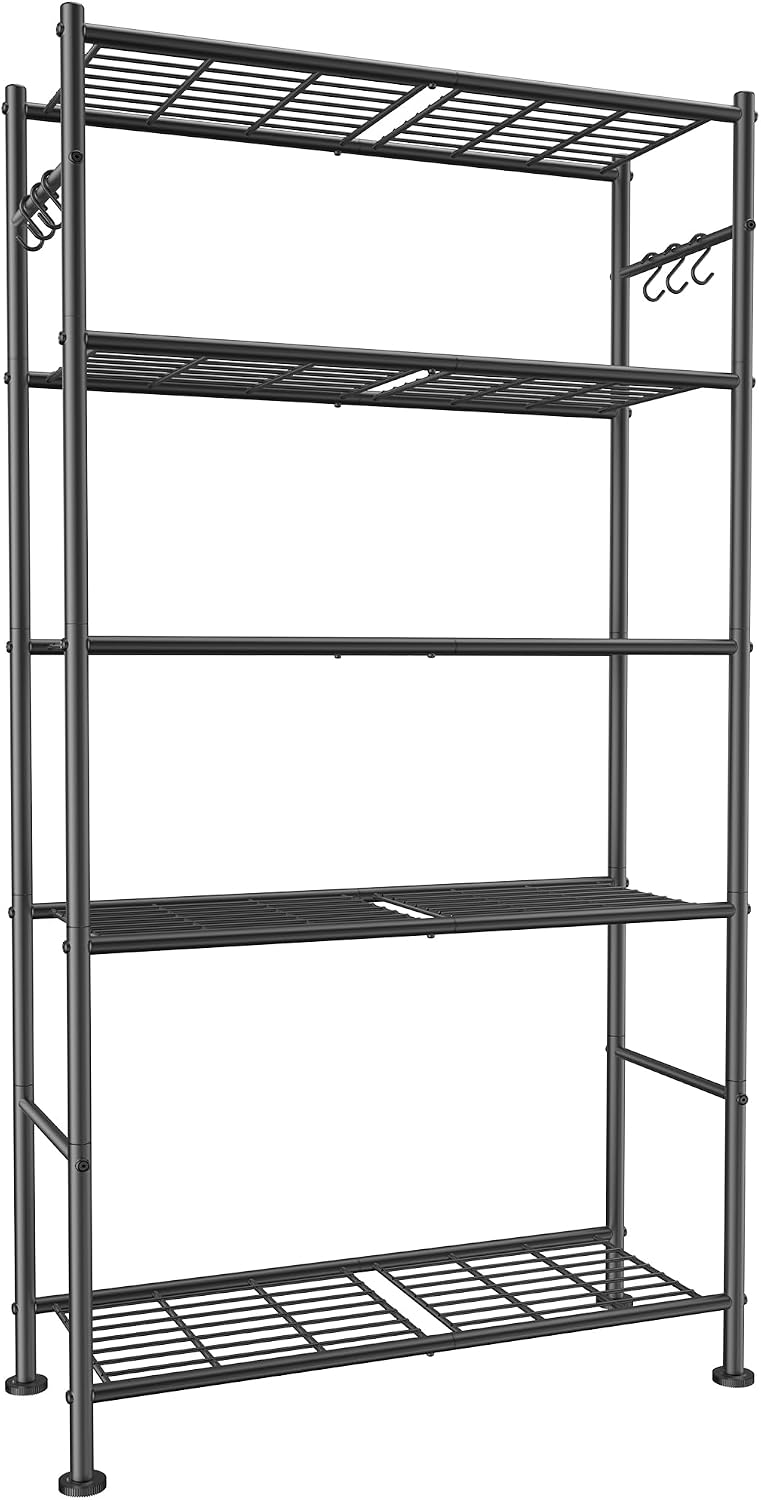
Freestanding is a different animal. The Sakugi is 32.1 inches wide, 12.4 inches deep, 71.4 inches tall, five tiers, black, and it ships with leveling feet and hooks. That combination tells me the maker understands something a lot of them don't: a tall rack on a sloped garage floor wobbles, and a wobbling rack is a rack that walks.
Leveling feet are the most underrated part of any freestanding shelf. Garage slabs drain, so they slope. A rack with fixed feet rocks on that slope, and a rocking rack works its fasteners loose over a winter of freeze and thaw. Feet you can adjust take the rock out, and that's why I'd take this one over a cheaper five-tier with welded feet.
The trade-off with any freestanding rack is that it lives in your floor space. Five tiers at 71.4 inches tall does get a serious pile of totes off the ground, and the hooks handle cords and extension leads. What it does not do is hold a transmission. There's no published weight number in the listing, and where a number isn't published, I treat the rack as a light-to-medium load unit: totes, camping gear, seasonal decorations, paint. Not engine blocks, not a stack of tile.
How I tested
Every rack that comes through my shop gets the same treatment, and it's the reason I don't trust a spec sheet by itself. Load it to what the label says. Then double it. Then leave it for a year, through a Kansas City winter and a Kansas City August, and watch what the coating and the fasteners do.
Most failures aren't dramatic. They're a bracket that stretched a sixteenth, a wire that took a set and never came back, a clip that popped, a weld that started a hairline crack at the toe. You don't see any of that in the first week. You see it in March.
Install time is the other half of the test, and I time it. A rack one person can hang in 40 minutes with a drill, a level, and a stud finder is a rack a homeowner can actually finish. A rack that needs two people, a second trip to the hardware store, and a paper template you have to tape to the wall is a rack that sits in the box until spring. I don't do "DIY in an hour" claims. I do a clock.
And mounting advice without knowing the wall type isn't advice. So before anything goes up, I ask the same three questions. What's behind the drywall? Is it studs, masonry, or nothing but paper and vapor barrier? And what is this shelf actually going to hold, not what you hope it holds.
Analysis and test results
Ranking these four comes down to the load path, the install, the finish, and the floor space it eats.
Load path first. The Jusgym panels win because the load travels from a welded grid into brackets and into studs. That's a short, inspectable path, and it's the one I can verify with a tape measure instead of a promise. The Sakugi wins on adjustability, because leveling feet let the rack sit solid on a slab that isn't level. The TIDYME tool organizer is a wall panel with hooks, so its load is mostly shear against the wall, which is the strongest direction for a fastener. The Plano is plastic, and plastic flexes. A 200 pound capacity spread across four shelves is roughly 50 pounds a shelf, and that is a different animal from a wall panel carrying 1,400.
Install second. Wall-mounted units are more work up front and less work forever after, because the floor stays clear. Freestanding units are faster to stand up and slower to live with, because you move them to sweep, and every move is a chance to bump a load off a shelf. I've watched a homeowner drag a loaded five-tier rack four feet to get a snowblower out. Nothing fell. That time.
Finish third. A garage swings from below freezing to above 100 degrees, and it does it with humidity in the air. Powder coat that's thin flakes at the corners and the weld toes, which is exactly where rust starts. I've seen cheap coatings fail before the welds ever did. When you unbox a rack, look at the corners of the frame and the spot welds. If the coating is already chipped in the box, that's your answer.
Floor space last, and it's the one people forget. Ceiling and wall is the only free real estate in a garage. If you're not using it, you're renting it to the air.
The garage shelving reference table
This is the table I keep on my phone when I'm standing in a client's garage trying to remember which unit fits which wall. Capacities are the manufacturer's stated numbers. Check current Amazon price on each listing, because these move.
| Product | Type | Stated capacity | Mounting | Best for |
|---|---|---|---|---|
 Visit on Amazon → Visit on Amazon →Jusgym 4 Pack Wall Mounted Garage Shelving |
Wall mounted grid panels, 2x3 ft | 1,400 lb per pack (stated) | Studs | Heavy totes, ladders, long items |
 Visit on Amazon → Visit on Amazon →Sakugi 5-Tier Storage Shelves |
Freestanding, 5 tiers, 71.4 in tall | Not published | Leveling feet on slab | Seasonal totes, cords, medium loads |
 Visit on Amazon → Visit on Amazon →TIDYME Garage Tool Organizer Wall Mount, 64 in |
Wall mounted tool panel | Not published | Studs or a ledger board | Hand tools, cords, small parts |
 Visit on Amazon → Visit on Amazon →Plano 4-Shelf Plastic Storage Shelves |
Freestanding plastic, 4 shelves | 200 lb | None, sits on the floor | Light and bulky, high shelves |
TIDYME Garage Tool Organizer Wall Mount, 64 in
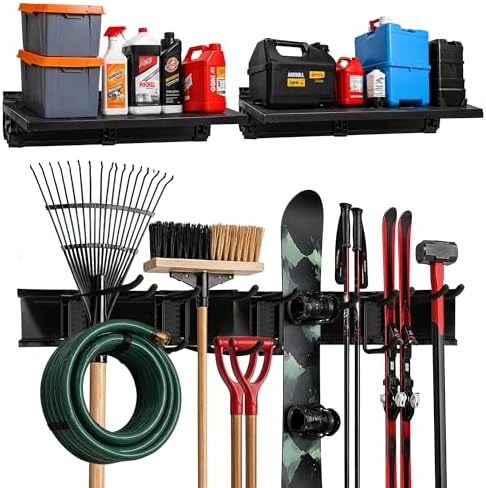
A 64 inch wall panel with two shelves and four double hooks is not a shelving unit in the load sense. It's a wall station, and it's the piece that fixes the mess you can't put in a tote: the trimmer, the hoses, the cords, the pry bars, the shop vac attachments that live on the floor until you trip over them. Double hooks mean each hook takes two items, one on each side, which doubles your hang points without doubling the hardware.
Mount it into studs. A ledger board screwed across the studs first gives you a continuous fastening surface and lets you place the panel exactly where you want it instead of where the framing says. Anchors into drywall alone will hold a broom and let go of a chainsaw. I've said this before and I'll keep saying it: find the studs or find a wall plan.
Plano 4-Shelf Plastic Storage Shelves
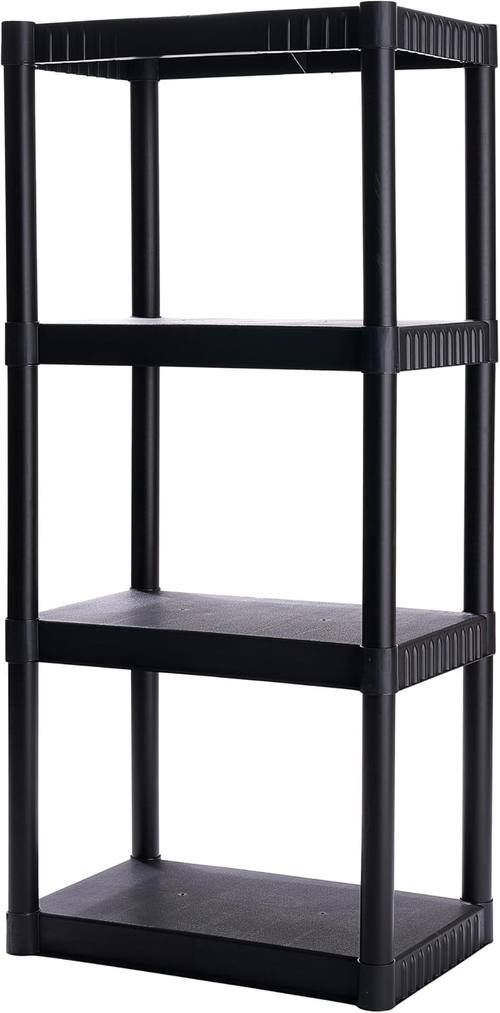
48 by 23 by 14 inches, four shelves, 200 pounds, and it goes together without a drill. Plastic shelving has its place: light stuff, high up. This is the unit for holiday bins, pool toys, empty coolers, and the 40 pounds of gift wrap nobody wants to talk about. It's also the one you can move by yourself and hose off in the driveway.
The moment you put a toolbox on it, you've made a bet. Plastic shelves take a set under a point load. Put a 60 pound tool chest in the middle of a 48 inch plastic shelf and by spring that shelf has a smile in it that doesn't come out. If you need to hold steel, buy steel or mount to the wall. That's not a knock on the Plano, it's a job description.
Should you buy the Jusgym 4 Pack Wall Mounted Garage Shelving?
Yes, if you have studs and you're willing to find them. Four 2x3 foot grid panels at a stated 1,400 pounds is the most useful shape in this group, because it takes the load off the floor and puts it on the wall where a garage has structure to spare. Plan the layout on paper first, mark the studs with tape, and check for wiring before you drill. Do that and this is the rack you stop thinking about, which is the highest compliment I can pay a shelf.
Should you buy the Sakugi 5-Tier Storage Shelves?
Yes, if your walls are finished, rented, or concrete and you don't want to drill. The leveling feet are what make it work on a sloped slab, and five tiers at 71.4 inches tall gets a serious pile of totes off the ground. Just respect what it is. There's no published weight number, so treat it as a medium-load rack, keep the heavy stuff on the bottom two shelves, and anchor the top to the wall if you have kids or a dog with a tail.
Should you buy the TIDYME Garage Tool Organizer Wall Mount?
Yes, if your problem is tools and cords rather than boxes. Two shelves and four double hooks on a 64 inch panel covers the long, awkward stuff that never fits a shelf, and it gets the trimmer off the floor where it belongs. Screw it into studs or a ledger board, not into drywall plugs, and it will outlast the tools hanging on it.
Should you buy the Plano 4-Shelf Plastic Storage Shelves?
Yes, for light and bulky. It's a 200 pound plastic unit and the easiest install in the group, and for bins, coolers, and seasonal gear it does the job for years. Keep it away from toolboxes. If you load it like a steel rack, you'll be buying a steel rack anyway, plus a new set of shelves.