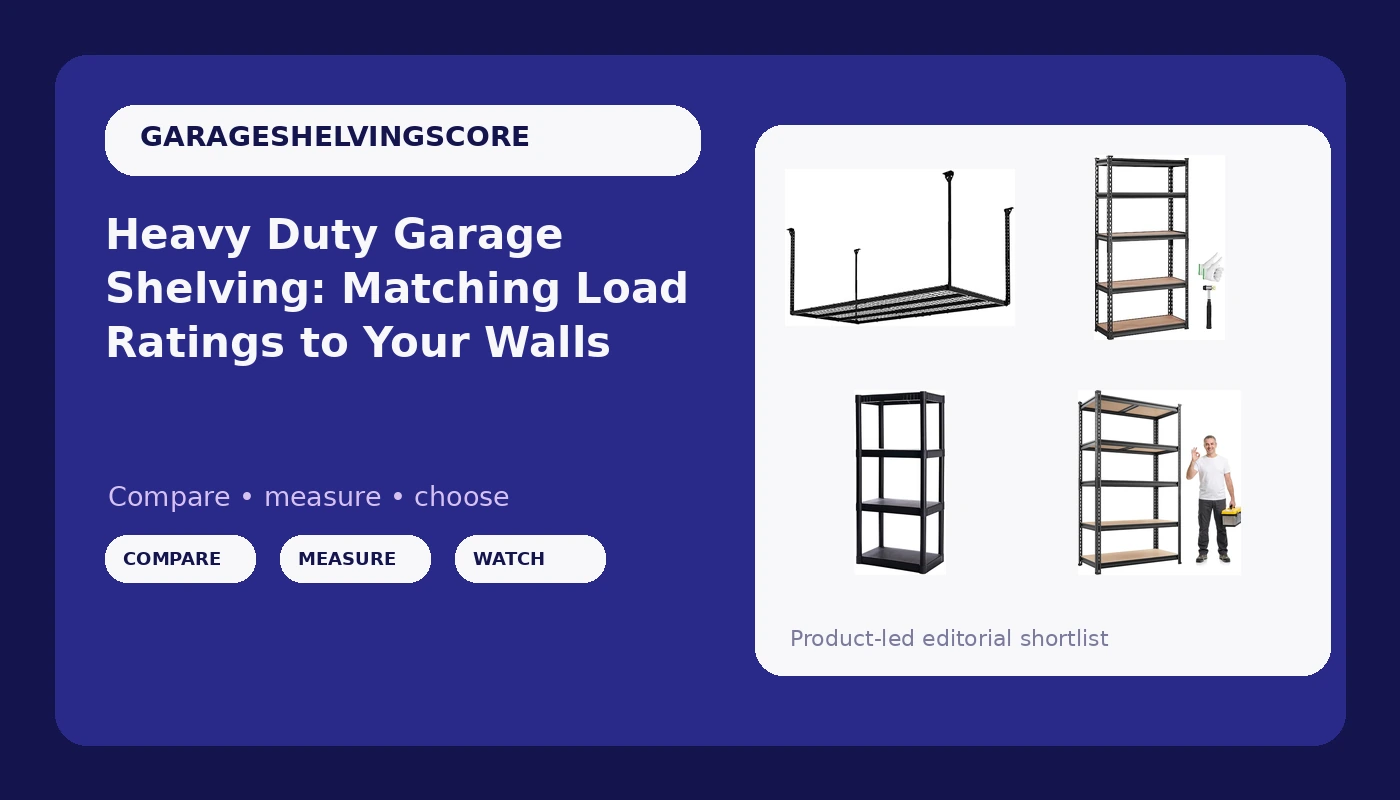
Every garage shelving failure I get called out to inspect has the same root cause, and it is almost never the shelf. It is the surface behind it. A load rating printed on a box describes a steel frame tested under controlled conditions. It says nothing about your drywall, your ceiling joists, or the fasteners that came in the bag. That gap is why two homeowners can buy the same heavy duty garage shelving unit and get completely different results: one holds a decade of holiday bins without complaint, the other folds a shelf and dents a car hood.
This explainer covers how garage shelving load ratings are actually established, which plane (floor, wall, or ceiling) suits which kind of load, and how four current units fit those roles. The goal is not to chase the biggest number on a label. It is to match the shelf to the structure you actually have.
Related: How to Find Studs in a Garage Wall Before You Drill →
Quick answer
Match the shelf to the mounting surface first, then to the load. Floor-standing steel units carry the most weight because the load path runs straight down into concrete. Ceiling-mounted shelves carry less per square foot but use space you are not otherwise using. Wall-mounted shelving depends entirely on hitting studs. Plastic shelving is for light, bulky items and does not belong in the same conversation as tool boxes, tile, or engine parts.
Four useful options
| Model | Best fit | What stands out |
|---|---|---|
| HyLoft 48-Inch by 96-Inch Super Pro Ceiling Mounted Shelf | Overhead storage above a parked car or a work zone | 2 foot by 8 foot platform, manufacturer rating up to 600 lbs, ceiling mounted |
| REIBII 2400LBS Garage Shelving, 36" W x 16" D x 72" H | Dense, heavy loads against a wall or in a basement | 72 inch height, 36 by 16 inch footprint, manufacturer rating of 2400 lbs |
| VEVOR Storage Shelves 5-Tier Adjustable 2000 lbs, 30" x 12" x 60" | Steel shelving where shelf spacing has to change | Five tiers, adjustable shelf heights, 2000 lb manufacturer rating |
| Plano 4-Shelf Plastic Storage Shelves, 48" x 23" x 14" | Light and bulky overflow, pantry and closet duty | Plastic construction, 200 lb capacity, listed as easy to assemble |
The overhead option: HyLoft 48-Inch by 96-Inch Super Pro Ceiling Mounted Shelf
The ceiling is the only free real estate in a garage, and this is the unit that claims it. Two things decide whether it works in your building. First, joist direction. If your ceiling joists run front to back and you want an 8 foot platform running side to side, the shelf will span across them, which is the orientation you want. Second, clearance. Measure from the ceiling down to the top of your car, your garage door in its raised position, and the door tracks and springs. A ceiling shelf that interferes with a moving door is a problem you find out about once. Plan the mounting so the platform lands on joists, not on the drywall between them, and add blocking if the spacing does not line up with the frame.
The heavy floor unit: REIBII 2400LBS Garage Shelving, 36" W x 16" D x 72" H
A floor unit like this is the closest thing to a guaranteed load path. The weight rides on the uprights and lands on concrete, so the wall is doing almost nothing except keeping the thing from tipping. That last part still matters. Garage floors slope toward the door, so shim or level the feet before you load it, and if the manufacturer provides a wall-anchoring bracket, put it into a stud rather than a drywall plug. A tall, narrow, heavily loaded shelf that is not restrained is a tipping hazard, not a storage solution.
The adjustable steel unit: VEVOR Storage Shelves 5-Tier Adjustable 2000 lbs, 30" x 12" x 60"
Adjustability is the feature people underestimate. A fixed shelf grid forces you to store what fits the grid. An adjustable one lets you set a tall gap for a cooler, a short gap for parts bins, and reconfigure it in October when the storage mix changes. The 12 inch depth is the other quiet advantage: it hugs a wall without eating into the parking space, which matters in a single bay garage where every inch of door swing is spoken for. As with any steel unit, distribute weight evenly across a shelf rather than stacking one dense pile in the middle.
The light duty plastic unit: Plano 4-Shelf Plastic Storage Shelves, 48" x 23" x 14"
Plastic shelving has a real place, and that place is light and high. Holiday totes, empty coolers, sports gear, seasonal decor: things that are bulky but not dense. Where it stops working is the moment a tool box, a case of oil, or a box of tile lands on it. The capacity figure tells you the same thing. Compare 200 pounds to the 2000 and 2400 pound ratings on the steel units and the division of labor becomes obvious. Put the plastic where the load is soft and the steel where the load is hard.
Prices and availability may change. Product images, names, and retailer links must be matched by verified ASIN. Do not state a current price, rating, stock status, or measured result without current evidence.
How garage shelving weight ratings actually work
A capacity number is a manufacturer figure produced under specific conditions, and those conditions are rarely spelled out on the box. Three things usually sit behind it.
The first is where the rating is measured. A frame can be rated at the upright or at the bracket rather than at the shelf surface itself, which means the shelf you actually pile stuff on may be the least supported part of the assembly.
The second is even distribution. Almost every rating assumes the load is spread across the shelf. A single 100 pound item sitting in the middle of a span puts more stress on that span than the same 100 pounds spread corner to corner. This is why a shelf rated for a large number can still bow under a modest but concentrated pile.
The third, and the one that decides the outcome in a real garage, is the mounting surface. The same wall bracket behaves differently in wood studs, metal studs, drywall alone, and concrete. Fasteners rated for one material are not rated for another. A rating assumes the shelf is attached correctly to a structure capable of carrying the load, and that assumption is doing an enormous amount of work.
Ceiling, floor, and wall: choosing the right plane
Each plane has a different job. The floor is the strongest because compression straight down into a slab is the simplest load path there is. It is also the most expensive space, because it is where the car, the mower, and the trash cans live.
The ceiling is the cheapest space and the most limited. Ceiling joists are typically spaced 16 or 24 inches on center, and they were sized for drywall and insulation, not for a 600 pound platform. The span between supports and the direction the joists run determine how much you can hang and in which orientation.
Walls sit in between and depend completely on studs. If you can hit studs at both ends of a run, a wall system carries serious weight. If you are fastening into drywall alone, you are hanging a decoration.
- Measure the space: width, depth, ceiling height, door swing, and the clear height you need above the car.
- Find the structure: use a stud finder, mark every stud, and confirm each mark with a small nail or a thin drill bit before committing.
- Match the load to the surface: dense items low and on the floor, bulky light items overhead, mid weight items on stud anchored walls.
- Plan the load path: keep heavy weight over uprights and near the wall, not out on the cantilevered edge of a shelf.
- Anchor, load, and recheck: use fasteners rated for the material, then re-tighten and inspect after the first full season of temperature swings.
Practical guidance for installation and loading
- Never hang anything heavy from drywall alone. Drywall plugs hold pictures, not shelving.
- Keep the heaviest items on the lowest shelf to lower the center of gravity and reduce tip risk.
- Leave clearance for garage door tracks, springs, and the raised door panel before you commit to a ceiling shelf location.
- Keep shelving shallow enough that you can reach the back of every shelf without unloading the front.
- Recheck fasteners and leveling after the first season. Wood shrinks, concrete settles, and bolts loosen.
Which option should you choose?
Choose the HyLoft 48-Inch by 96-Inch Super Pro Ceiling Mounted Shelf when your ceiling joists can take it and you need floor space back more than you need another wall unit. Choose the REIBII 2400LBS Garage Shelving, 36" W x 16" D x 72" H when you are storing genuinely heavy material against a wall or in a basement and want the load riding on concrete. Choose the VEVOR Storage Shelves 5-Tier Adjustable 2000 lbs, 30" x 12" x 60" when your storage mix changes and you need shelf heights that move with it. Choose the Plano 4-Shelf Plastic Storage Shelves, 48" x 23" x 14" when the load is light and bulky and a steel frame would be overkill.
One caveat before you order anything. Every capacity figure here comes from the manufacturer, not from a test performed on your wall. Verify joist direction, wall construction, and stud spacing in your own garage first. A shelf that matches your structure beats a shelf with a bigger number every time.
The bottom line
The rating on the box is the starting point, not the answer. Read it, then ask what it is attached to. Floor units with a straight load path to concrete handle the dense, heavy material. Ceiling platforms like the HyLoft buy back the floor at the cost of some ceiling clearance and a careful joist plan. Adjustable steel units such as the VEVOR adapt as your storage changes. Plastic shelving handles the light and bulky end of the job and should stay there. Get the surface right and almost any of these will do its job for years. Get it wrong and none of them will.