Related: How to Find Studs Behind a Finished Garage Wall
A garage shelf is a promise about weight. The manufacturer rates it in a lab, mounted perfectly into perfect framing. Your wall is not a lab. It is drywall over studs you have not met yet, in a building that swings fifty degrees between August and January. That is why I judge heavy duty garage shelving by where the load goes before I judge it by how much it claims to hold.
I have spent twenty years building and finishing garages, and the last eight of those years doing nothing but storage systems. I have installed hundreds of shelving units, from wire racks that came in a flat box to welded industrial racks that showed up on a pallet. I keep a tape measure in every pocket, and I keep a running list of which units survived a Kansas City winter without flaking, sagging, or pulling out of the wall. This comparison is that list, narrowed to four units.
Before you buy anything, answer three questions. What is behind the drywall where the unit will sit? How deep can the unit be before it eats the parking space? And what is the heaviest single thing that will ever land on a shelf? If you cannot answer all three, you are not ready to buy shelving. You are ready to buy a stud finder.
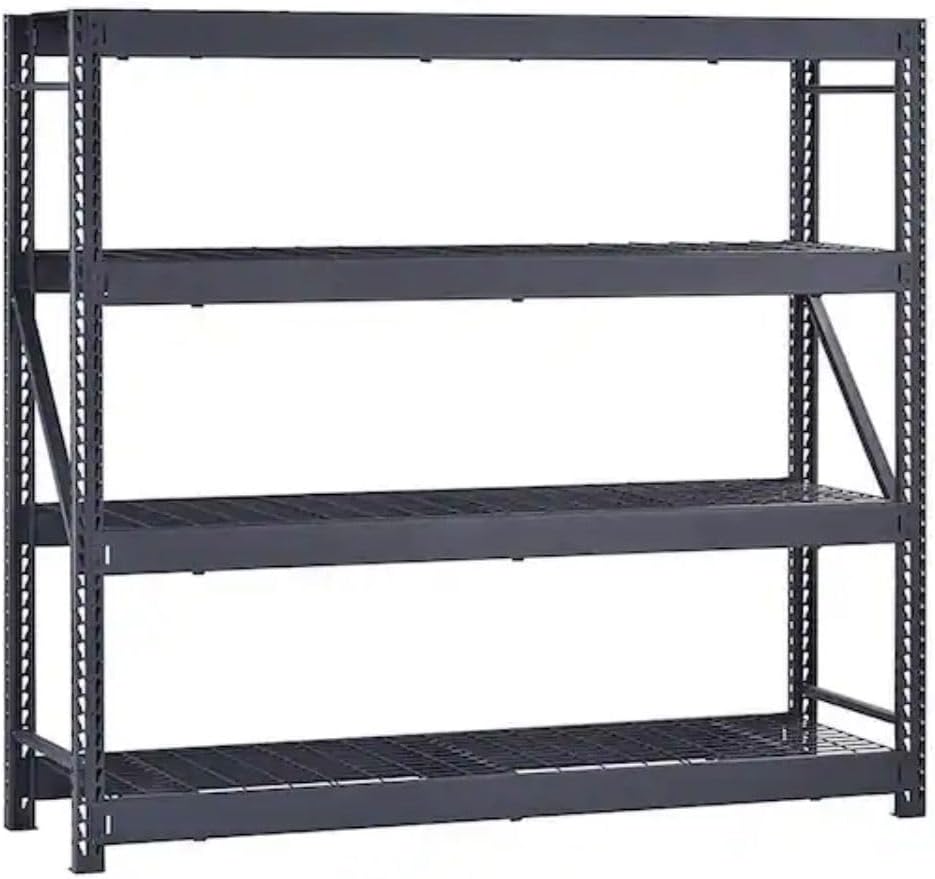
Best Overall: Husky Industrial Duty Steel Garage Shelving Unit
The Husky Industrial Duty Steel Garage Shelving Unit is the only unit in this group that publishes a capacity for every single shelf rather than for the whole rack. That matters more than most shoppers realize. A rack rated at 2,500 pounds across five shelves and a rack rated at 2,500 pounds per shelf are not the same product, and they are not built the same way.
What separates it is the welded frame. Bolted racks loosen. You tighten the bolts at install, you load the shelves, and six months later the whole thing has a wobble you can feel with one hand. Welded frames do not rack like that. The adjustable tiers move without the frame giving up its geometry, which is the whole reason you pay more for a unit like this.
This is a furniture-grade piece of garage infrastructure. It is also the unit I would install in a paying client's garage without a second thought, because I know what happens when you load it past the label and leave it. It is not a starter shelf. It is the shelf you buy when you are done replacing shelves.
Two honest caveats. The listing does not publish a height or a footprint, so measure your wall before you commit and confirm the dimensions with the seller. And a unit built like this is heavy enough that you want two people for the install, not because it is complicated but because lifting a welded frame over your head alone is how people get hurt.
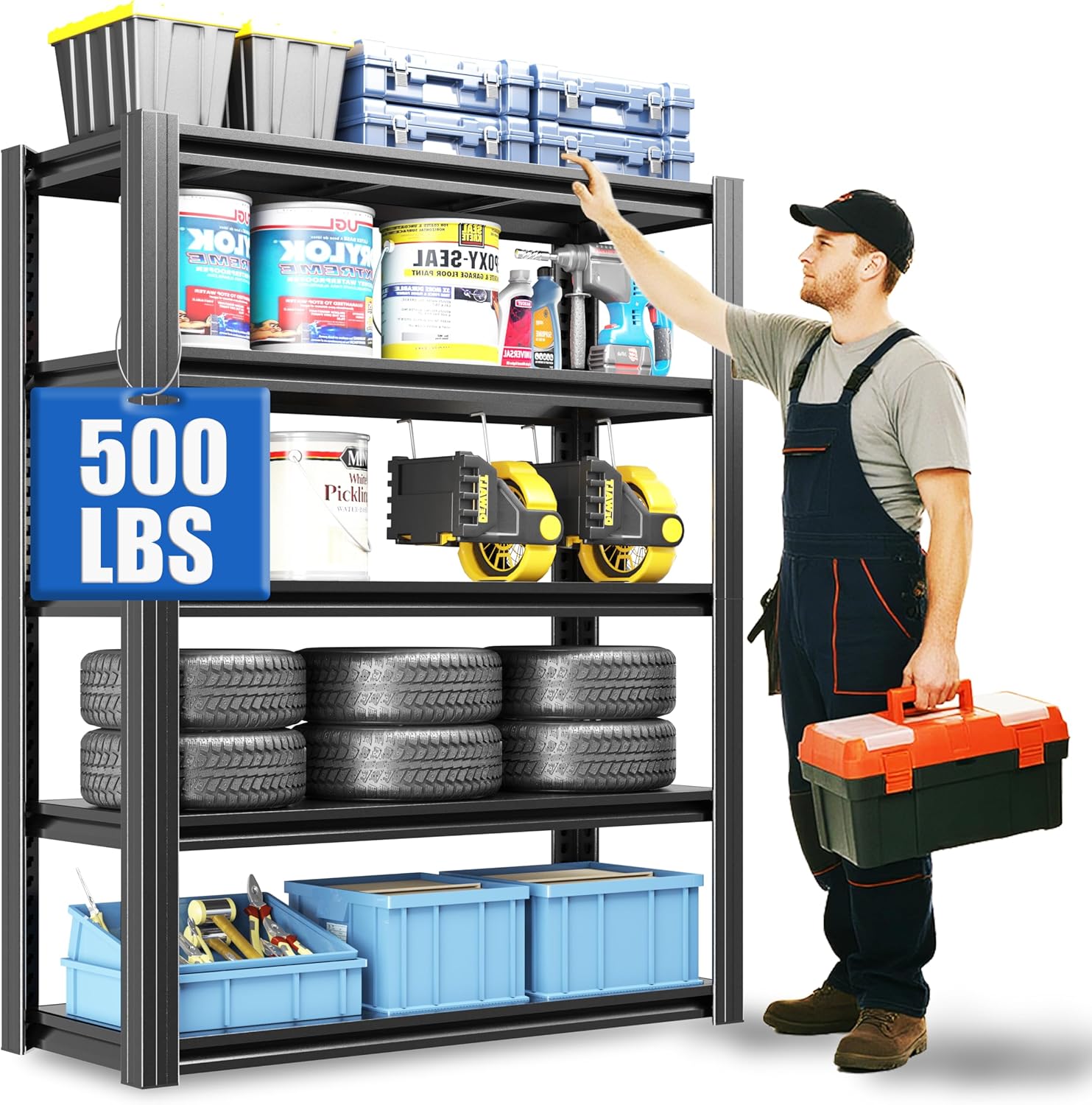
Best Value: 72" H Garage Shelving 2,500 LBS Heavy Duty 5-Tier
This is the unit I recommend to most people who ask me the question. Seventy-two inches tall, 35.4 inches wide, 15.7 inches deep, five tiers, adjustable. That is a serious amount of vertical storage for a footprint that still leaves you room to open a car door, and the depth is the number I care about most. Fifteen and a half inches takes a 27-gallon tote with room to spare and keeps the aisle clear.
The 2,500 pound figure in the listing is where you need to read carefully. Unlike the Husky unit, this listing does not break the number down shelf by shelf. That does not mean the rating is fake. It means you should not assume every tier holds the full figure. Load the bottom tiers heavy, keep the top tier for light and bulky, and anchor the unit to the wall. That is good practice on any rack, and it is non-negotiable on a five-tier unit that stands six feet tall.
Where this unit wins is value. You get height, tier count, and a real weight class for a fraction of what an industrial welded rack costs. If you are organizing a two-car garage for the first time and you do not know yet how you will use the space, this is the shelf that lets you find out without spending like it is permanent.
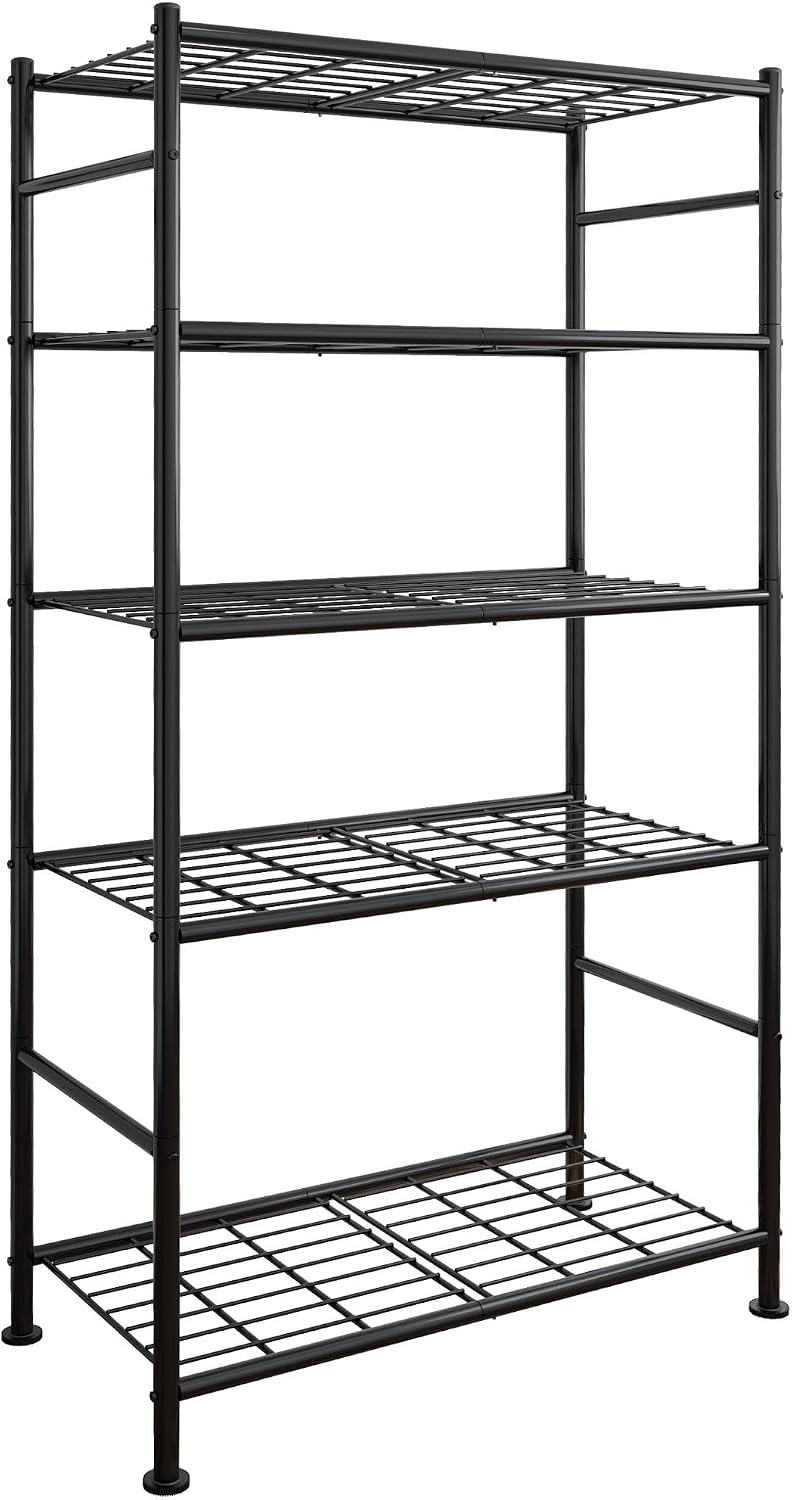
Best for Tight Walls: Sakugi Storage Shelves 5 Tier
Not every garage wall is a load wall. Sometimes you have a strip of wall beside a water heater, a nook behind a door, or a closet that needs shelves more than the garage does. The Sakugi Storage Shelves are built for that: 33 inches wide, 72 inches tall, and only 12.6 inches deep.
That depth is the feature. A 12.6 inch shelf slides into places a 15.7 inch rack will not, and it still holds the cans, jars, bins, and boxed goods that make up most of what people actually store. The leveling feet are the second feature, and if you have ever tried to shim a shelf on a sloped garage floor, you know why. Garage slabs drain. They are not level. Feet that adjust beat a stack of paint stirrers every time.
Be honest about the class of unit, though. This is a five-tier organizer with a heavy duty label, and the listing does not publish a per-shelf weight figure. It is a pantry and closet shelf that happens to live in a garage. Put cases of water and boxed goods on it and it will be fine for years. Put a loaded toolbox and a set of tires on it and you are asking a different question than the one it was designed to answer.
Best for Light Loads: Amazon Basics 4-Shelf Steel Wire Storage Shelves
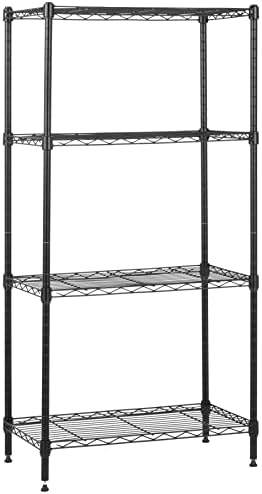
I will say the unpopular thing and then I will defend it. Wire shelving has a place. This unit is 23.2 inches wide, 13.4 inches deep, 48 inches tall, four shelves, rated at 200 pounds per shelf. That is a real rating from a real spec sheet, and for a narrow wall where you need to stack totes, paint cans, and small bins, it works.
The place it does not work is under point loads. Wire sags between the wires. A heavy toolbox concentrates its weight on two or three wires instead of spreading across a solid deck, and that is how a shelf develops a belly. The clips are the other weak point. They pop. Not always on day one, but eventually, and usually while you are loading the shelf.
So the rule is simple. Keep it under 200 pounds per shelf, mount it into studs, and put light stuff on it. I have a wire shelf in my own garage holding paint cans, and I have admitted that out loud more than once. It does the job. But I would not hang my heaviest storage on it, and neither should you.
How I test garage shelving
My test is the same for every unit, and it is not a lab test. I load the unit to its published rating. Then I double it. Then I leave it alone for a year and let a Kansas City winter do what it does.
That year matters more than the first afternoon. Cold contracts metal, heat expands it, and condensation finds every bare edge. Powder coat that looks flawless in October can start flaking by February. Clips that felt tight in July can loosen by the following spring. A shelf that holds its shape through a full seasonal cycle is a shelf I trust.
I also time the installs, because "DIY in an hour" is a claim I have never seen survive contact with a real garage wall. I check whether the unit can be assembled by one person with normal tools. I check whether the mounting hardware is actually hardware or a drywall plug wearing a costume. And I check whether the unit still sits flat after it is loaded, because a rack that twists under load is telling you something about its frame.
The last part of the test is not technical. Would I install it in a paying client's garage? If the answer is no, it does not get recommended here, no matter what the listing says.
Analysis and test results
Ranked by how the load path works, these four units fall into three tiers, and the tiers are set by construction, not by marketing.
The Husky unit sits alone at the top because of the welded frame and the per-shelf rating. When a manufacturer publishes capacity per shelf, they are telling you they tested per shelf. That is the kind of specificity I want to see before I put a client's tile saw on a rack.
The 72 inch five-tier unit is the value tier, and it earns that spot with dimensions rather than claims. A 72 inch height and a 35.4 by 15.7 inch footprint is a genuinely useful shape, and five adjustable tiers give you room to change your mind about how you store things. The single number to be careful with is the 2,500 pound figure, because the listing does not say per shelf. Treat it as a whole-unit ceiling until you know otherwise.
The Sakugi shelves and the Amazon Basics wire unit share the light-load tier for different reasons. The Sakugi is limited by depth and by a missing per-shelf figure, and it solves a space problem better than it solves a weight problem. The Amazon Basics unit publishes 200 pounds per shelf, which is honest and modest, and wire construction means you should stay well under it with anything heavy.
None of that makes the light units bad. It makes them specific. The most common mistake I see in garage organization is buying one shelf for every job. Buy the unit that matches the wall you have and the load you actually own.
Heavy duty garage shelving reference table
| Unit | Shelves | Footprint (W x D) | Height | Rated capacity | Where it belongs |
|---|---|---|---|---|---|
 Visit on Amazon → Visit on Amazon →Husky Industrial Duty Steel Garage Shelving Unit |
Adjustable tiers, count not published | Not published | Not published | 2,500 lbs per shelf | The anchor unit for the heaviest loads in the garage |
 Visit on Amazon → Visit on Amazon →72" H Garage Shelving 2,500 LBS Heavy Duty 5-Tier |
5, adjustable | 35.4" x 15.7" | 72" | 2,500 lbs, per-shelf breakdown not published | Full-height value pick for totes, tools, and shop gear |
 Visit on Amazon → Visit on Amazon →Sakugi Storage Shelves 5 Tier |
5 | 33.0" x 12.6" | 72" | Heavy duty, per-shelf figure not published | Narrow walls, pantry, closet, beside the water heater |
 Visit on Amazon → Visit on Amazon →Amazon Basics 4-Shelf Steel Wire Storage Shelves |
4, adjustable | 23.2" x 13.4" | 48" | 200 lbs per shelf | Light loads: totes, paint cans, small bins |
Every one of these units needs the same thing before it holds anything: a stud. Find the framing, anchor into it, and if the wall has no framing where you need it, add a ledger board or a wall plan. A shelf anchored into drywall alone is a shelf on a countdown.
Should you buy the Husky Industrial Duty Steel Garage Shelving Unit?
Yes, if the budget is there and the wall is real. A welded frame with a published per-shelf rating is the closest thing to a permanent answer in garage storage. It is the unit I would install for a client who told me she never wanted to think about her garage shelves again. Measure your wall first, because the listing does not publish dimensions, and bring a second set of hands for the lift.
Should you buy the 72 inch 2,500 pound 5-tier unit?
For most people, yes. It is the best combination of height, tier count, and price in this group, and 72 inches of vertical storage changes how a garage works. Just respect the ambiguity in the rating. The listing does not tell you what each shelf holds, so load from the bottom up, keep the top tier light, and anchor it to the studs. Do that and it will earn its spot for years.
Should you buy the Sakugi Storage Shelves?
Yes, if your problem is a narrow space rather than a heavy load. At 12.6 inches deep and 33 inches wide, it goes where a full-depth rack cannot, and the leveling feet solve a real problem on a sloped slab. Think of it as a pantry shelf with a garage address.
Should you buy the Amazon Basics wire shelves?
Only for light duty. Two hundred pounds per shelf is a legitimate rating, and at 48 inches tall it fits under a window or along a short wall. Wire sags under point loads and the clips are the failure point, so keep toolboxes and heavy equipment off it. Used within its limits and anchored into studs, it does an honest job. Used as a heavy duty rack, it is a bet you will lose.