Related: How to Find a Stud in a Finished Garage Wall
Most garage shelving gets bought in an aisle, off a picture on a box, based on one number printed in the corner. That number is the problem. Heavy duty garage shelving is rated in a lab, on a perfect wall, with perfect hardware, and your garage is not a lab. It has drywall over studs at 16 inches on center, a slab that slopes toward the door, and a Kansas City winter that swings forty degrees in a week.
I've been building and finishing garages for twenty years, eight of them focused almost entirely on storage systems: shelving, ceiling racks, wall panels, workbenches. I've hung racks, bolted units into block, and taken down shelving that somebody's brother-in-law anchored into drywall with plastic plugs. The four units below are the short list I keep coming back to, and they cover three different jobs: bulk storage on the floor, overhead storage on the ceiling, and the ladder that has been leaning in the corner since you moved in.
Two floor racks, one ceiling platform, one ladder rack. That's a garage that fits a car again.
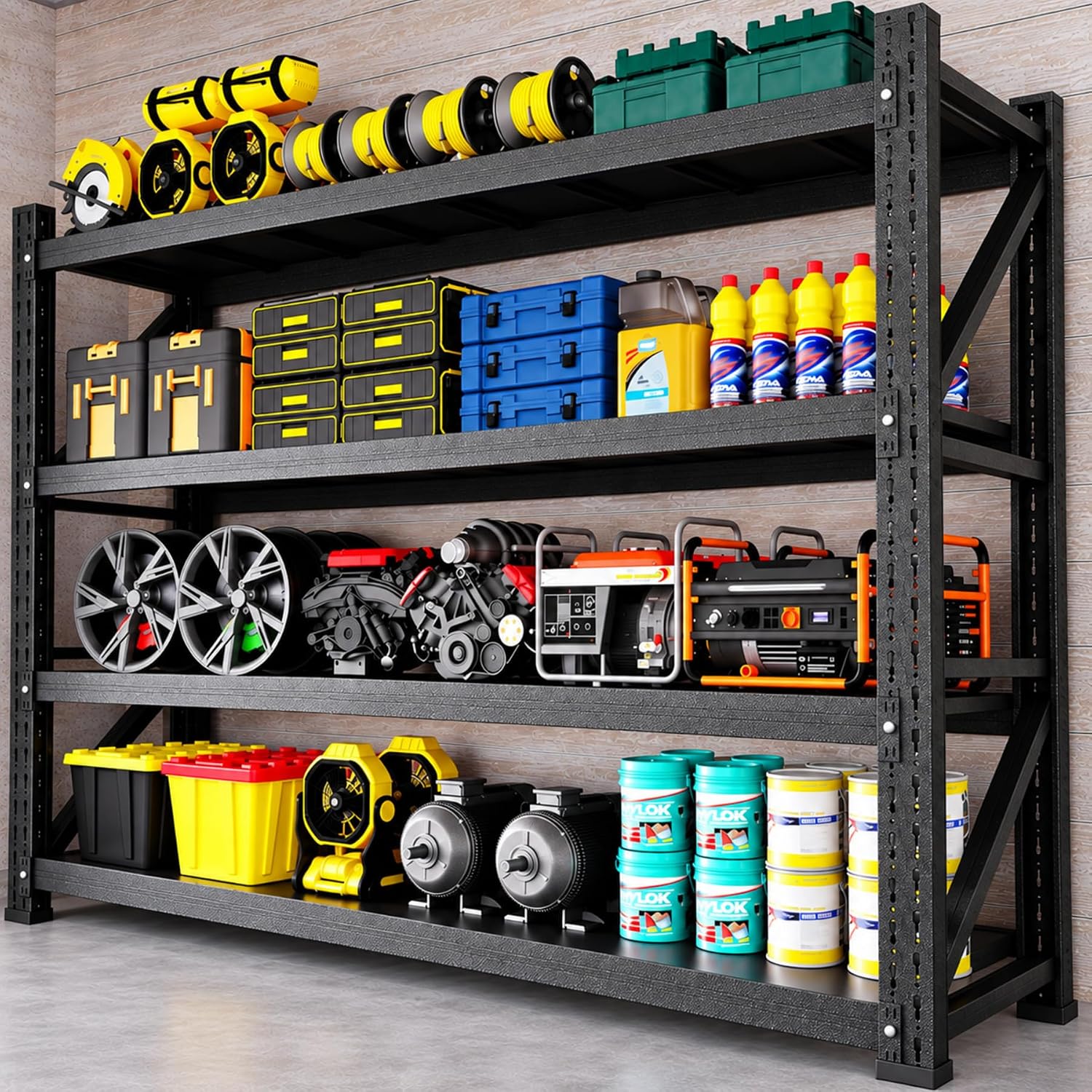
Best Overall Heavy Duty Rack: BYNSOE 4-Tier Steel Shelving Unit
This is the rack for the guy storing tile, engine parts, a decade of half-used paint, and the Christmas bins that weigh more than they should. It's 71 inches wide, 24 inches deep, and 69 inches tall, with four adjustable tiers, and it's rated for 5,000 pounds of capacity. Read that number the way it's written: that's the unit, not the shelf. Divide by four and you're still over a thousand pounds a tier, which is more than most homeowners will ever put on it.
The reason this one wins is the load path. Steel uprights carry the weight straight down to the slab, so nothing is hanging on your drywall and nothing is asking a joist to do work it wasn't sized for. Free-standing means you can put it anywhere, including against a wall with no studs behind it.
Two things I'd still do. Level it, because a rack that rocks will walk. And anchor the top to the wall, because a tall rack loaded heavy is a tipping risk, not a load risk. If you've got a back wall doing nothing, this is the unit that turns it into a warehouse aisle.
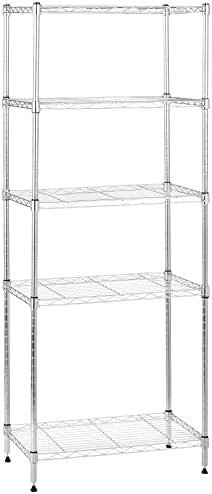
Best Value Wire Rack: Amazon Basics 5-Shelf Steel Wire Unit
I've said it before: wire shelving has a place, and that place is light stuff, high up. This is a 23.2 by 13.4 by 60 inch chrome unit with five adjustable shelves, rated 200 pounds per shelf, and it's the cheapest way to get a wall of totes off the floor.
The catch is the depth. 13.4 inches is shallow. A 27-gallon tote does not fit on this rack, and if you buy it expecting that, you'll be annoyed. What does fit is paint cans, shoe boxes, small parts bins, spray cans, bottled fluids, and the kind of clutter that multiplies on a workbench overnight. Put it over a bench or along a side wall, load it with the light stuff, and it earns its money.
Where it fails is the load. Wire shelves deflect. The wires take a set and the shelf sags, and the clips that hold the shelves to the posts are the weak point, not the steel. That's not a knock on this specific rack, it's the nature of the design. Keep it under its rating, keep it dry, and don't put a tool box on it.
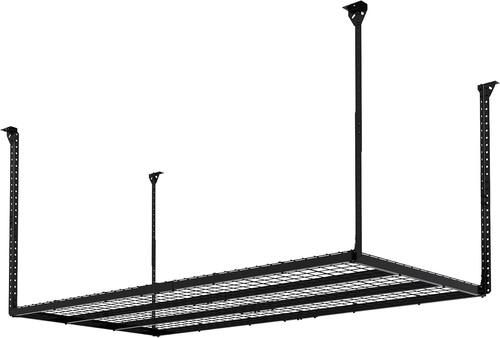
Best Ceiling Storage: HyLoft Super Pro Ceiling Mounted Shelf
Ceiling storage is the only free real estate in a garage. A 48 by 96 inch shelf is 32 square feet of it, hanging two feet down from the ceiling, rated to hold up to 600 pounds. That's the difference between a garage you park in and a garage you negotiate with.
This is the platform for the long, awkward, once-a-year stuff: the extension ladder you're not using, the kayak, the roof box, the camping gear, the folding tables, the artificial Christmas tree in a box taller than your kid. None of it belongs on the floor, and all of it fits up there.
Install is the whole story with a ceiling shelf. You're mounting into ceiling joists, and the shelf runs across them, so you need to know which way your joists run before you drill anything. Two people, a ladder each, and a stud finder. The hardware that ships with it is fine for wood joists. It is not fine for a finished ceiling over furring strips, and it is not fine for a steel-framed building. Check that first.
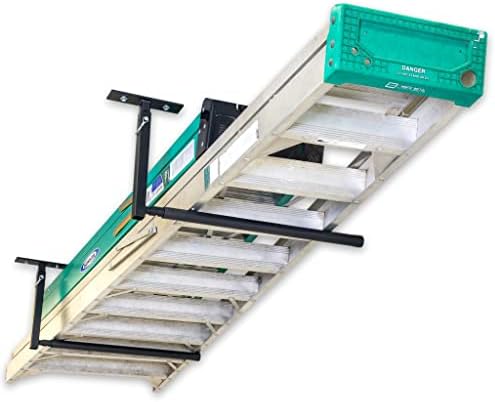
Best for Ladders: StoreYourBoard Adjustable Overhead Ladder Rack
A ladder lying on the floor eats eight to ten linear feet of wall, which in a two-car garage is the difference between a parking spot and a pile. This rack hangs from the ceiling, holds a step ladder and an extension ladder, and is rated for 75 pounds.
Seventy-five pounds is not a lot, and that's the point. This is a ladder rack, not a storage platform. It holds ladders. It will also hold a couple of long trim boards and a roll of wire, if you're honest about the weight.
The adjustment is what makes it worth buying over a pair of hooks. Ladders come in different lengths and thicknesses, and a rack you can slide to fit means you're not fighting it every time you put the ladder up. Mount it into joists, keep it near the garage door so the ladder lives where you use it, and get the floor back.
How I judge a garage shelving unit
Four things, in order.
The load path. Weight has to travel from the shelf, through the bracket or the post, into wood or concrete, and down. Anything that interrupts that path with drywall, a plastic plug, or a bracket that flexes is a failure waiting for a cold snap. If a unit hangs from the ceiling, the load is in tension on the fasteners, which is a different calculation than a floor rack standing on a slab.
The mounting hardware. "Wall anchor included" usually means a drywall plug, and a drywall plug is not an anchor. It's a placeholder. I want lag bolts or structural screws into studs, and I want to know the wall type before I promise anybody anything. That's the same reason I won't quote a ceiling storage layout without seeing the joists.
Temperature and moisture. A garage in the Midwest sees everything: triple digits in August, single digits in January, condensation on cold steel in March. Powder coat that flakes through one winter tells you what the welds will look like in five years.
The veto test. The best storage system is the one your spouse doesn't hate. A garage that is technically organized but impossible to walk through gets torn out. I've watched it happen more than once.
What the load ratings actually mean
Three things get confused constantly.
Total capacity versus per-shelf capacity. A 5,000-pound rack is not a 5,000-pound shelf. A 200-pounds-per-shelf wire unit is 200 pounds per shelf, evenly distributed, on a level floor, with the shelf clips fully seated. Nobody loads anything evenly.
Lab conditions versus your garage. Ratings get measured at the bracket, in a controlled setup, with hardware that's new and tight. Your garage has a sloped slab, a wall that may or may not have studs where you want them, and hardware that a previous owner already stripped.
Hanging loads versus standing loads. A ceiling rack pulls down on fasteners in tension, which is why a 600-pound ceiling shelf and a 600-pound floor rack are not the same product. The ceiling rack depends entirely on the joists and the fasteners. Get that wrong and the rating is fiction.
So here's my rule: take what the unit is rated for, cut it in half in your head, and load it to that. If it's still standing after a year of real life, it's a good product. That's the contractor test.
The short list in one table
Ratings and mounting are the manufacturer's. The mounting column is what I'd use in a typical garage with drywall over 2x4 studs at 16 inches on center.
| Unit | Type | Rated capacity | Mounting | Price |
|---|---|---|---|---|
 Visit on Amazon → BYNSOE Heavy Duty Shelving Unit |
4-tier steel, free standing | 5,000 lbs total | Slab, anchor top to wall | $184.99 |
 Visit on Amazon → Amazon Basics 5-Shelf Wire Unit |
Wire, 5 shelves | 200 lbs per shelf | Free standing or wall | $45.89 |
 Visit on Amazon → HyLoft Super Pro Ceiling Shelf |
Ceiling platform, 2 ft x 8 ft | 600 lbs | Ceiling joists, lag bolts | Visit on Amazon → |
 Visit on Amazon → StoreYourBoard Overhead Ladder Rack |
Ceiling ladder rack | 75 lbs | Ceiling joists | $64.99 |
Should you buy the HyLoft Super Pro ceiling shelf?
If you can reach your ceiling joists and your floor is losing the war, yes. It's 32 square feet of storage that never touches a parking space, it's rated for 600 pounds, and it's a two-person afternoon. The reason to buy this one instead of a wire ceiling rack is the platform. A flat 2-by-8 deck holds a kayak, a roof box, and boxes that don't stack. Wire doesn't.
What I'd check first: joist direction, ceiling height, and whether the garage door tracks and opener leave you the room. If the opener sits in the middle of the ceiling, you've got two bays on either side of it, and that's usually plenty.
Should you buy the BYNSOE heavy duty rack?
Yes, if you store heavy and you're tired of pretending a wire shelf can take it. Four adjustable tiers, 5,000 pounds of rated capacity, and a load path that ends on concrete instead of drywall. This is the rack I'd put in a client's garage for tile, engines, and bulk goods.
Skip it if you need something shallow, movable, or cheap. It's a permanent piece of furniture with a real footprint. Measure the wall, measure the depth of your biggest tote, and make sure you can still open the car door.
For everything in between, the wire unit handles the light stuff and the ladder rack gets the ladder off the floor. Floor, wall, ceiling. That's the whole system, and it's the one your spouse won't veto.