Related: Garage Ceiling Storage: What Your Joists Will Actually Hold
I have hung shelving in Kansas City garages for twenty years, and the conversation almost always starts the same way. Somebody wants their car back. The floor is buried in totes, the totes are buried in dust, and the wall above the workbench is doing nothing at all. The answer is almost never more cabinets. The answer is heavy duty garage shelving that can take a real load in a footprint that still leaves the car a place to park.
Here is the problem with shelving listings. The weight rating is the first number you read and the last number you should trust. A 2,000-pound rating means somebody loaded that unit on a flat floor with the weight spread evenly across every shelf. Your garage is not a lab. Your slab slopes toward the door. Your real load is four paint cans on one shelf and nothing on the other four. The rating is a starting point, not a promise.
So I size up any steel rack on four things: the footprint, the shelf count and spacing, how the shelves connect to the uprights, and whether the feet can be leveled. Everything below is measured against those four. The range runs from a narrow pantry-height column to a 3,000-pound industrial unit, and the right pick depends less on the number on the box than on the wall you are bolting it to.
Best Overall: VEVOR 5-Tier Adjustable Shelving Unit
If you only read one section, read this one. A 48-inch wide, 18-inch deep, 72-inch tall unit is the size I end up recommending more than any other, because it fits the wall above a workbench and still holds a serious stack of totes. The 2,000-pound rating across five tiers works out to about 400 pounds per shelf if you load it evenly, and that is more than most homeowners will ever put on a shelf.
The adjustable shelves matter more than people expect. You do not want five shelves spaced the way the factory decided. You want one tall gap for a shop vac and four tight gaps for bins. Adjustability is what turns a rack into a system instead of a piece of furniture you work around.
The 18-inch depth is the other thing I like. At 18 inches you can still walk past it in a two-car garage. Push much deeper and the unit starts eating the aisle, which is the space you actually need to open a car door. This is the unit I would put in a client's garage first.
Highest Capacity: 3000 lb Industrial Utility Rack
This is the one for tile, concrete mix, engine blocks, and anything else that scares a normal shelf. It carries a 3,000-pound rating across five tiers, which is roughly 600 pounds per shelf when the load is spread out. It is also the deepest unit here at 23.6 inches, and that depth is the whole point. Deep shelves hold deep things: coolers, parts washers, stacked lumber, the bins nobody wants to lift twice.
The trade is floor space. At 47.2 inches wide and nearly 24 inches deep, this is not a wall-hugger. It wants a dedicated bay, a corner, a spot where nothing else fits. If you have that spot and you need to stack heavy material, this unit earns its footprint.
The 72-inch height keeps it under most garage ceiling obstructions, which matters if you have a door track running along that wall. Measure the track before you buy. I have watched people buy a 72-inch rack, get it home, and find the door track sitting at 70.
Best for Narrow Walls: Sakugi 5-Tier Shelf Organizer
At 33 inches wide and 12.6 inches deep, this is the shallowest unit in the group, and that is its job. It goes where nothing else will: beside a water heater, along the wall behind a parked car, in the narrow strip between the garage door and the corner. Those strips are dead space in most garages, and dead space is where storage should go.
It has leveling feet, which is more useful than it sounds, because garage slabs are rarely flat. Leveling feet let you take the wobble out without shimming with scrap wood. A wobbling rack is a rack that walks, and a rack that walks eventually falls.
The listing does not publish a load rating, so I treat this as a light-to-medium duty rack. It is also the unit I would put in a pantry, a laundry room, or a closet. The 72-inch height and 12.6-inch depth make it a storage column more than a storage wall. If your garage has one awkward narrow slot, this fills it.
Best for Covering a Wall: Sakugi 2-Pack
Two 33.5 by 12.6 by 72-inch steel units in one order. This is how you turn a bare wall into a wall of storage in one purchase instead of two, and buying the pair usually beats buying singles.
Two narrow racks side by side give you roughly 67 inches of linear shelf space per tier. That is often more usable than one 48-inch wide rack, because you can keep a gap in the middle for hanging a broom or parking a ladder. Narrow units also move easier when your layout changes, and in a garage, your layout will change.
Same caveat as the single: the listing does not publish a load rating. Plan on totes, tools, and holiday bins rather than engine parts, and anchor both units into studs.
How I judge a shelving unit
The load path. Weight has to travel from the shelf, into the upright, into the foot, into the floor. Anywhere that path breaks, you have a problem. Look at how the shelf sits on the upright. If it rests on a couple of tabs and a prayer, keep it light.
The wall. Shelving this tall should be anchored. Not because the unit is weak, but because a tall rack is a lever, and a kid, a dog, or a car door can tip it. Anchor into studs. Find them with a stud finder before you drill anything. A drywall plug is not an anchor, no matter what the little bag says.
The floor. Garage slabs slope. Leveling feet solve it. If your unit does not have them, you shim, and shims fall out. Check the feet before you buy, not after.
The temperature swings. A Kansas City garage goes from below freezing in January to triple digits in August. That cycle works on powder coat and on cheap hardware. If the finish flakes by spring, the metal underneath starts to rust. The coating is the first thing to fail, long before a weld does.
The hardware. Bolts that strip before they are tight are a real thing. Sort the fasteners before you start, and do not overtighten. Snug is enough on most shelving, and snug is what keeps the uprights square.
Analysis and comparison
Run the footprint math before you buy. The VEVOR gives you 48 by 18 inches of shelf, or 864 square inches per tier. The industrial rack gives you 47.2 by 23.6, about 1,114 square inches per tier, the most surface area of the group. The Sakugi single gives you 33 by 12.6, about 416 square inches per tier, and the pair doubles that.
Capacity per shelf is the number that matters day to day. The 2,000-pound rating spread across five shelves is about 400 pounds each. The 3,000-pound rack is about 600 pounds each. Neither number is a per-shelf limit you should chase. Ratings are for the whole unit with the load spread. Put 600 pounds on one shelf of a five-shelf unit and you have made a bet, and the shelf usually loses.
The Sakugi units do not publish a rating, so I would not stack a transmission on them. I would stack totes, and I would do it happily, because the shallow depth means they fit places the big racks cannot go.
Depth is the spec nobody reads and everybody regrets. Eighteen inches is the practical middle. Twenty-four inches holds more but eats aisle. Twelve inches fits anywhere but holds less. Pick the depth for the wall you have, not the capacity you imagine you need. A rack that fits gets used. A rack that blocks the car gets resented.
Reference table
| Shelving unit | Footprint (W x D x H) | Rated capacity | Tiers | Best for |
|---|---|---|---|---|
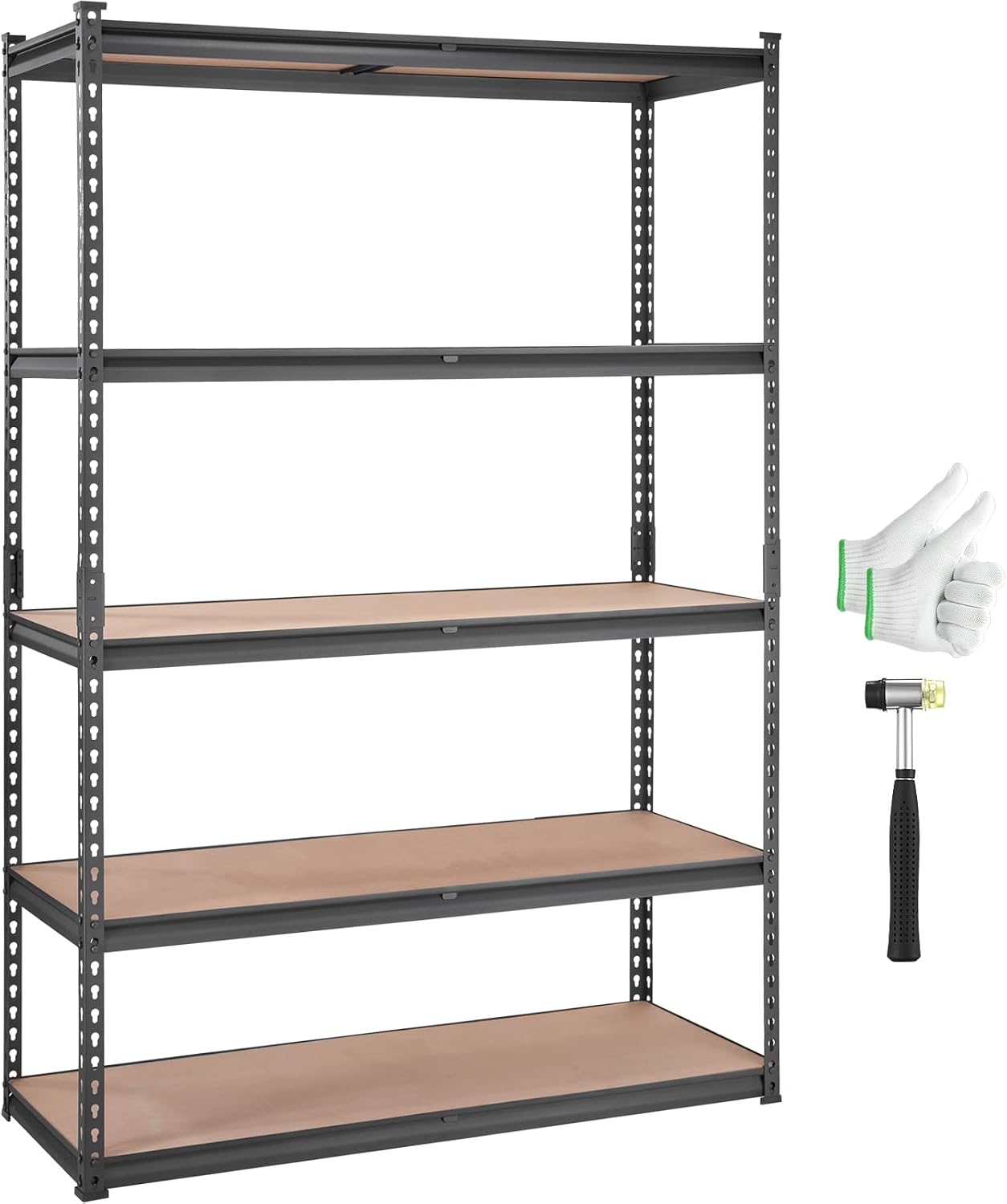 Visit on Amazon → Visit on Amazon →VEVOR 5-Tier Adjustable Shelving Unit |
48 x 18 x 72 in | 2,000 lbs | 5 | All-purpose garage wall |
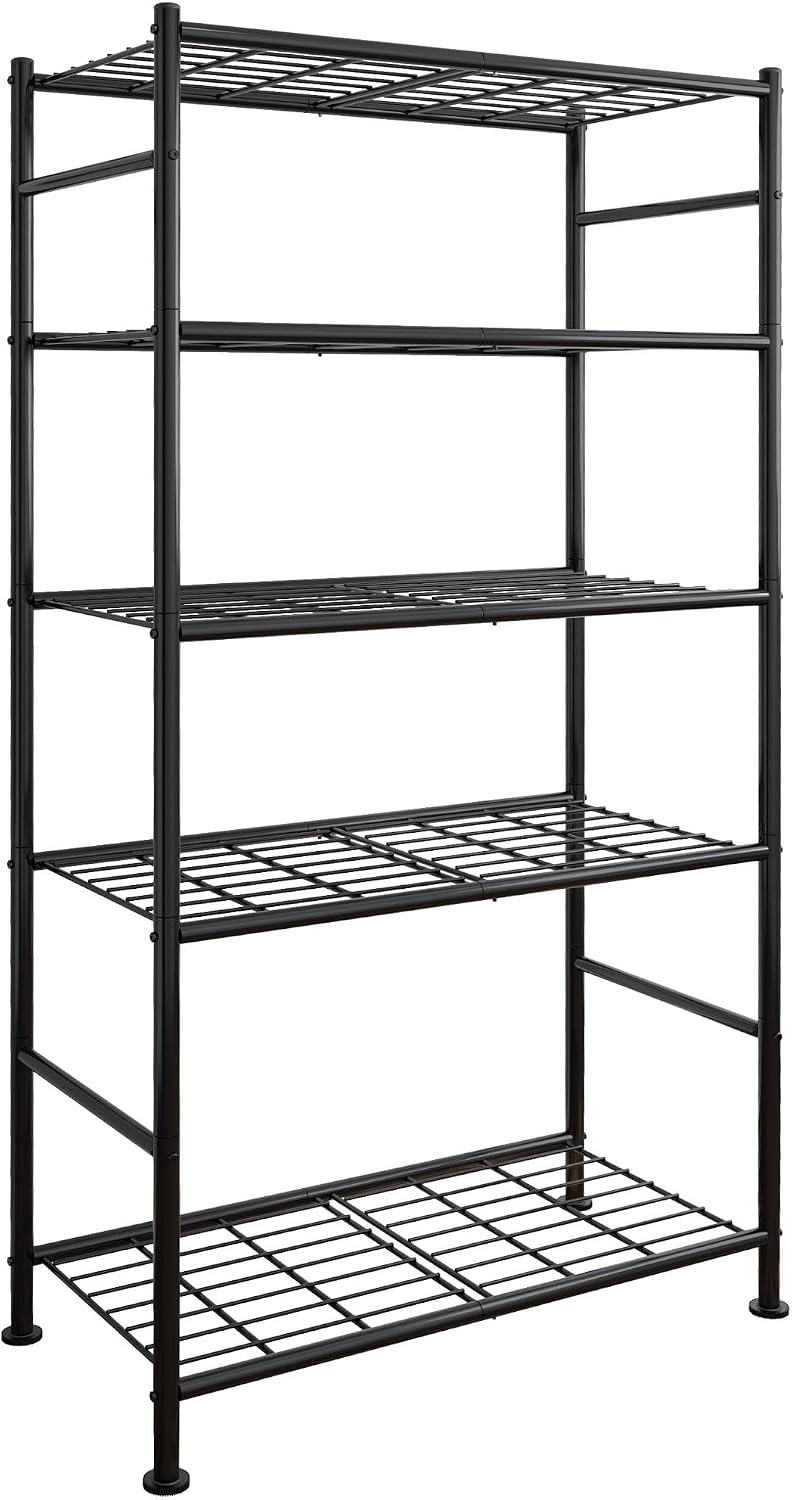 Visit on Amazon → Visit on Amazon →Sakugi 5-Tier Shelf Organizer |
33.0 x 12.6 x 72.0 in | Not published | 5 | Narrow gaps and closets |
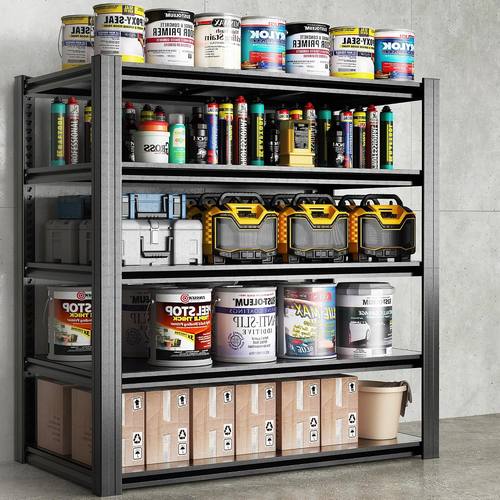 Visit on Amazon → Visit on Amazon →3000 lb Industrial Utility Rack |
47.2 x 23.6 x 72 in | 3,000 lbs | 5 | Heavy material, deep loads |
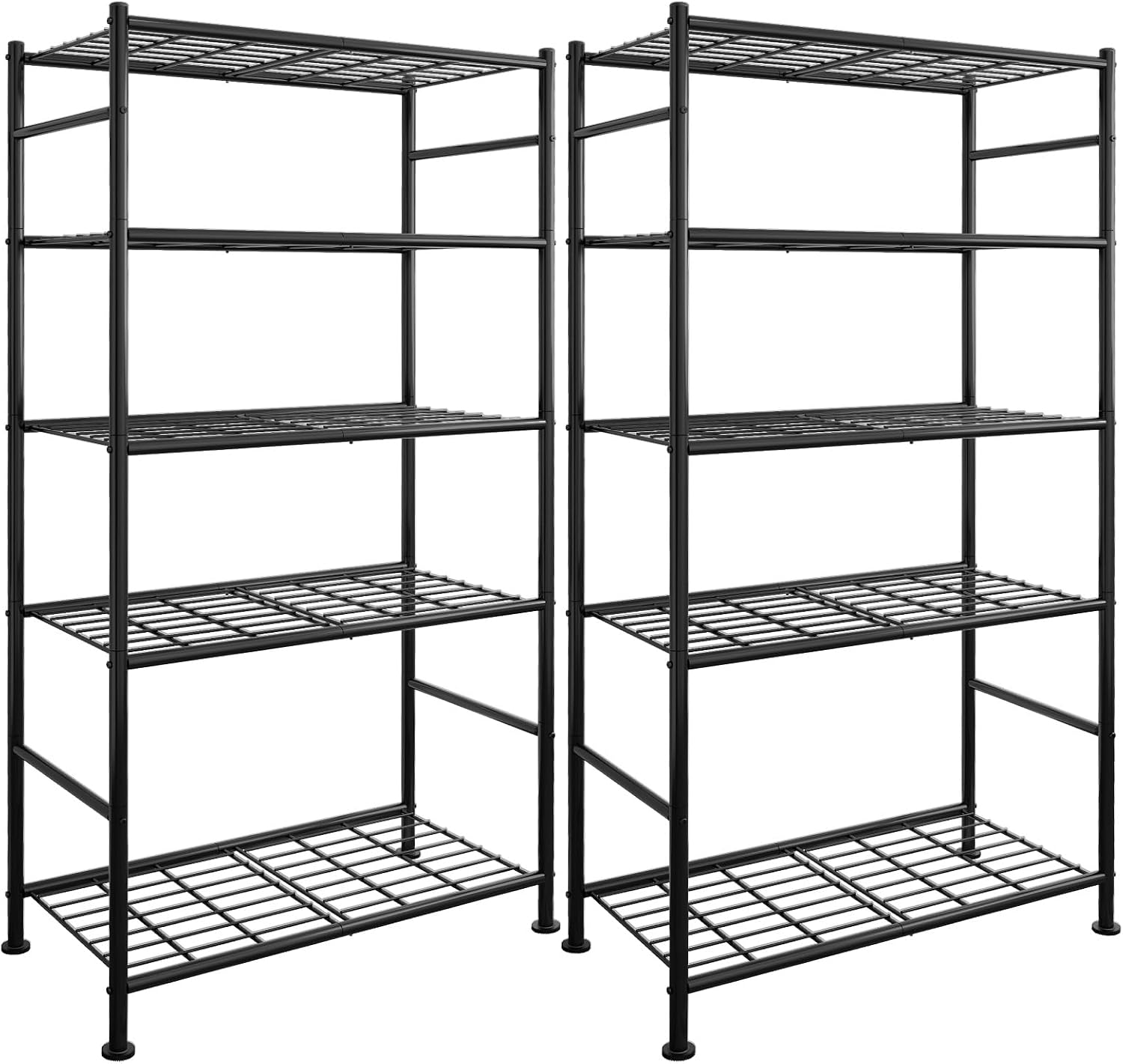 Visit on Amazon → Visit on Amazon →Sakugi 2-Pack Steel Shelves |
33.5 x 12.6 x 72 in (each) | Not published | 5 | Covering a full wall |
The pattern is simple. Wide and deep holds more. Narrow and shallow fits more places. Capacity ratings tell you what the unit will take in ideal conditions, and footprint tells you what it will take in your garage, which is the number that decides whether the car fits.
Should you buy the VEVOR 5-Tier?
Yes, for most garages. The 48 by 18 by 72 size is the sweet spot, the 2,000-pound rating covers real household loads, and the adjustable shelves let you build the gaps your stuff actually needs. Anchor it into studs and keep the load spread. Check current Amazon price.
Should you buy the 3000 lb Industrial Utility Rack?
Yes, if you are storing material, not memories. Tile, mix, tools, and engine parts belong on this one. It is deep and wide, so measure the bay and the door track first. Check current Amazon price.
Should you buy the Sakugi 5-Tier?
Yes, if your problem is a narrow slot rather than a bare wall. Leveling feet and a 12.6-inch depth make it the best fit for tight spaces, and it works just as well in a pantry or closet. Keep the load light, since no rating is published. Check current Amazon price.
Should you buy the Sakugi 2-Pack?
Yes, if you want to cover a wall in one order. Two narrow racks beat one wide rack for flexibility, and the pair is the better value of the two Sakugi options. Plan on totes and tools. Check current Amazon price.