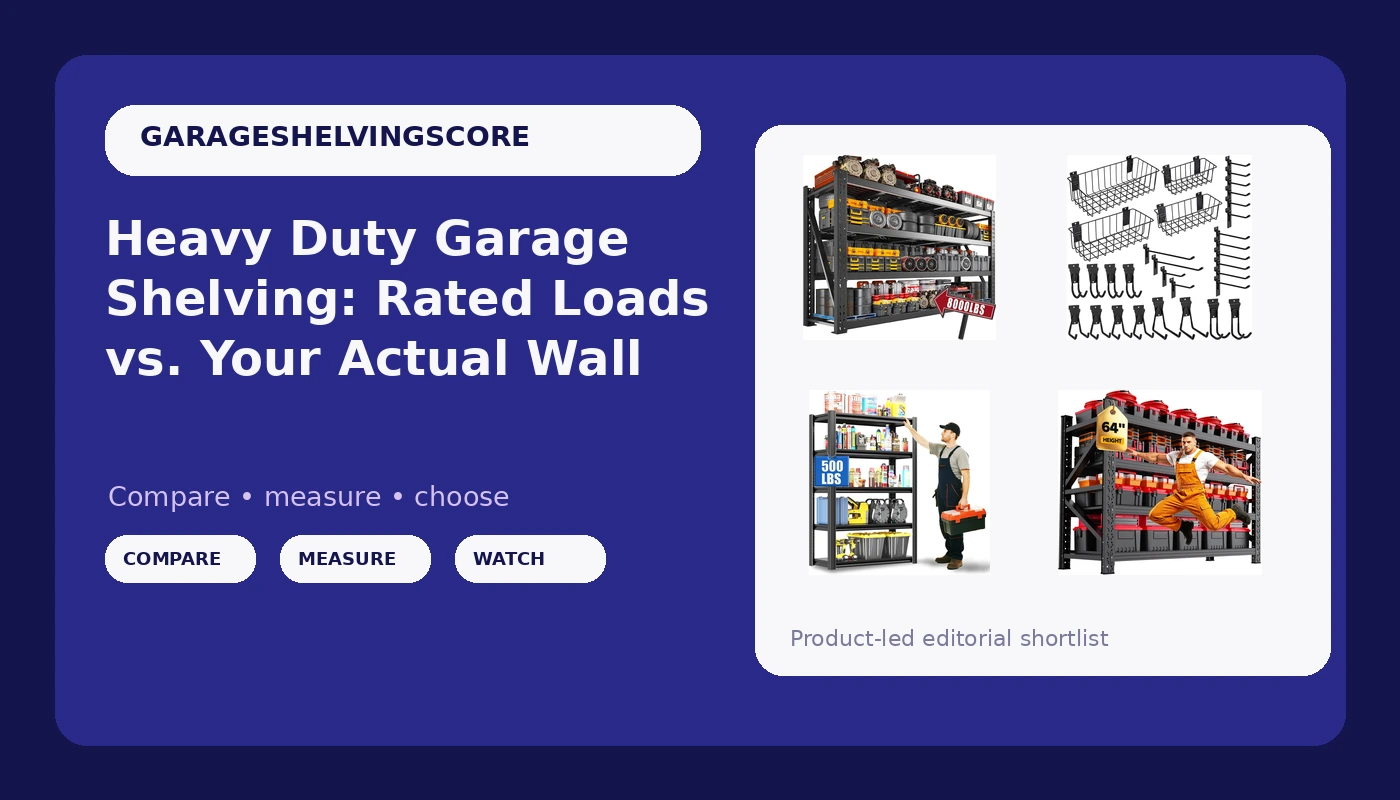
Heavy duty garage shelving usually gets bought in the wrong order. Most people pick the unit first and look at the wall second. It works better the other way around: measure the span you need, figure out what is behind the drywall, and then choose a rack whose listed capacity and footprint fit what the wall can realistically carry. The products below cover the shapes that show up most often in a two-car garage. Two are wide, four-post style units, one is a narrow five-tier stacker, and one is a slatwall accessory kit for the small things that never seem to fit on a shelf. What follows is how to tell them apart without guessing, and without buying a unit twice.
Related: Garage Wall Storage: Slatwall vs. Rail vs. Pegboard →
Quick answer
Match the rack to the wall before you match it to the budget. On a wall you can anchor into studs or concrete, a wide unit with a high listed capacity gives you the most usable storage per square foot of floor. In a tight footprint, a narrow five-tier unit stacks more vertically and steals less parking space. For hand tools, cords, and loose parts, a slatwall basket and hook kit only makes sense if a slatwall panel is already mounted, because the kit is an accessory, not a system.
Four useful options
| Model | Best fit | What stands out |
|---|---|---|
| Bepatio 8000LBS Heavy Duty Garage Shelving | Wide, heavy loads on a long wall | 77 inch width and the highest listed capacity in this group |
| 69" W Storage Shelves, 4T Adjustable Garage Shelving Unit | A deep, adjustable run against one wall | 69 inch width, 24 inch depth, adjustable shelf positions |
| 60" H Heavy Duty Garage Shelving 3000LBS | Narrow gaps and tight footprints | Five tiers in a 27.5 inch wide, 12 inch deep frame |
| Heavy-Duty Slatwall Baskets and Hooks | Small parts, hand tools, cords | Fits standard slatwall panels you already have |
The wide heavy-duty frame: Bepatio 8000LBS Heavy Duty Garage Shelving
A listed capacity is a starting point, not a guarantee. A rack in this class only performs at its number when the load path runs from the shelf, through the uprights, into a base, and into a wall or floor that can absorb it. On a stud wall, that means lagging into studs, not into drywall plugs. On concrete, it means the right masonry anchor for the wall condition. If the unit is freestanding with no wall attachment, the floor plates and the bracing carry everything, and a tall, wide frame loaded top-heavy is a tipping risk. Plan the anchor before you plan the load.
The adjustable wide unit: 69" W Storage Shelves, 4T Adjustable Garage Shelving Unit
Depth cuts both ways. A 24 inch deep unit holds more per shelf, but it also sticks 24 inches into the garage, which matters if the shelving sits beside a parking space or a door swing. Before ordering, park the car where it lives, open both doors, and mark the floor. If you have the room, the deep unit wins on volume. If you are squeezing along a wall, the extra depth is the first thing that will annoy you. Adjustment is the other factor: shelf positions you can move are worth paying for, because garages change, and a fixed shelf height that fits nothing is just a shelf you work around.
The narrow five-tier stacker: 60" H Heavy Duty Garage Shelving 3000LBS
Height is where a tall, narrow unit earns its keep and also where it gets dangerous. Stacked heavy, a 60 inch tower with a small base has less resistance to tipping than a wide frame, so either anchor it to a stud or reserve the upper tiers for light goods: paint, filters, boxed supplies, seasonal items. A 12 inch deep shelf also means you are storing in single file, so this is a parts and supplies unit, not a place for a miter saw. Run the same wall check you would run on a wide unit. Narrow does not mean less anchored.
The wall-accessory kit: Heavy-Duty Slatwall Baskets and Hooks
The trap with slatwall accessories is buying them before the panel. This kit hangs on a standard slatwall system you already own, so if the wall is bare, the order is wrong: panel first, then the hardware that fits it. Check the groove spacing on your existing panel before adding anything, because not every panel uses the same standard, and a basket that will not seat is not a bargain. Once the panel is up, though, this is the layer that keeps the shelves from filling with things that should be hanging.
Prices and availability may change. Product images, names, and retailer links must be matched by verified ASIN. Do not state a current price, rating, stock status, or measured result without current evidence.
How a listed load rating is actually written
Manufacturers usually rate a shelving unit at the strongest point in the assembly, often the upright, the bracket, or the beam, under ideal conditions: even loading, flat floor, correct fasteners, straight wall. Your garage is not that. Loads are lopsided. The floor slopes toward the door. The wall has a bow in it. A rating is a ceiling for the product in a lab, and a starting point for you. Practical rules that hold up across brands: cut the listed number hard for a particleboard or thin-gauge unit, treat per-shelf limits as more important than the unit total when you are loading one heavy item, and remember that deflection, not failure, is what usually makes a shelf useless first. A shelf that has sagged two inches is still technically holding, and still unusable.
Wall type picks the anchor, not the shelf
The same rack on two different walls is two different products. Stud walls at 16 or 24 inches on center give you reliable structure to lag into, and a stud finder plus a pencil is the whole job. Drywall alone holds almost nothing in shear or pull-out, which is why an included drywall plug is not an anchor plan for a loaded rack. Concrete and block walls need masonry anchors sized to the material, and block needs different hardware than poured concrete. Slatwall is a fourth case: the panel itself has to be fastened into structure before it carries a basket of tools. Whatever the wall, the sequence is the same, find structure, fasten into structure, then load.
How to size a shelving run in five steps
- Measure the wall span you want to cover and subtract clearance for doors, outlets, and the garage door track.
- Find the studs and mark them at the height where the top of the unit will sit, then confirm the wall type for anything that is not wood framing.
- Add up what you actually plan to store, by weight, not by volume, and compare that total to the listed capacity with margin left over.
- Pick the footprint: wide and shallow along a long wall, deep in a corner, narrow and tall in a gap.
- Load from the bottom up, heaviest items on the lowest tiers, and anchor the unit before it carries anything.
Installation and layout notes that matter more than the label
- Anchor into studs or masonry for any unit over waist height, even if the listing shows it standing free.
- Keep the heaviest loads on the lowest shelves to lower the center of gravity.
- Leave at least 24 inches of walking aisle in front of a shelf, more if you pull things out regularly.
- Watch the powder coat and welded joints through a full winter of temperature swings, which is where cheap finishes show up first.
- Set shelf heights before you load them, because moving a shelf under load is how fingers get pinched.
- Test the frame with a light load first, then add weight in stages instead of all at once.
Which option should you choose?
Choose the Bepatio 8000LBS Heavy Duty Garage Shelving when you have a long wall with structure to anchor into and you need one wide, high-capacity span for bulky items. Choose the 69" W Storage Shelves, 4T Adjustable Garage Shelving Unit when depth matters more than span and you want shelf positions you can rearrange as the garage changes. Choose the 60" H Heavy Duty Garage Shelving 3000LBS when the only space left is a narrow gap and you want to build storage upward instead of outward. Choose the Heavy-Duty Slatwall Baskets and Hooks when a slatwall panel is already on your wall and the small items are what keep the shelves messy.
Every capacity figure above comes from the product listing, not from testing done here. Ratings assume correct mounting, even loading, and a wall that can carry the load. Confirm your wall type, your stud locations, and your anchor hardware before you commit to a unit, and check the current listing for shelf counts, post gauge, and hardware included, since those details change between production runs.
The bottom line
Heavy duty garage shelving works when the unit, the load, and the wall agree. A wide, high-capacity rack with nothing solid to bolt to is a liability, and a small, well-anchored unit will outlast it every time. Pick the footprint that fits your floor plan, match the listed capacity to what you actually store with margin to spare, and anchor into structure before the first tote goes on. Sort the small stuff onto a slatwall kit, keep the heavy bulk on the lowest shelves, and the garage stops being a place you avoid.