Related: Garage Wall Storage That Survives a Winter
Every spring I get the same call. A homeowner has a garage they cannot park in, a row of plastic totes along one wall, and a set of heavy duty garage shelving that has already started to lean away from the drywall. The shelves are rarely the problem. The mounting is.
I have built and finished garages around Kansas City for twenty years, and the last eight have been nothing but storage: racks, ceiling platforms, wall panels, workbenches. I keep a tape measure in every jacket. This guide covers four units I looked at this season, what each one is actually for, and which ones I would put in a paying client's garage. None of them is junk. Two of them are the wrong product for most people, and that is a different problem.
The best overall pick for most garages: Amazon Basics 5-Shelf Rack with Casters
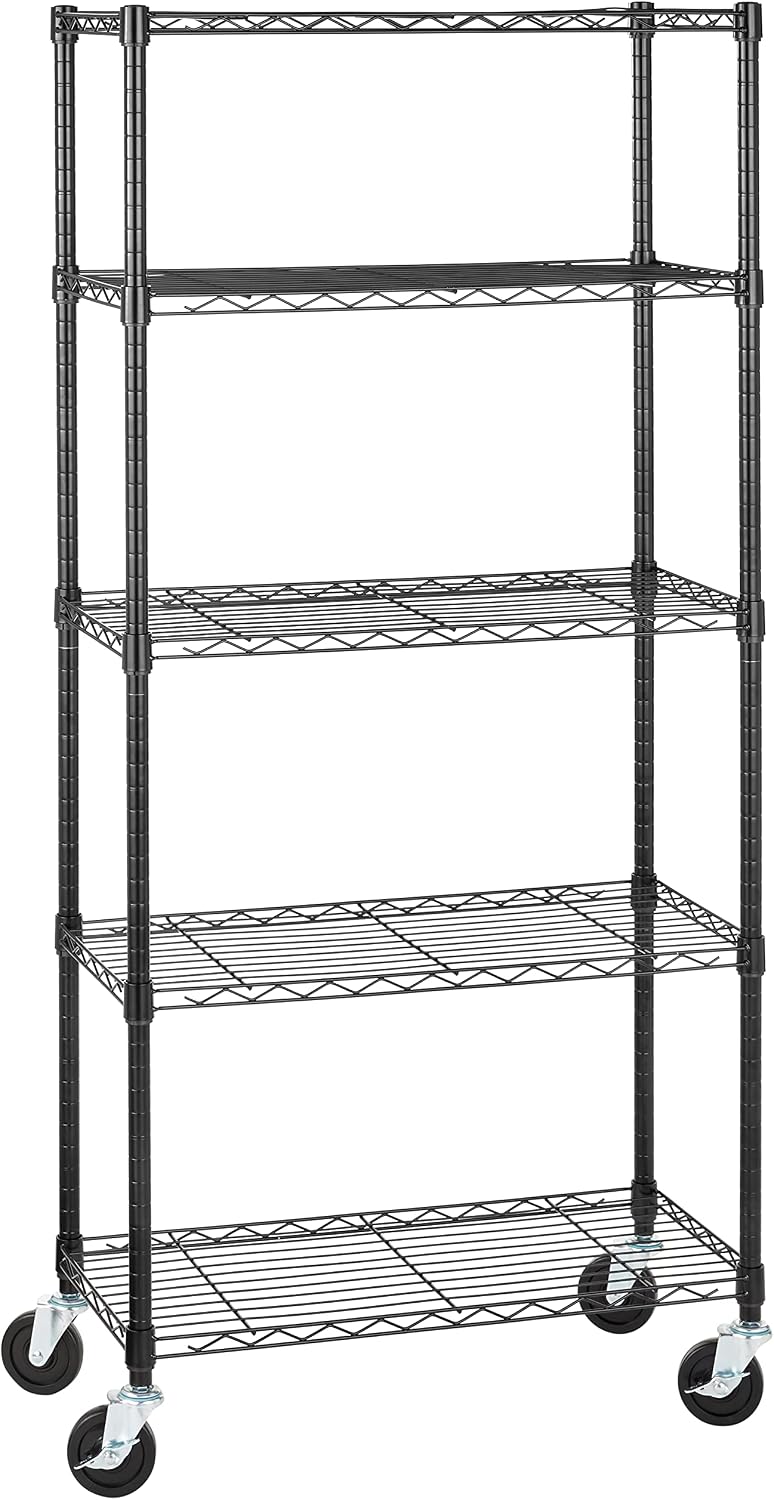
The Amazon Basics rack is the one I would hand to a homeowner who wants the garage back this weekend and does not want to think about it. It is 30 inches wide, 14 inches deep, and 64.75 inches tall, with five adjustable wire shelves and a stated capacity of 300 pounds per shelf. The 14 inch depth is the number that matters. It fits a standard tote turned sideways, it holds paint cans two deep, and it stays out of the way of a car door. It will not swallow a 27 gallon bin or a cooler, so plan the wall before you order.
The casters are why this one wins. A garage is a workshop with a car parked in it, and a shop has to rearrange. Four inch wheels let you pull the whole rack out to sweep, to paint, or to get behind it for a water heater. Roll it empty and load it where it lives, because a fully loaded rack on small wheels is a physics lesson.
The wire deck is the compromise. Wire sheds dust and does not hold a spill, but small parts fall through and anything with a narrow base sits uneasy. Cut 1/2 inch plywood for the bottom two shelves if you plan to store tools or hardware there.
Best for a narrow wall: Sakugi 5-Tier Storage Shelves
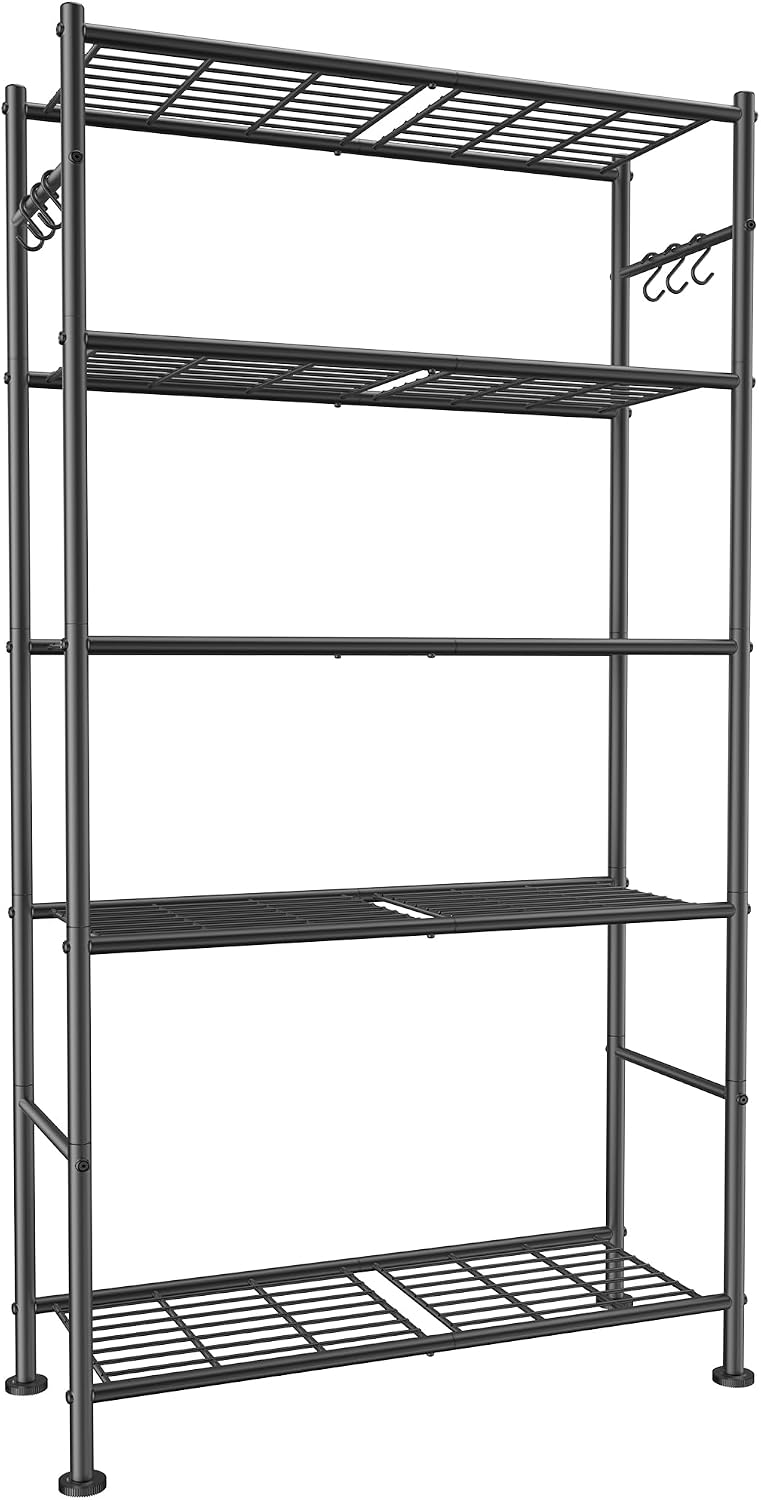
The Sakugi rack is 32.1 inches wide, 12.4 inches deep, and 71.4 inches tall, with five tiers and a set of hooks in the box. At 12.4 inches deep it is the shallowest unit here, and that is the point. It tucks against the wall behind a parked car and fits the gap beside a water heater without sticking out far enough to catch a hip on the way to the door.
Leveling feet are the other reason to look at it. On a sloped garage slab, feet that adjust independently beat casters, because a rack on wheels is only as stable as its brakes. The tradeoff is depth. Twelve inches will not hold a deep bin, a bag of fertilizer, or a case of oil that you need to pull back out. This is a shelf for things that line up, plus hooks for cords and brooms.
The bulk storage unit: 48 Inch 5-Tier Adjustable Metal Shelving
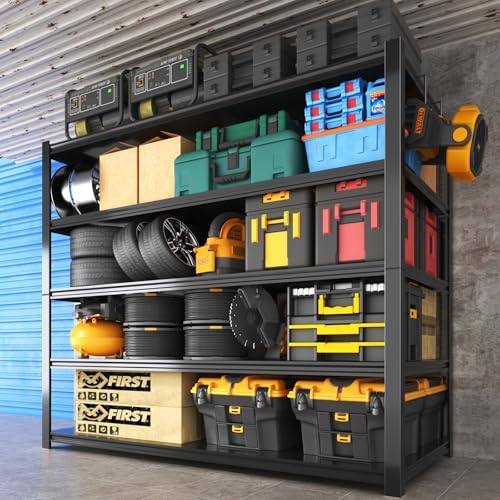
This is the biggest rack in the group and the one I would buy if the goal is a cleared floor. It is 48 inches wide, 20 inches deep, and 72.2 inches tall, with five adjustable tiers on an industrial frame. Twenty inches of depth is the difference between a shelf that holds a tote and a shelf that holds a tote plus whatever you set on top of it. It is also the difference between a rack that fits a two car garage and a rack that eats the space where the passenger door opens.
Forty eight inches is a lot of wall, so measure twice. Check the height against the garage door track, the opener rail, and any light fixture, because 72.2 inches plus a shelf above it runs out of room fast. The adjustable tiers do the real work here. Set the bottom shelf high enough for a shop vac or a rolling tool chest, then close the gaps up top for light, bulky items. One pack is one rack, so a two car garage usually wants two.
The finishing move: 2 Pack Garage Wall Shelf
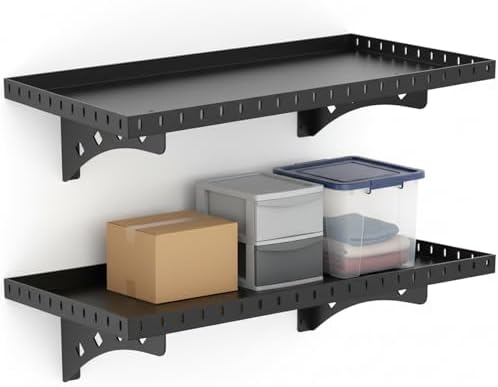
These are 1 foot by 2 foot wall mounted shelves sold as a two pack, rated to hold up to 100 pounds each. They are not a storage system, and anybody who buys them expecting to clear a garage will be disappointed. What they do well is the last ten percent of a garage: power tools, the weekly toolbox, chargers, spray cans, and the small things that end up on the floor because there is nowhere else for them.
The 100 pound rating comes with a condition the label does not always spell out. A wall shelf is only as strong as what it is fastened to. Into studs with lag screws, 100 pounds is a fair claim. Into drywall with the plugs in the box, you have hung a shelf on a timer. The shelf is fine. The mounting is the whole job.
How I judge a garage shelf
I look at every rack with the same four questions, and I answer them before I look at the price.
Where does the load go? A weight rating is measured in a lab with perfect mounting on a perfect wall, and your drywall is not a lab. Freestanding racks put the load into their own legs and the slab, which is simple and honest. Wall shelves put the load into your framing, which is only as good as your stud finder work.
Does the hardware match the claim? Bolts that strip before they are tight are a warning sign. Drywall plugs sold as anchors are a lie. If a wall shelf ships with hardware you would not trust on a gate, buy lag screws and washers before you start.
Will it survive a temperature swing? A Kansas City garage goes below freezing in January and over 100 in July, and that cycle finds every weak powder coat. Flaking paint is cosmetic until the day it is not, because flaking paint usually means moisture sitting on bare steel.
Can a homeowner do it in an afternoon? Freestanding racks are a two person, one hour job with a rubber mallet. Wall shelves are a drill, a level, a stud finder, and a decision about where the studs are. Neither is a mystery.
Analysis and what the specs actually mean
Depth is the spec nobody reads and the one that decides whether a rack works. The Amazon Basics and Sakugi units sit in the 12 to 14 inch range, which is wall line storage: totes, cans, boxes, things that line up. The 48 inch unit at 20 inches deep is floor space storage: coolers, bags, cases, anything with a footprint. Buy for the depth you need and the width is easy.
Wire deck versus solid deck is the second decision. Wire is lighter and cheaper, and it lets dust and spills fall through instead of pooling on the surface. Solid deck holds small parts and gives you a flat surface for a toolbox. The cheap fix on a wire rack is plywood cut to the shelf, which costs almost nothing and turns wire into solid. Do that on the bottom two shelves and leave the top wire, because that is where the light stuff lives.
Casters versus leveling feet is the third. Casters are for a rack you move, and they raise the unit, which costs you a couple of inches of top shelf clearance. Feet are for a rack that stays put, and on a sloped slab they are the only way to stop the rock. Do not split the difference and leave casters unlocked.
Then there is the wall. Every wall mounted shelf here lives or dies on studs. A stud finder costs less than a co-pay and takes two minutes. Find the studs, mark them with tape, and put the shelf where the studs are, not where you wanted it.
Garage shelving reference table
This is the table I keep on my phone when a client asks what to buy. Capacities are the ones stated on the product, and where a product does not state one, I am not going to invent it.
| Product | Type | Footprint | Stated capacity | Mounting | Where it belongs |
|---|---|---|---|---|---|
 Visit on Amazon → Visit on Amazon →Amazon Basics 5-Shelf Rack with Casters |
Freestanding, wire deck, casters | 30" x 14" x 64.75" | 300 lbs per shelf | Freestanding, no wall anchor needed | Wall line storage, shop cart |
 Visit on Amazon → Visit on Amazon →Sakugi 5-Tier Storage Shelves |
Freestanding, hooks, leveling feet | 32.1" x 12.4" x 71.4" | See product page | Freestanding, feet adjust to the slab | Narrow walls, shallow shelves |
 Visit on Amazon → Visit on Amazon →48 Inch 5-Tier Adjustable Metal Shelving |
Freestanding, adjustable tiers | 48" W x 20" D x 72.2" H | See product page | Freestanding, one pack is one rack | Bulk storage on a long wall |
 Visit on Amazon → Visit on Amazon →2 Pack Garage Wall Shelf |
Wall mounted | 1 ft x 2 ft each | Up to 100 lbs each | Into studs with lag screws | Tools above a workbench |
Freestanding racks versus wall shelves
Freestanding racks are the fast answer. No framing, they move, and the heavy stuff sits at floor level where lifting is easy. The cost is floor space, and in a two car garage floor space is the whole argument. Wall shelves cost almost no floor space and put the used-every-week items at eye level, but every pound goes into your framing and the shelf is fixed once it is up. The best garages I have worked in use both: a rack for bulk on a side wall, shelves over the bench, and nothing on the floor that could hang.
What to do before you mount anything
Empty the wall first, because you will not move a loaded rack twice. Find the studs and mark them. Check your heights against the door track, the opener rail, and the lights. Lay out shelf spacing around the tallest thing you own, not the average one. And put the heavy items on the bottom, always, because the shelf that fails is the shelf that was overloaded three feet off the ground.
Should you buy the Amazon Basics rack with casters?
Yes, for most garages. A stated 300 pounds per shelf, 30 inches wide, casters that let you clean behind it, and five adjustable shelves you can set around your actual totes. It is the rack I would hand to somebody who wants the garage back this weekend. Add plywood to the bottom shelves and keep the top shelf light.
Should you buy the Sakugi 5-tier?
Yes, if your storage is shallow and your wall is narrow. The 12.4 inch depth and the leveling feet make it the steadiest option here on an uneven slab, and the included hooks handle cords and brooms. It is not the rack for a cooler or a deep bin, and it is not the rack for a stack of tile. Buy it for the wall behind the car and it earns its place.
Should you buy the 48 inch heavy duty rack?
Yes, if you have a long wall and a floor problem. Forty eight inches wide and 20 inches deep clears serious square footage, and the adjustable tiers let you build around a shop vac and a tool chest. Measure the wall, measure the height against the door track, and buy two if the garage is a two car. This is the unit that changes what a garage can hold.
Should you buy the 2 pack wall shelves?
Yes, but as a finishing move, not a plan. Up to 100 pounds each, one foot by two feet, mounted into studs, and suddenly the power tools and the chargers are off the bench. Skip them if you are not going to find the studs, because a wall shelf on drywall plugs is a shelf on a timer.