Every garage storage failure I get called out to look at starts the same way. Somebody bought shelving based on the picture on the box instead of looking at the wall behind it. Heavy duty garage shelving is a category where the label and the reality can be two different things, because a weight rating is established under controlled conditions with proper fasteners in sound material. Your garage wall is drywall over studs, with insulation, a vapor barrier, possibly a water line running through it, and decades of seasonal movement working on the paint.
That is the frame for everything below. Four units, four different jobs, and one question that matters more than any spec sheet: what is this thing actually going to attach to, and what are you going to put on it?
Related: How to Find Studs in a Garage Wall →
Quick answer
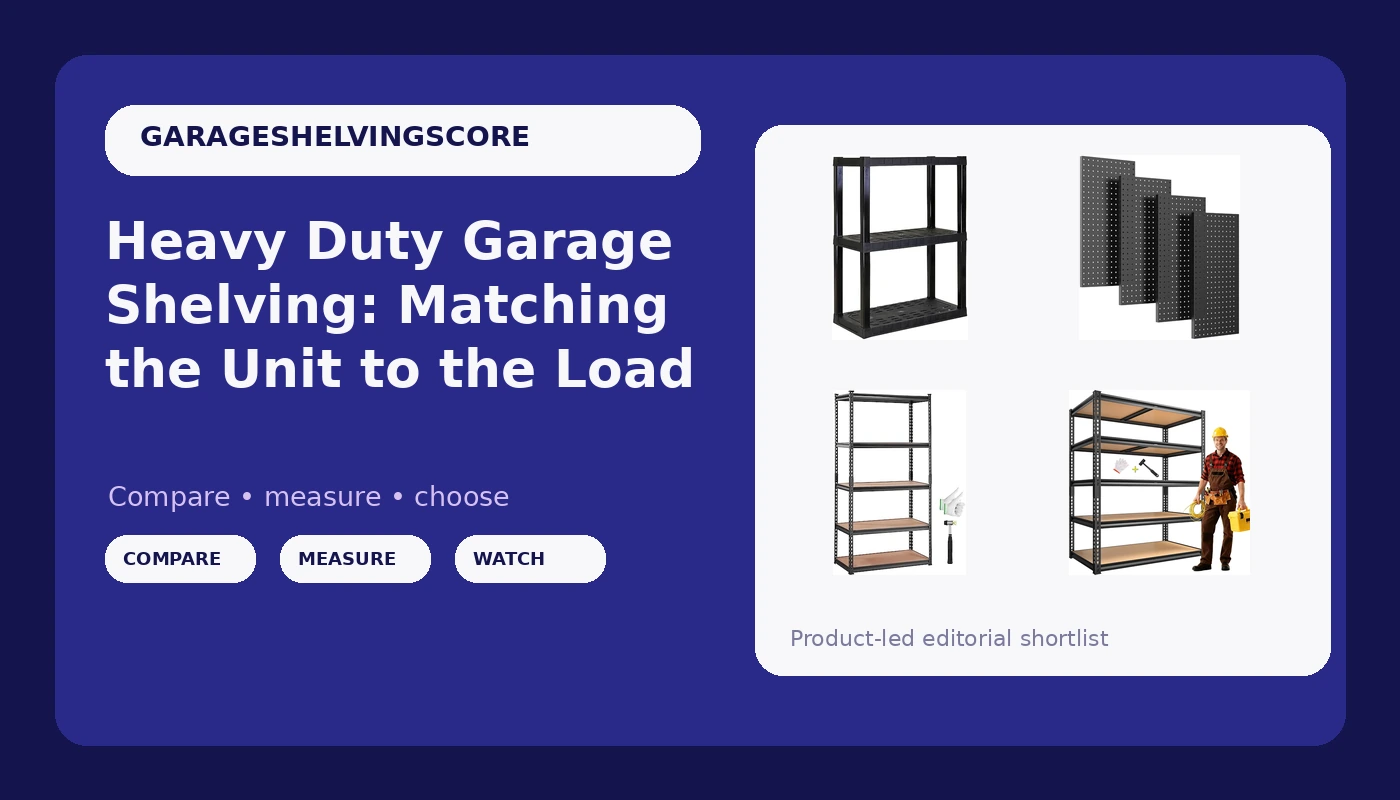
The right pick depends on your load and your wall, not on tier count. For a freestanding rack that covers the widest range of garage jobs, start with the ROOMFAVE Garage Shelving Heavy Duty five-tier unit. If listed capacity and adjustable shelf spacing matter most, the VEVOR five-tier unit lists a 2,000-pound capacity on a 36 by 18 by 72 inch frame. If your loads are light and you want a rack you can move by hand, the Oskar three-tier plastic unit fits that job. If floor space is the thing you do not have, the Ultrawall metal pegboard wall panels move the storage onto the wall instead.
Four useful options
| Model | Best fit | What stands out |
|---|---|---|
| ROOMFAVE Garage Shelving Heavy Duty, 5 Tier,72" H x 35.56" W x 16" D Black | Freestanding storage along a garage wall | Five tiers on a 72 inch tall frame, 35.56 inches wide and 16 inches deep, in black |
| VEVOR Storage Shelves 5-Tier Adjustable 2000 lbs 36"x18"x72" Shelving Unit | Heavier loads and adjustable shelf spacing | Listed 2,000-pound capacity, adjustable tiers, 36 by 18 by 72 inch overall size |
| Oskar Heavy Duty Plastic Storage Shelves- for Garage, Kitchen, Bathroom Basement Kids Room, Stackable 3-Tier Black Organizer Rack for Books Shoes, Toys, Pantry, Cleaning and Closet Organization | Light loads and rooms that keep changing | Three stackable plastic tiers, sold for books, shoes, toys, pantry, and cleaning supplies |
| Ultrawall Metal Pegboard Wall Panels, Peg Boards for Garage Tool Storage | Tools and small items that need wall space | Metal pegboard panels that mount to the wall for garage tool storage |
Freestanding workhorse: ROOMFAVE Garage Shelving Heavy Duty
A freestanding rack solves the anchoring problem by removing it, but it creates a different one: tipping. A tall, narrow unit loaded top-heavy is a lever, and the wall is what stops it. If you go this route, plan on fastening the top of the frame to a stud once it is loaded, even though the unit holds itself up. The 16 inch depth is worth noting too. It is right for tote bins and boxed goods, and wrong for anything you want to store two rows deep.
Listed capacity: VEVOR Storage Shelves 5-Tier Adjustable
Read that capacity figure the way it was written: it is a manufacturer rating, not a promise about your garage floor. A rack rated in the thousands of pounds transfers that load through its posts to the slab, and a slab that is not level means some posts carry more than others. Set this one on the flattest spot you have, keep the heavy material spread evenly instead of piled in one corner, and recheck the connections after the first full load. The extra two inches of depth over the ROOMFAVE unit is the real difference in daily use.
Light duty: Oskar Heavy Duty Plastic Storage Shelves
Plastic shelving has a real place in a garage: light goods, high up, and shelves you can pull down and reposition on a Saturday afternoon. What it does not have is a future once you set a loaded tool box on it. Plastic creeps under steady load, and a garage that swings from summer heat to a Kansas City cold snap asks a lot of any polymer. Keep this one for paper goods, cleaning supplies, seasonal decor, and shoes, and it will outlast the shelf you would have bolted to the wall.
Wall storage: Ultrawall Metal Pegboard Wall Panels
Pegboard is only as strong as what holds it up. Panels screwed into drywall alone are decoration; panels screwed into studs or into a properly anchored backer can carry hand tools, cords, hoses, and small bins without complaint. Before you order panels, map your wall. Mark the studs with tape, then lay out the panels so the fastening holes land on solid wood. A wall panel also forces you to make a decision you can skip with a shelf: what actually belongs on the wall, and what is better off in a bin.
Prices and availability may change. Product images, names, and retailer links are matched to verified listings. No current price, rating, stock status, or measured result is stated here without current evidence.
How shelving weight ratings actually work
A capacity number describes the shelf assembly under ideal conditions. It assumes the unit is assembled correctly, sitting on a level surface, loaded evenly, and not moving. It also assumes the fasteners and the structure behind them can take the same load, which is where most home installs part ways with the spec sheet.
There are really three capacities in play, and they are not equal. The first is the shelf surface, how much weight the panel or wire deck can hold before it deflects. The second is the frame and the post connections, which is usually where the headline number comes from. The third is the anchor, the fastener, and the material it bites into. That third one is almost always the smallest number in the chain, and it is the one nobody publishes, because it depends entirely on your wall.
Dynamic load matters too. A static rating assumes nothing is moving. In a garage, things move: you slide a tote across a shelf, you drop a box the last two inches, you lean on the front edge while reaching for something in back. Those moments concentrate force in ways a lab test does not. If a unit is rated for 2,000 pounds, that does not mean it enjoys 2,000 pounds of shifting, sliding, unevenly distributed weight. Treat any listed figure as a ceiling, not a target.
Matching the unit to your wall and your load
- Measure the wall, not the unit. Get the available run in inches, the ceiling height, and the depth you can give up without clipping a car door. Depth is the measurement people skip, and it is the one that decides whether you can still park.
- Find the studs before you buy anything. A stud finder and a pencil cost less than a replacement shelf. Mark every stud across the run, then photograph the wall with the marks visible so you have a record when the panels arrive.
- Decide freestanding or wall mounted. A freestanding rack needs no studs to stand, only to stay put. A wall panel is entirely dependent on what is behind the drywall. If the wall is masonry or a finished partition, that changes the anchor plan before it changes the product.
- Assemble on the floor, then stand it up. Building a rack against the wall in a tight bay is how bolts get cross threaded and clips get cracked. Lay the parts out, get it square, then tip it into place.
- Load from the bottom up. Heavy items between knee and chest height, lighter goods above, and nothing over your head that you would not want to catch. The load path runs down through the posts, so keep the weight low and centered.
Practical guidance
- Keep the heaviest totes on the lowest tiers and the lightest items on top. A shelf's job is to move load straight down, and a top-heavy rack fights that.
- Use same-size bins across a whole unit. Mixed bin sizes waste vertical space and make every shelf height a compromise.
- Leave a few inches of clearance above the top tier. You will need it to slide a bin out, and you will want it when you recheck the frame.
- Recheck fasteners and connections after the first full load and again after a season change. Temperature swings work on metal and on anchors.
- Keep plastic shelving for light goods only. Once a loaded tool box goes on a plastic tier, you have made a bet, and the plastic is the one holding the cards.
- Leave the wall behind a wall panel accessible if you can. Hanging a panel over a hose bib or an outlet box creates a problem you will meet later.
Which option should you choose?
Choose the ROOMFAVE Garage Shelving Heavy Duty, 5 Tier,72" H x 35.56" W x 16" D Black when you want a freestanding rack that uses vertical space along a wall without taking much depth, and you are willing to tie the top of it into a stud. Choose the VEVOR Storage Shelves 5-Tier Adjustable 2000 lbs 36"x18"x72" Shelving Unit when the listed capacity and adjustable shelf spacing are the priorities, and you have a level spot to set it on. Choose the Oskar Heavy Duty Plastic Storage Shelves- for Garage, Kitchen, Bathroom Basement Kids Room, Stackable 3-Tier Black Organizer Rack for Books Shoes, Toys, Pantry, Cleaning and Closet Organization when your loads are light, you want to move the rack by hand, and stacking a second tier beats buying a second unit. Choose the Ultrawall Metal Pegboard Wall Panels, Peg Boards for Garage Tool Storage when the floor is the scarce resource and your storage problem is hand tools, cords, and small items rather than bulky totes.
None of these picks come with a mounting plan for your specific wall, because no product can. The listed capacities are manufacturer figures. Whether any of them hold up in your garage depends on the studs behind the drywall, the fasteners you choose, how level the floor is, and how honestly you load them.
The bottom line
Buy the storage to fit the load and the wall, in that order. A freestanding five-tier rack like the ROOMFAVE unit covers the most common garage situation, the VEVOR unit is the one to look at when the capacity figure and adjustable tiers are what you need, the Oskar rack handles the light end without asking anything of your framing, and the Ultrawall panels are the answer when you have more wall than floor. Whatever you choose, spend ten minutes with a stud finder before you spend a Saturday with a drill. The shelf is rarely the part that fails. The connection is.