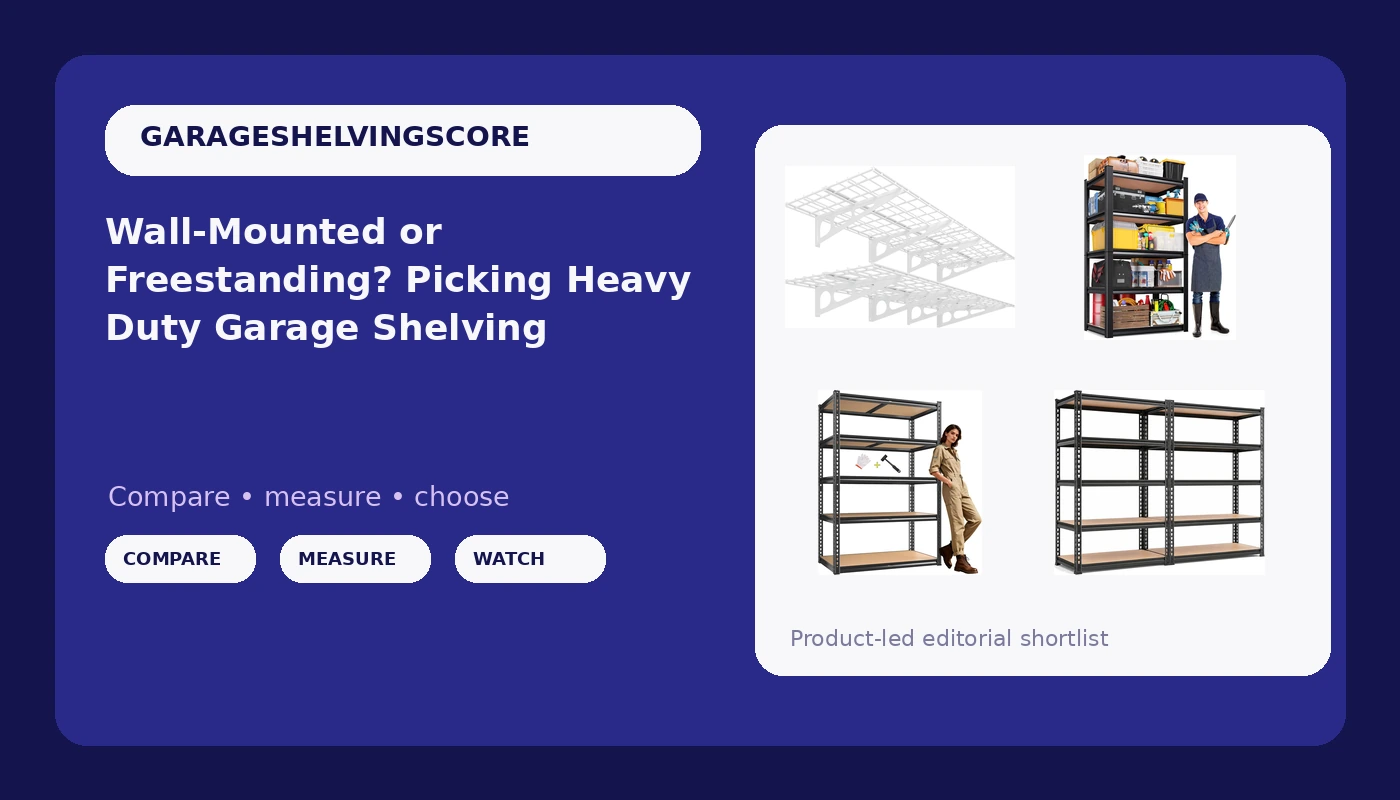
A garage fills up in a predictable order. First the lawn chairs, then the paint cans, then the boxes nobody wants to open. By the time you start shopping for heavy duty garage shelving, the floor is already gone and you are stacking things on top of other things. Two questions decide almost everything else: what the shelf stands on, and what it is attached to. Freestanding steel racks carry the load down to the floor. Wall-mounted racks carry it into your studs and give the floor back. Choose the wrong style for your wall or your load, and the shelf turns into its own project.
Related: Ceiling Racks vs Wall Shelving: Where Garage Storage Actually Belongs →
Quick answer
For most garages, a freestanding steel rack is the right first purchase, because it needs no wall structure and holds heavy items at floor level where loading is easy. A wall-mounted rack is the right second purchase, because it clears the floor and lifts totes and long items up out of the way. Match the unit to your wall type before you order: a wall-mounted shelf belongs on studs, blocking, or a properly planned wall, not on drywall plugs alone. Freestanding five-tier steel units cover the widest range of loads, and the four options below differ mainly in footprint, mounting style, and how many racks arrive in the box.
Four useful options
| Model | Best fit | What stands out |
|---|---|---|
| FLEXIMOUNTS 2-Pack 2x6ft Garage Shelving 24-inch-by-72-inch Heavy Duty Wall Mounted Shelves Garage Storage Rack Floating Shelves, 1400lbs Load Capacity, White, Classic Series | Garages where floor space is the constraint | Two 24 by 72 inch wall-mounted shelves with a 1,400 lb listed load capacity |
| ROOMFAVE 5 Tier Garage Shelving Heavy Duty Storage Shelves, 72"x35.8"x16" | A single wide rack along a long wall | Five-tier freestanding unit at 72 by 35.8 by 16 inches |
| 71"H x 28"W x 12"D Garage Shelving Unit, 5-Tier Heavy Duty Metal Storage Shelves 1900 LBS Capacity, Adjustable Utility Steel Racks and Shelving for Garage, Pantry, Basement, Warehouse, Black | Narrow wall runs and pantry-height spaces | Five tiers, 1,900 lb listed capacity, adjustable shelf heights |
| 2 Pack Garage Shelving, 36"W x 16"D x 72"H, 5-Tier Storage Rack | Two separate storage zones in one order | Two 36 by 16 by 72 inch five-tier racks |
The wall-mounted option: FLEXIMOUNTS 2-Pack 2x6ft Garage Shelving
The trade-off is entirely in the install. A freestanding rack forgives a bad floor; a wall-mounted rack does not forgive a bad wall. Long shelves like these want brackets landing on studs at regular intervals, and the load path runs from the shelf deck into the bracket and then into framing. On a finished garage wall, that means finding studs and planning bracket spacing before a single hole gets drilled. Do that part right and you get two six-foot shelves at eye level with nothing underneath them, which is the closest thing to free square footage a garage offers.
The wide freestanding unit: ROOMFAVE 5 Tier Garage Shelving
Freestanding does not mean you skip anchoring. A tall, wide, five-tier rack is a lever, and a rack that tips is worse than a shelf that sags. If you can reach a stud or a concrete wall, tie the top of the unit back. If you cannot, keep the heaviest items on the lowest tiers, where the center of gravity works for you instead of against you. The width here is the selling point: it takes wide, awkward items that a narrow rack forces you to stack at an angle.
The tall narrow unit: 71"H x 28"W x 12"D Garage Shelving Unit
Depth is the spec people ignore and then regret. A 12-inch rack fits beside a parked car, between a water heater and a wall, or along the short wall of a pantry, and it leaves a walkway you can actually use. The cost of that slim profile is stability: a 71-inch-tall unit on a 28-inch-wide base is easier to tip than a wide rack, so load it heavy at the bottom, keep the top tiers for light totes, and anchor it if there is anything solid to anchor into. Adjustable shelf heights matter more here than on a wide rack, because the whole point of a narrow unit is fitting odd-shaped items into a small footprint.
The two-pack option: 2 Pack Garage Shelving, 36"W x 16"D x 72"H
A 36-inch-wide rack is the middle of the road, and the middle of the road is usually where garages live. It is wide enough for a tote and a toolbox side by side, narrow enough to sit between a garage door track and the wall. Two of them mean you stop treating one wall as the answer to everything. The caveat is the same for any freestanding steel rack at this height: the unit is only as stable as its base and its loading. Put the heavy stuff low, keep the top tier light, and if the rack sits anywhere near where a car door swings, tie it back.
Prices and availability may change. Product images, names, and retailer links are matched to verified listings. No current price, rating, stock status, or measured result is stated here without current evidence.
How weight ratings actually work
Every rack on this page lists a capacity, and every one of those numbers describes a unit in ideal conditions: level floor or solid framing, hardware torqued properly, and the load spread evenly across the shelf. It does not describe your garage.
The first thing to check is whether the number is total or per shelf. A five-tier unit rated at 1,900 lb is almost always a total across the whole rack, and the honest per-shelf figure is a fraction of that. The second thing is the load path. Weight travels from the shelf deck into the beam, from the beam into the upright or bracket, and from there into the floor or the stud. Break any link in that chain, with a stripped bolt or a bracket screwed into drywall paper, and the rating stops meaning anything.
The third thing is deflection. Steel spans sag under a steady load, and a shelf that sags for a year does not spring back. That is why the big box wire shelves have a reputation problem: the wires are thin, the spans are long, and the clips are the weak link. Heavier gauge steel with shorter spans holds its shape. In a garage, temperature swings work on the same joints, and cheap coatings fail long before the welds do.
What your wall can actually carry
Wall type decides whether a wall-mounted rack is even an option, and it is the step most people skip.
- Drywall over wood studs: workable, but only if the brackets land on studs. Find the studs, mark both edges, and plan bracket spacing before drilling.
- Drywall alone: not a mounting surface for a loaded shelf. Drywall plugs hold a picture frame, not a shelf full of totes.
- Concrete or masonry: workable with the correct masonry anchors, which are a different product than the plugs in the box.
- Open stud bays: the best case. Add blocking or a ledger board, then mount to that.
If the wall cannot take the load, the shelf does not get mounted there. That is not a limitation to work around, it is the decision point. This is also why a freestanding rack is the safer first purchase in an unknown garage: it does not care what the walls are made of.
- Measure the wall run and the floor footprint you are willing to give up, then subtract at least 30 inches of walkway before you buy anything.
- Identify the wall type and locate studs, blocking, or masonry before choosing between wall-mounted and freestanding.
- Decide what actually goes on the shelf, by weight and by size, and write it down. Guessing here is how racks get overloaded on the top tier.
- Choose the footprint: wide and shallow for long items, narrow and deep for totes, slim depth for tight runs beside a car.
- Plan the anchor or tie-back before assembly, not after the rack is loaded and wobbling.
Practical guidance for a garage that stays organized
- Put the heaviest items on the bottom tier of any freestanding rack, always. The rating assumes a low center of gravity that a fully loaded top shelf violates.
- Leave the top tier for light, bulky, rarely used items: empty coolers, holiday bins, camping gear.
- Anchor or tie back every tall freestanding rack you can reach a stud or masonry wall from. A rack that tips takes everything on it with it.
- Keep a 30-inch minimum walkway and keep the rack clear of the path a car door swings through.
- Re-check hardware a month after loading. Bolts settle, and the joint that was tight in October is not always tight in January.
Which option should you choose?
Choose the FLEXIMOUNTS 2-Pack 2x6ft Garage Shelving when floor space is the whole problem and you have studs or solid framing to mount into. Choose the ROOMFAVE 5 Tier Garage Shelving when you want one wide freestanding rack that handles long, awkward items and does not depend on wall structure. Choose the 71"H x 28"W x 12"D Garage Shelving Unit when the wall run is narrow, the walkway is tight, or the space is a pantry or basement corner rather than a garage. Choose the 2 Pack Garage Shelving, 36"W x 16"D x 72"H when you already know storage is needed on two separate walls and you would rather solve it in one order.
The caveat on all four is the same: listed capacity is a lab number, and mounting is what makes it real. A wall-mounted shelf on drywall plugs is not a shelf, and a tall freestanding rack that has never been tied back is a load waiting for a reason to fall. Fix the mounting first, then load the shelves.
The bottom line
The right heavy duty garage shelving is the unit whose load path ends somewhere solid. Freestanding steel racks get there through the floor, which is why they are the safer first buy in a garage you have not measured yet. Wall-mounted shelves get there through your studs, which is why they free up the floor and why they demand a stud finder and a plan before the drill comes out. Pick the footprint that matches what you actually store, keep the weight low, tie back anything tall, and check the hardware again after a month. Do those four things and the shelf stays where you put it.